1. The Renaissance of Optics and Computational AI: The Titan Clash of Sony, Canon, and Nikon
From the perspective of a photographer who has spent over a decade in the field, the technological leaps made across optical and cinematic imaging over the past few years are nothing short of breathtaking.
Having evolved from film to digital, and from DSLR to mirrorless, cameras are no longer mere light-recording boxes.
They have transformed into intelligent imaging computers fusing ultra-high-speed sensors, on-device AI neural processing, and precision mechanical engineering.
⚡ 1) Sony: The Pinnacle of Sensor Architecture & On-Device AI
• A9 III & Full-Frame Global Shutter:
Sony revolutionized the industry with a 24.6MP 2-layer transistor pixel stacked global shutter sensor, physically eliminating rolling shutter jello distortion to 0%.
Freezing high-speed golf swings and spinning helicopter blades with zero warping while synchronizing flash at every shutter speed up to 1/80,000s when a compatible flash is fitted (1/500s without one) has rewritten the rules for commercial and sports photographers.
• Dedicated AI Processing Unit (DPU):
Integrated into the A7R V and A7C II, this neural co-processor powers Human Pose Estimation.
Even if a subject turns around, wears sunglasses, or is obscured in crowded wedding venues, the system tracks skeletal structures with uncanny persistence.
• FX3 Cinema Workflow:
With active cooling fans, Dual Base ISO (ISO 800 / 12,800), and 15+ stops of dynamic range via S-Log3 and S-Cinetone, the FX3 remains the undisputed standard for solo filmmakers worldwide.
🎯 2) Canon: Accelerated Capture Architecture & Neural Vision
• DIGIC Accelerator + DIGIC X Dual Engines:
Powering the EOS R1 and R5 Mark II, this co-processing engine processes massive sensor throughput to execute neural network algorithms in real time.
• Action Priority AF:
Deep learning models trained on football, basketball, and volleyball analyze ball trajectories and joint positions, automatically switching focus to key players the moment a decisive pass or shot occurs.
• Eye-Control AF & In-Camera Deep Learning Upscaling:
Infrared sensors track corneal reflections to instantly shift focus wherever the eye looks, while in-camera neural upscaling enlarges 45MP JPEG and HEIF files to 180 megapixels.
🛡️ 3) Nikon: Mechanical Shutter Elimination & The Strategic RED Acquisition
• Complete Elimination of Mechanical Shutters:
The flagship Z9 and Z8 employ a stacked sensor Nikon calls the world’s fastest scan rate, completely ditching the physical shutter mechanism for fully silent, vibration-free shooting, with about 120fps available in the dedicated C120 mode at roughly 11 megapixels, JPEG only.
• A Full-Frame Mirrorless First — Partially-Stacked Sensor:
The Z6 III places high-speed processing circuits directly above and below the pixel array, achieving roughly 3.5x faster readout than the previous Z6 II and internal 12-bit 6K/60p N-RAW recording at an accessible price point.
• RED Digital Cinema Acquisition:
Nikon’s historic acquisition of Hollywood cinema titan RED will combine Nikon’s optical Z-mount glass with RED’s legendary R3D RAW codec and IPP2 color science, forging a disruptive hybrid cinema powerhouse.
2. Shattering Physical Limits: DJI’s Mechanical Engineering & Integrated Gimbal Ecosystem
While traditional manufacturers pushed the limits of sensors and glass, DJI conquered mobility and physical stabilization.
🎬 Osmo Pocket 3: The 1-Inch Sensor Mobility Revolution
Combining a large 1-inch CMOS sensor and a 2-inch rotatable OLED touchscreen into a pocket form factor, it supports 10-bit D-Log M and 4K/120fps slow motion, completely redefining primary and B-cam workflows for creators.
🎥 Ronin 4D-8K & Inspire 3: 4-Axis Cinema Mastery
The Ronin 4D adds active vertical Z-axis stabilization, while the Inspire 3 captures full-frame 8K cinema RAW from the air, allowing solo operators to execute movements that previously required massive crane and Steadicam crews.
📡 LiDAR Precision AF & Wireless Transmission:
Emitting up to 43,200 laser ranging points within a 10 m range, the LiDAR Range Finder transforms manual cinema lenses into lightning-fast autofocus optics, while DJI Transmission demolishes physical communication barriers on set.
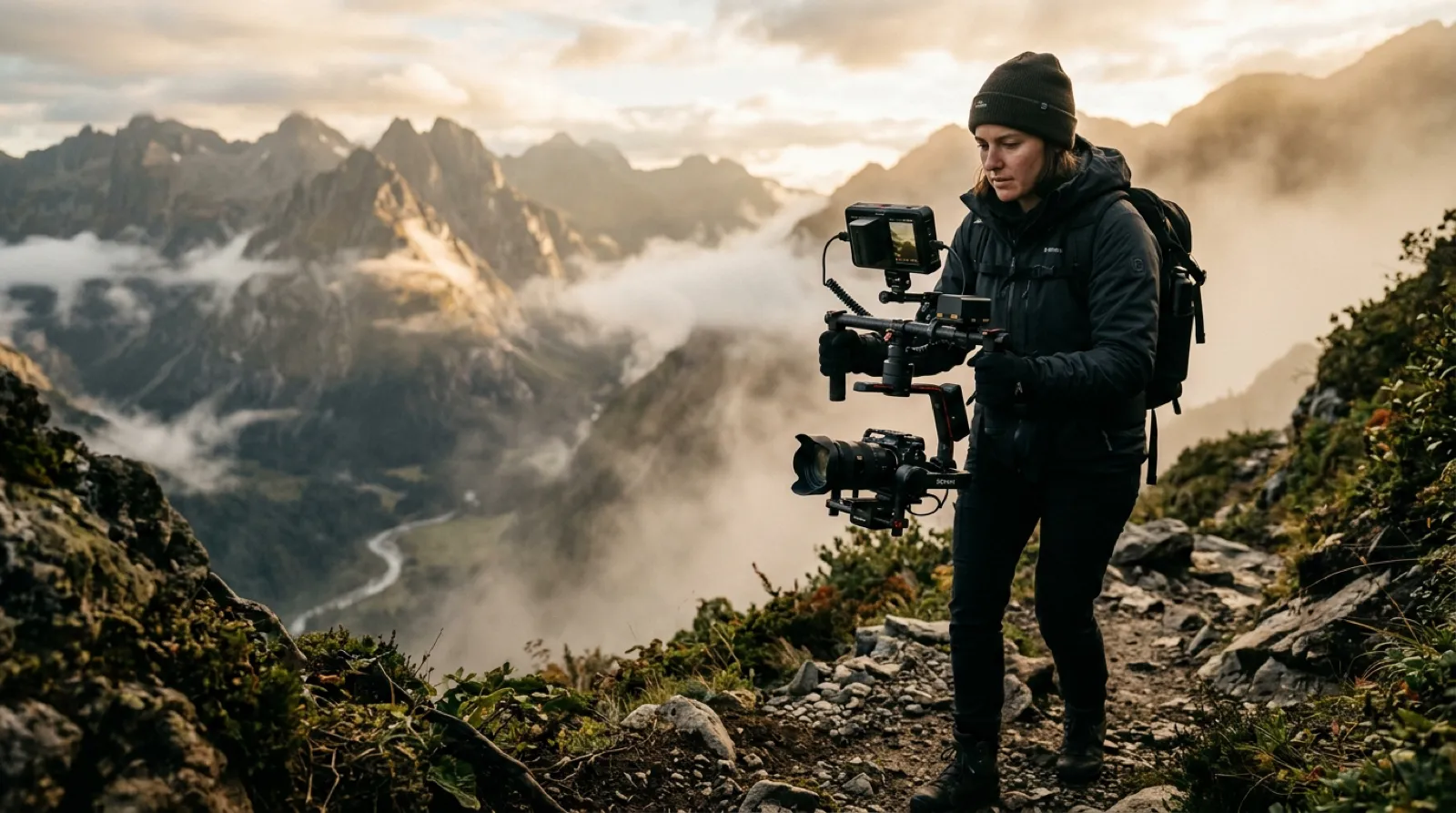
* AI-reconstructed illustration · Not an actual on-site photograph
3. Praise for the Current Market Icons
- Sony FX3 & A7C II: The FX3 is the gold standard for independent cinema with its fan-cooled reliability, while the A7C II is the ultimate daily full-frame snap camera with AI AF.
- Canon EOS R5 Mark II: Striking the ideal equilibrium between high-res stills and 8K RAW video, it serves as the trusted workhorse for commercial studios and weddings.
- Nikon Z8: Distilling flagship Z9 power into a compact body, it delivers unmatched value across landscape, wildlife, and portraiture.
- DJI RS 4 Pro & Pocket 3: Automated axis locks, powerful motor torque, and Pocket 3 agility make them indispensable for fast-paced outdoor shooting.
4. Next-Gen Horizons: Anticipating Future Lineups
🔮 1) Sony A7 V & FX3 II Sensor Evolution:
The upcoming Sony A7 V is poised to adopt partially-stacked architectures to eliminate rolling shutter and offer uncropped 4K/120p, while the FX3 II is anticipated to feature 8K oversampling and built-in Electronic Variable ND filters.
🎬 2) First Nikon + RED Cinema Hybrid (N-RED):
A dedicated Z-mount cinema line integrating REDCODE and RED IPP2 color pipelines will trigger an intense three-way rivalry against Sony FX and Canon Cinema EOS.
👑 3) Canon’s Next-Gen Global Shutter Flagships:
Building on Accelerated Capture, future high-resolution flagships with global shutters will redefine flash sync and studio dynamic range.
🚁 4) DJI’s Deepening Cinema & Drone Integration:
Lighter RS5 gimbals and next-gen LiDAR 2.0 with deeper AI tracking will continue to push the boundaries of creative freedom for solo visual artists.
When the Tool Expands the Artist’s Inspiration
While cameras represent the pinnacle of engineering, the finger on the shutter is guided by human vision and emotion.
The fierce competition among Sony, DJI, Canon, and Nikon grants creators the ultimate gift: complete creative freedom unconstrained by technical barriers like noise, camera shake, missed focus, or distortion.
As our tools approach perfection, we are free to concentrate purely on the soul and story of our subjects.
Looking through the viewfinder into the next generation of visual wonders, the journey ahead has never felt more exhilarating.