1. Where Comparisons Go Wrong: Different Levels in One Line
“Finland has no exams so children are happy, Korea has many exams so scores are high, Germany is strong in vocational training, and American schools teach through debate.” Each clause carries a fragment of something true, but the four countries in that sentence stand on different floors. The Finland claim is about early childhood education and the way comprehensive schools assess pupils; the Korea claim is about an international test taken at 15; the Germany claim is about a vocational pathway at upper secondary level; the U.S. claim is about individual classrooms and university admissions. Placing different levels side by side produces impressions, not comparison.
This article reverses the order. Instead of naming a country and attaching traits to it, it fixes the education stage and the indicator first and then reads what each country’s official sources actually say at that stage: the start and length of compulsory schooling, assessment in primary and lower secondary school, achievement at age 15, vocational pathways at upper secondary level, and the attainment of 25- to 34-year-olds. Seen level by level, some received ideas survive and others collapse.
2. Start and Length Differ First: The Frame of Compulsory Education
The Finnish National Agency for Education states that compulsory education “applies to all 6–18-year-olds” and “includes pre-primary, primary, lower secondary and upper secondary education.” After nine years of basic education, pupils move to general upper secondary school, which leads to the matriculation examination, or to vocational education and training, which leads to a vocational qualification. Korea’s Ministry of Education describes the Korean system as a “6-3-3-4 single ladder system” of six years of elementary school, three of middle school, three of high school, and four of university, notes that elementary and middle school are compulsory, and records that the first semester begins in March and the second at the end of August.
The OECD’s Education at a Glance 2024 country note for Korea puts the difference in numbers: compulsory education in Korea “lasts 9 years until the age of 14, shorter than the average of 11 years across the OECD.” Yet the same note adds that most Korean students continue well beyond that point, with 85 percent of 15- to 19-year-olds enrolled in education, on a par with the OECD average of 84 percent. A short compulsory period and a high enrolment rate are not a contradiction. They show that what the law requires and what a society actually chooses are two different measures, and any attempt to read educational zeal or system quality from the single figure “years of compulsory schooling” fails right here.
3. Correcting the Finland Myth: The Exact Scope of “No Exams”
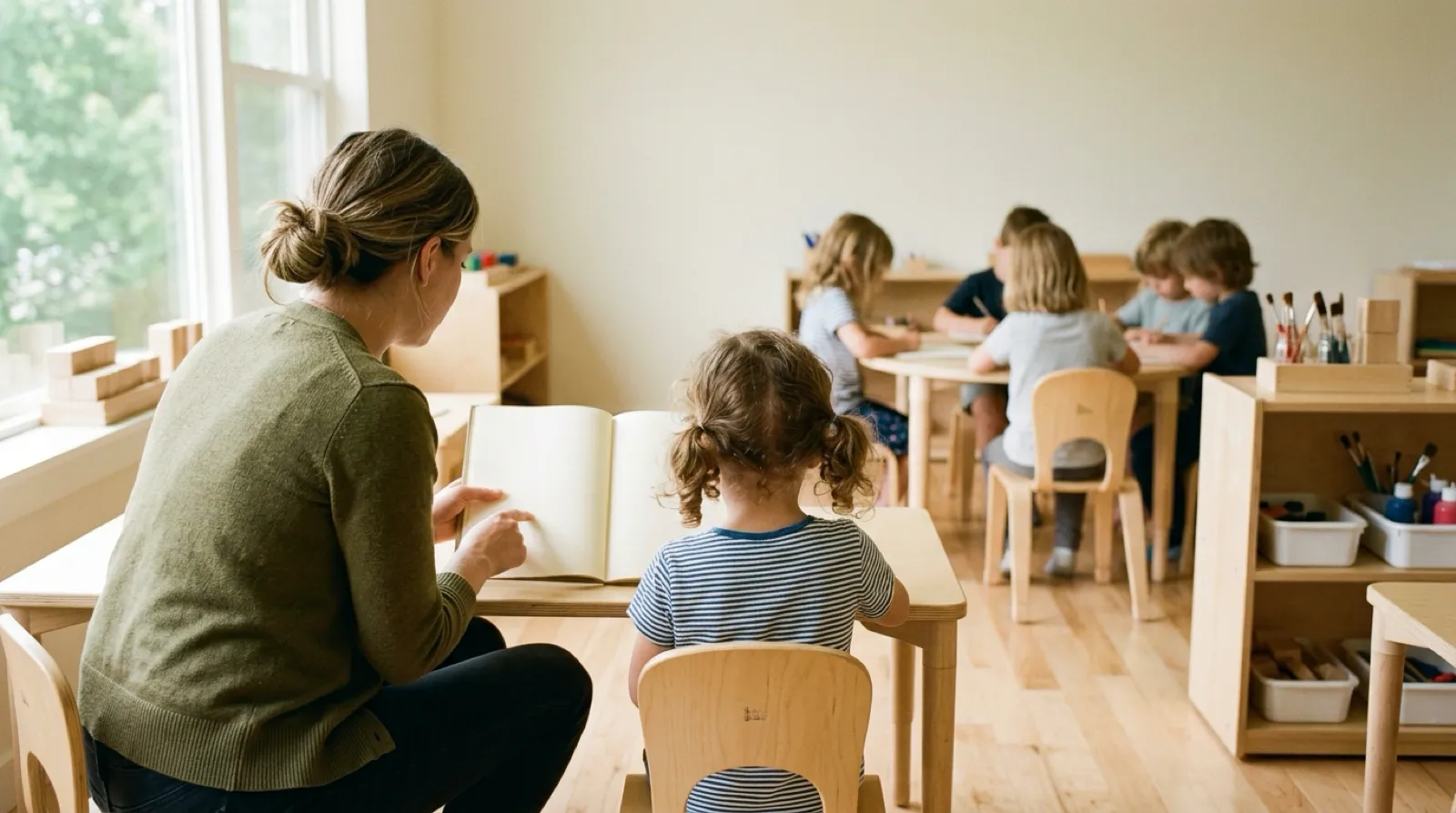
The most common sentence about Finnish education is that it has no exams and children learn through play. Official sources split that sentence in two. First, play. The Finnish National Agency for Education does say that “Learning through play is essential,” but it says so in its guidance on early childhood education and care (ECEC), a stage run according to a national core curriculum. Play-based learning is a principle of early childhood education, not a description of compulsory schooling as a whole.
Second, exams. The Agency’s guide to primary and lower secondary education states plainly: “There are no national tests in Finnish comprehensive schools.” Instead, all pupil assessment is done by teachers, not only at the end of semesters but throughout the school year, and it uses various means, including exams, class work, and participation. Pupils also assess their own learning, guardians are regularly informed of their child’s progress, and every pupil receives a school report at least once a year. And here the myth divides. Assessment in the lower grades is descriptive, but “At the latest in the grade 4 the assessment is numerical,” on a scale of 4 to 10. “No exams” means no national standardized tests. It does not mean no grades.
The same guide records the other features of Finnish comprehensive schools. Pre-primary, primary, and lower secondary education are free, textbooks and learning materials are free, pupils receive a free school meal every day, and health and welfare services are free, with free transport for pupils who live far from school. There are 18 compulsory subjects across primary and lower secondary education, a lesson lasts 45 minutes, and minimum weekly lessons rise from 20 in grades 1–2 to 30 in grade 9. Education has been compulsory since 1921 and school meals free since 1948; there are 2,210 comprehensive schools with 555,000 pupils and an average school size of 250. Claims that Finnish pupils have no homework or that every school receives identical funding appear nowhere in these official materials.
4. What PISA Says and What It Does Not
PISA is the OECD’s assessment of 15-year-olds’ mathematics, reading, and science literacy, conducted every three years since 2000. According to Korea’s Ministry of Education, PISA 2022, released on 5 December 2023, involved around 690,000 students from 81 countries, 37 OECD members and 44 non-members, with a Korean sample of 6,931 students from 186 schools. Korea’s mean scores were 527 in mathematics, 515 in reading, and 528 in science, against OECD averages of 472, 476, and 485, margins of 55, 39, and 43 points. Rankings are published as ranges to account for sampling error; among the 81 countries Korea placed 3rd to 7th in mathematics, 2nd to 12th in reading, and 2nd to 9th in science.
Korea.net adds context. Among OECD members, only Japan, with 536 in mathematics, 516 in reading, and 547 in science, and Ireland, with 516 in reading, scored above Korea. Compared with the 2018 survey, OECD averages fell by 17 points in mathematics, 11 in reading, and 4 in science owing to the impact of COVID-19, while Korea’s scores rose by one point in mathematics and reading and nine in science. These numbers are certainly meaningful facts.
What PISA does not say is equally clear. It measures literacy in three domains at a single age, 15. The quality of early childhood education, the results of vocational training, higher education, and students’ wellbeing or creativity lie outside the score. And the score does not prove what produced it. Attributing Korea’s results to “a structured curriculum” or to private tutoring is interpretation, not data, and so is explaining a number of East Asian countries as one “Confucian culture.” In the same test, Japan and Korea were 19 points apart in science; a shared-culture explanation cannot account for that gap.
5. Germany’s Dual System: Powerful, but Not “German Education” as a Whole
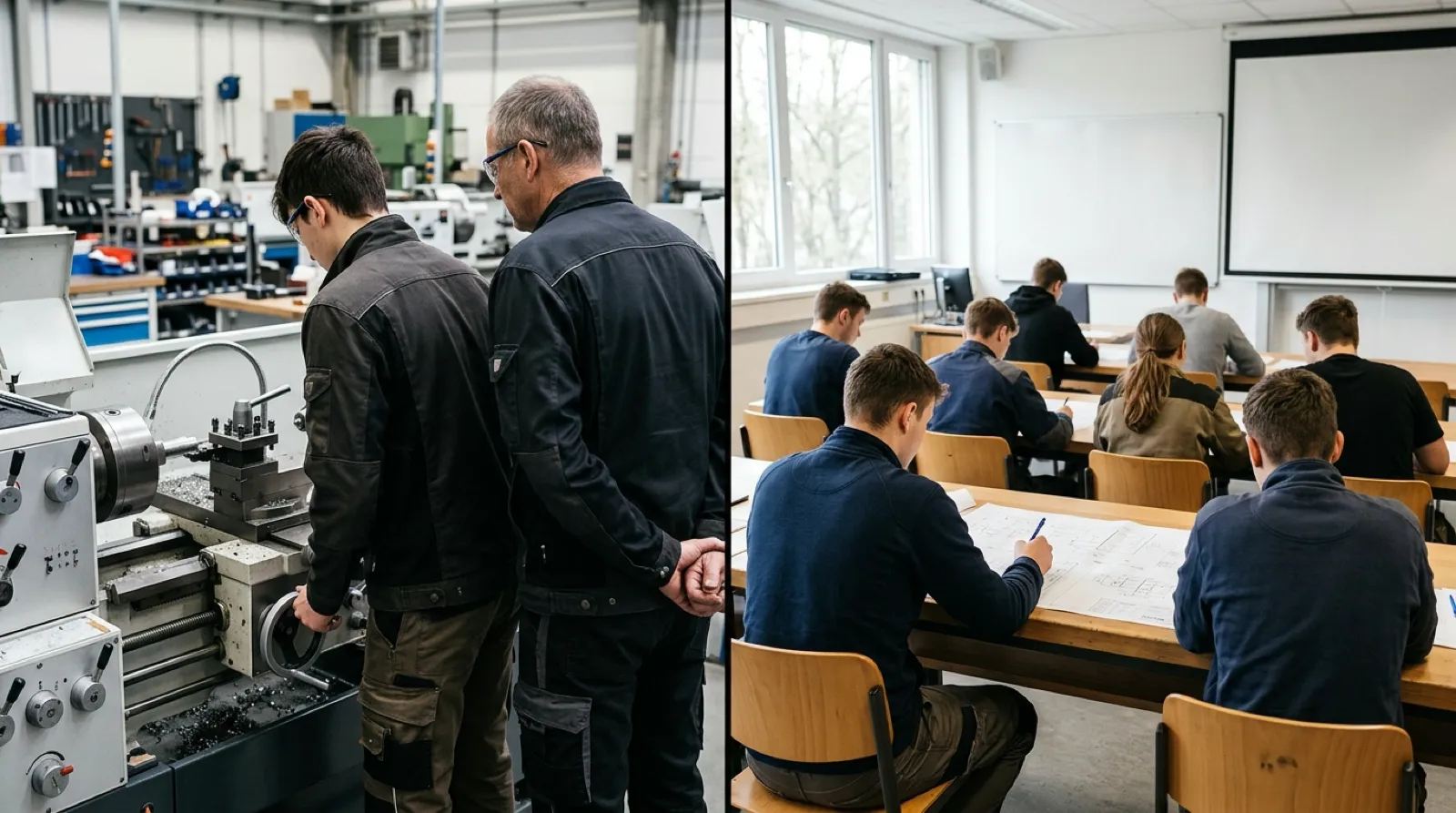
Germany’s Federal Institute for Vocational Education and Training (BIBB) describes the dual system as one in which “Learning takes place at two venues – the company and the vocational school.” Depending on the occupation, training lasts between two and three and a half years; apprentices are employed by the company during the apprenticeship and are paid for it. There are more than 300 training occupations recognised under the Vocational Training Act, and the apprenticeship concludes with a final examination administered by the chambers of each sector, such as the chambers of commerce and industry. The heart of the system is that learning happens at a real workplace under an employment contract, not only in a school.
But the dual system is one pathway within Germany’s education system. General upper secondary tracks leading to university, school-based vocational programmes, and higher education all coexist, and which route a young person takes depends on the student, the family, and the region. The shorthand “German education equals vocational education” is a misunderstanding created by erasing the fact that the dual system is one option at upper secondary level. Its proper counterpart is not “Korean education as a whole” but Korea’s vocational pathways at the same stage, such as specialized high schools and junior colleges.
6. The United States: “American Education” Does Not Legally Exist
Received ideas about American education usually come from impressions of particular schools, classrooms, or universities. The U.S. Department of Education’s own FAQ explains institutionally why such generalizations are hard to make. “Education is mainly a state and local responsibility in the United States,” and “There are no federal national standards for any academic area.” States create standards, and states and local agencies develop curricula. From its creation, Congress prohibited the Department from exercising “any direction, supervision, or control over the curriculum, program of instruction, administration, or personnel of any educational institution, school, or school system.”
So statements such as “American schools teach through debate” or “American universities weigh character over grades” cannot be fact-checked unless they name the school or university in question. Some colleges do use holistic admissions and some classrooms do prioritize discussion, but the moment these are turned into national characteristics, they describe a system that does not exist. When the United States enters a comparison, the frame must narrow at least to the state and, where possible, to the school district.
7. Korea Measured With the Same Yardstick
Applying the same-level rule to Korea yields a picture far more specific than a league table. According to the OECD’s Education at a Glance 2024 note, in 2023 only 1 percent of Korean 25- to 34-year-olds lacked upper secondary attainment, 13 percentage points below the OECD average, and 77 percent of women and 63 percent of men in that age group held a tertiary qualification. Yet women with tertiary attainment were 7 percentage points less likely to be employed than men, similar to the OECD-wide gap of 6 points. High attainment and equal returns to that attainment in the labour market are separate indicators.
The texture of day-to-day schooling differs too. In 2022 almost no Korean student from primary through general upper secondary education repeated a grade, while OECD averages were 1.5 percent at primary, 2.2 percent at lower secondary, and 3.2 percent at general upper secondary level. Korean lower secondary teachers were required to teach 517 hours a year in 2023, below the OECD average of 706, though the note adds that teachers’ work also includes lesson preparation, grading, and communicating with parents. Between 2015 and 2023, statutory salaries of lower secondary teachers with 15 years of experience rose 19 percent in nominal terms but only 3 percent in real terms, below the 4 percent average for countries with data. These figures are far less dramatic than “exam hell” or “the world’s best education,” but they say exactly which stage and which measure they describe.
8. Three Principles for Using Comparison as a Question, Not a Ranking
First, fix the stage. Compare early childhood education with early childhood education, achievement at 15 with achievement at 15, vocational training with vocational training. Finland’s comprehensive school assessment practices, Germany’s dual system, and Korea’s PISA scores answer different questions; they are not results from one contest.
Second, record the year and the source with every indicator. PISA 2022 reports results for 15-year-olds released in December 2023, and the attainment data in Education at a Glance 2024 refer to 2023. A number detached from its year quietly becomes a wrong number as time passes.
Third, do not turn correlation into cause. No international comparison proves that the system standing next to a high score produced that score. Looking abroad for ideas is necessary, but transplanting one element while ignoring a country’s school structure, funding, teacher training, and labour market is not the purpose of comparison but its misuse. A good comparison ends by giving us sharper questions to ask of our own system.
Sources and Further Reading
- Finnish National Agency for Education (EDUFI) — Early childhood education and care in Finland (Accessed: 2026-09-07)
- Finnish National Agency for Education (EDUFI) — Primary and lower secondary education in Finland (2022) (Accessed: 2026-09-07)
- Finnish National Agency for Education (EDUFI) — Finnish education system (Accessed: 2026-09-07)
- Ministry of Education, Republic of Korea — Education System: Overview (Accessed: 2026-09-07)
- Ministry of Education, Republic of Korea — OECD Announces PISA 2022 Results (Accessed: 2026-09-07)
- Korea.net (official website of the Republic of Korea) — OECD ranks Korea among world leaders in student performance (Accessed: 2026-09-07)
- OECD — Education at a Glance 2024: Country Note — Korea (Accessed: 2026-09-07)
- German Federal Institute for Vocational Education and Training (BIBB) — The dual system: Young people study in the company and at school (Accessed: 2026-09-07)
- U.S. Department of Education — Frequently Asked Questions: Elementary and Secondary Education (Accessed: 2026-09-07)