1. Why the Map of Chopstick, Fork, and Hand Cultures Fails
Introductions to world food culture often cut the globe into three pieces: East Asia eats with chopsticks, Europe and the Americas with fork and knife, and South Asia, the Middle East, and Africa with the hands. The map looks tidy, but no international body or academic consensus stands behind it. It is a convenience of travel guides, and real tables are far more mixed.
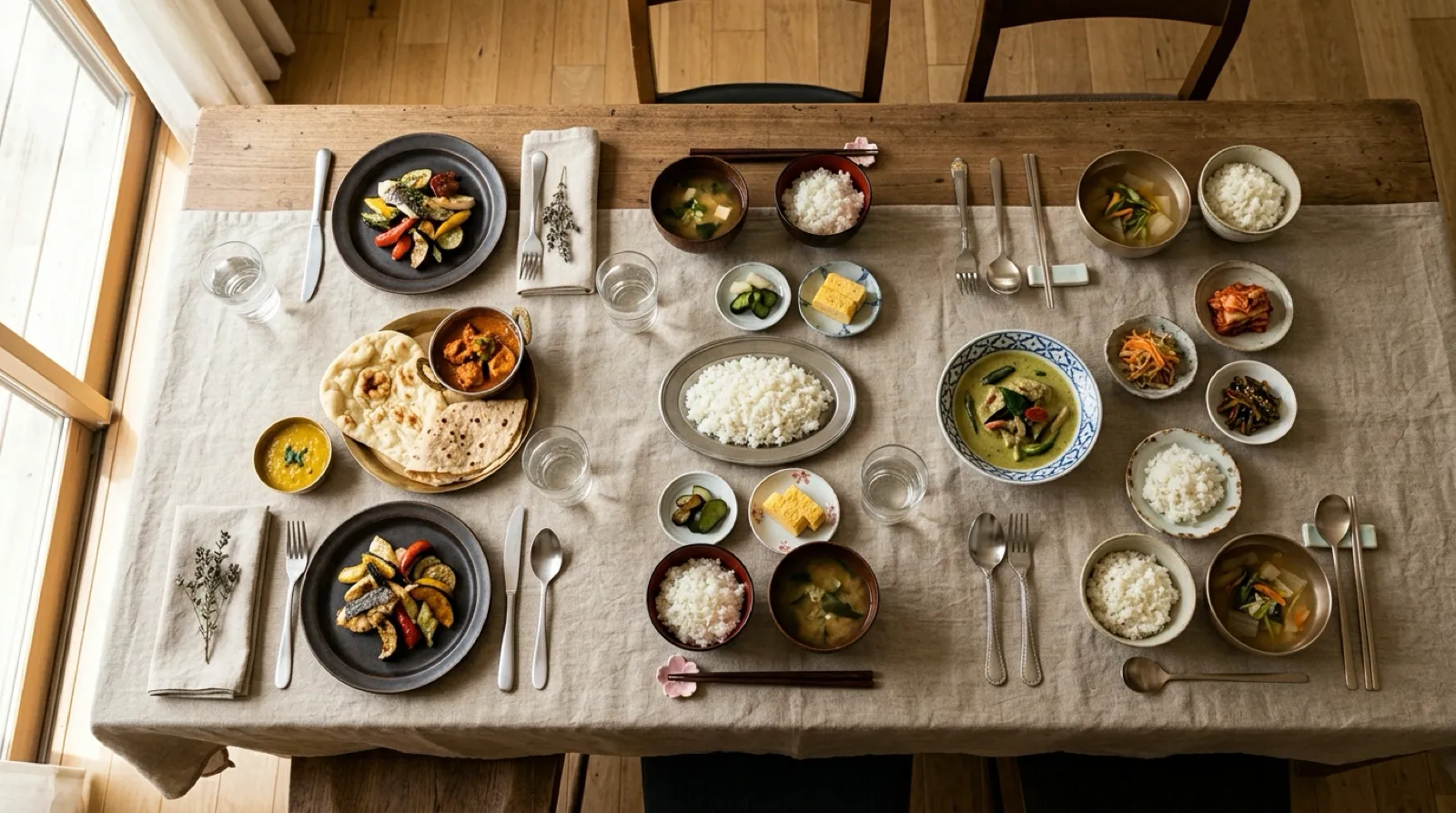
Korea is filed under chopstick cultures, yet the table-manners guide on Korea.net, the official portal of the Republic of Korea, explains that rice, soup, and side dishes are all set out on the table at once, with the spoon on the left and the chopsticks on the right. In other words, the basic utensils at a Korean table are not chopsticks alone but a spoon and a pair of chopsticks. Thailand is often mistaken for a chopstick culture, but Smithsonian Magazine points out that, contrary to a common Western misconception, Thais do not use chopsticks in everyday life. In Thailand most food is widely known to be eaten with a spoon and fork, with chopsticks limited mainly to Chinese-style noodle dishes. For India, material from the Indian embassy says that meals are “traditionally” eaten sitting on the floor or on low stools, using the fingers of the right hand, yet it does not claim this is the rule in every setting. In city restaurants and on formal occasions, cutlery is used as well.
So this article starts from different questions. When and how did each utensil reach each table? Why did societies that share a tool end up with opposite rules? And how old, really, is what we call traditional food?
2. Five Thousand Years of Chopsticks and the Late Fork: Tools Spread Unevenly
According to the history compiled by Smithsonian Magazine, chopsticks developed about 5,000 years ago in China. The earliest form is thought to have been twigs used to pull food out of boiling pots, and around 400 BC, as cooking methods that cut ingredients into small pieces so they would cook quickly spread, knives became unnecessary at the table. The same article quotes Confucius on not keeping knives at the table and explains that by around AD 500 chopsticks had spread to Japan, Vietnam, and Korea. Early Japanese chopsticks were used only in religious ceremonies and were shaped like tweezers, made from a single piece of bamboo joined at the top.
The fork traveled much later and far more roughly. Smithsonian Magazine’s history of Western utensils explains that the forks of ancient Egypt, Greece, and Rome were cooking tools, and that the small table fork was first used by the wealthy of the medieval Middle East and the Byzantine Empire. In 1004, when a niece of a Byzantine emperor used a golden fork at a wedding feast in Venice, local clergy condemned it as sinful luxury, and it was even said that God had given humans natural forks in their fingers. In 1533 Catherine de Medici brought silver forks from Italy when she married into the French royal family, and in 1608 the English traveler Thomas Coryate described the fork use he had seen on the continent, only to be ridiculed at the time. Forks were still rare in the North American colonies in the early seventeenth century, and only in the 1850s did the fork become established in the United States. Knives changed too: in 1669 Louis XIV of France ordered that the points of knives brought to the table be ground blunt.
Spoons tell a different story. The same source notes that spoons have been eating utensils since Paleolithic times, that medieval royalty and the wealthy used spoons of precious metal, and that pewter, common by the fourteenth century, made spoons affordable to the general population. The contrast of a fork-using West and a chopstick-using East erases the thousands of years in which Western tables had no forks at all.
3. Same Chopsticks, Opposite Rules: What Official Korean and Japanese Guidance Says
Lumping Korea and Japan into one East Asian dining culture because both use chopsticks hides rules that run in opposite directions. Korea.net explains that younger people at a Korean table wait until their elders pick up their utensils, that chopsticks should not be stuck into a bowl of rice, and that one should not lift the rice or soup bowl while eating. It adds that sticking chopsticks upright in rice is something done in rituals for the dead. At the same time, the same guide adds that “many households eat quite casually,” and says that only some families still keep the old etiquette of not talking during a meal. Even the official source sets down both the rule and the distance between it and everyday life.
The Japan National Tourism Organization’s food etiquette guide lists its own prohibitions: do not stick chopsticks vertically into rice, do not pass food from chopsticks to chopsticks, do not point with them or drag dishes around with them. So far the two countries overlap. The rule about bowls, however, is reversed. JNTO advises lifting the bowl close to your mouth to eat — exactly the motion the Korean guide tells you not to make. On noodles, JNTO says it is fine to slurp comfortably, but it does not present slurping as an obligation.
The lesson is simple. A shared tool does not mean shared body rules. Those rules differ by country and, within a country, by household and occasion. There is no such thing as chopstick-culture etiquette. What exists are the specific rules each society publishes and the looser everyday practice around them.
4. The Order of Eating by Hand: India and Malawi
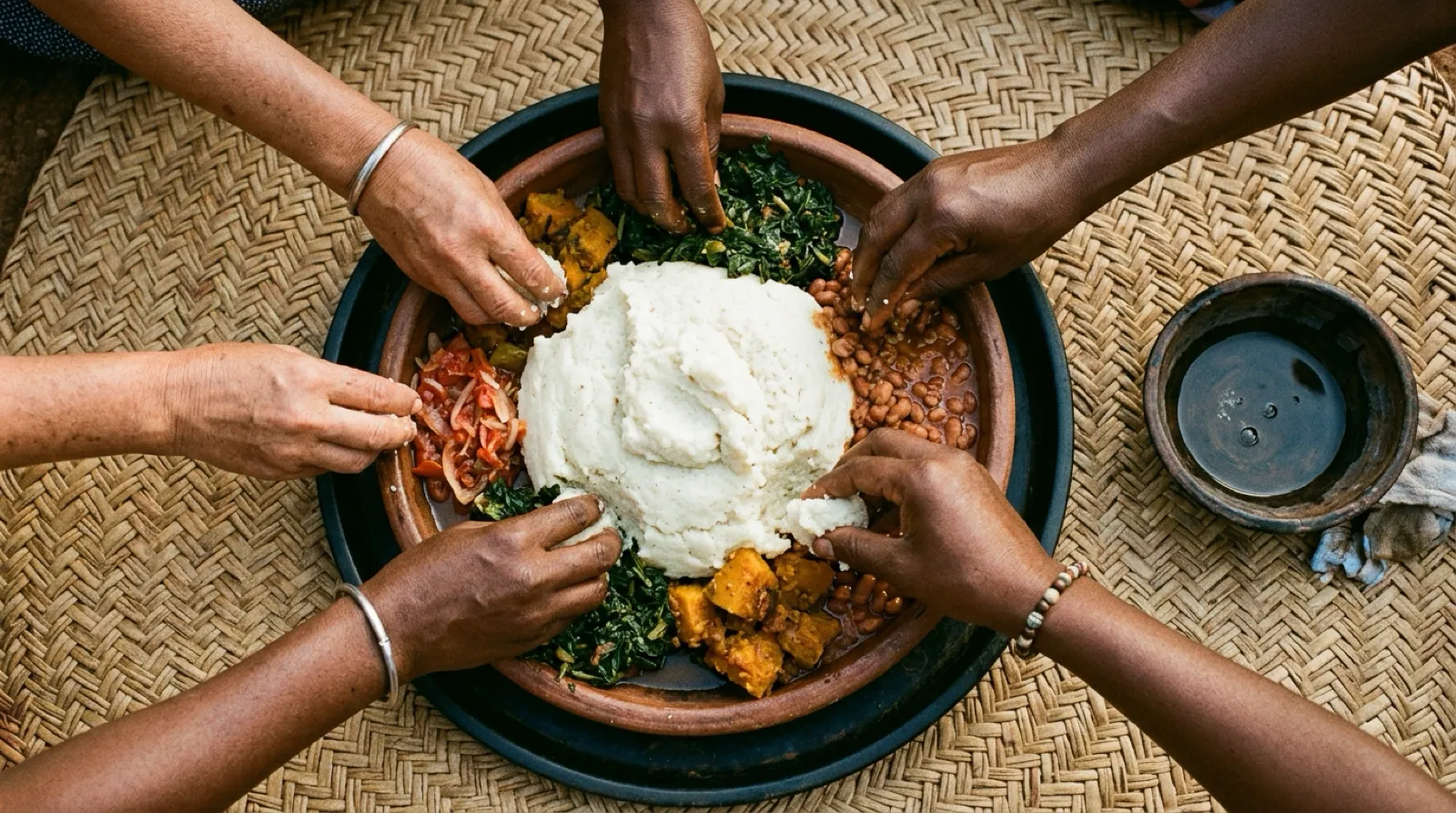
Eating with the hands is often misread as the absence of tools, when it is in fact one of the most rule-bound ways of sharing a meal. The Indian cuisine overview published by the Embassy of India in Ukraine notes that several customs are associated with the way food is consumed, and that traditionally meals are eaten while sitting on the floor or on very low stools, eating with the fingers of the right hand. The key word is traditionally. Which hand is used and how strictly varies by region, religion, household, and occasion, and there is no basis for describing a single taboo that applies across an entire continent. A visitor’s task is not to memorize a rule but to find where to wash their hands and follow the way the host demonstrates first.
Nsima, the staple of Malawi in southeastern Africa, was inscribed on UNESCO’s Representative List of the Intangible Cultural Heritage of Humanity in 2017. UNESCO describes it as a form of thick porridge prepared with maize flour, and calls its preparation an elaborate process requiring specific knowledge, from pounding the maize into flour to selecting the accompanying food. Eating nsima, the entry says, is a communal tradition in families and an opportunity to strengthen bonds, and the meal comes with customs that regulate gluttony and promote cleanliness and cohesion. Knowledge is transmitted informally between adults and children. The example shows that a table eaten by hand is not a table without rules; it is a place where restraint, cleanliness, and sharing are taught through the body.
5. Chili, Tomato, and Potato: How Recent Is Traditional Food?
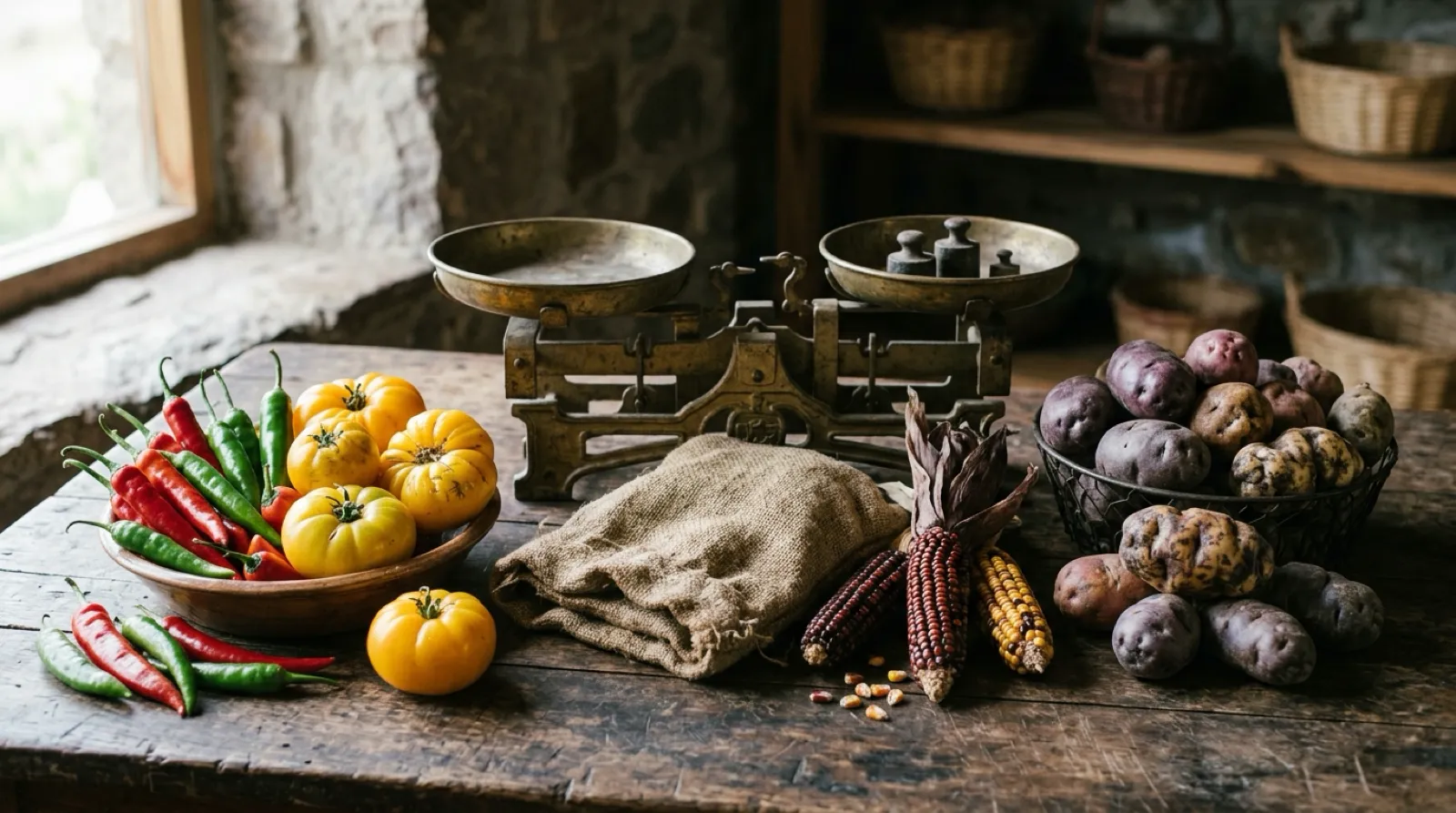
Korean food without red kimchi and gochujang is hard to imagine, yet the entry on the chili pepper in the Encyclopedia of Korean Culture notes that the chili, native to Central America, is commonly believed to have been eaten by Koreans since ancient times but in fact arrived in the early seventeenth century. Since the Joseon work 『Jibong yuseol』 records that the chili came in from Japan and was called “waegyeoja” (Japanese mustard), it is presumed to have entered Korea by way of Japan, and the encyclopedia explains that salted seafood began to be added to kimchi only from the late 1700s, after the chili’s arrival. Today’s “tradition” was formed within roughly three centuries.
The tomato followed a similar path. A 2022 paper in the journal PeerJ by van Andel and colleagues analyzed sixteenth-century European tomato specimens and illustrations and reported that the Italian physician Mattioli gave the first description of the tomato in 1544, that early European tomatoes varied far more in color and shape than tomatoes do today, and that they appear to have originated in both Mexico and Peru. Smithsonian Magazine recounts that Spanish conquistadors brought tomato seeds from Mexico and Mesoamerica to southern Europe in the early sixteenth century, that after John Gerard of England described the tomato in a herbal in 1597 as a plant with a foul smell, suspicion persisted in Britain and the North American colonies for more than two hundred years, and that the tomato won broad popularity across Europe around 1880, when pizza appeared in Naples.
The potato’s timeline is even more extreme. The Food and Agriculture Organization of the United Nations (FAO) explains that about 8,000 years ago hunter-gatherer communities around Lake Titicaca in the Andes began domesticating wild potatoes, that around the sixteenth century the Spanish brought the potato from Peru to Europe, where at first it was treated as a rare gift to be sent to botanists or the Pope, and that it spread around the world through sailors who ate potatoes on long voyages. Today the potato is the third most consumed food in the world. As UNESCO’s Silk Roads Programme puts it, what travelled along the trade routes was not only goods but knowledge and ideas, cultures and beliefs. Rather than explaining fermentation and spices by climate alone, it fits the sources better to see trade, migration, agriculture, and religion as having shaped today’s table together.
6. Tables Designed by Law: Kashrut and Religious Diets
Table rules come not only from tools and ingredients but from faith. The Jewish Museum Berlin explains that the Hebrew word kashrut means ritual suitability and refers to the Jewish dietary laws; foods permitted under kashrut are kosher. Land animals must chew the cud and have cloven hooves, aquatic animals must have fins and scales, and permitted animals must be slaughtered according to specific procedures. The most widely known rule forbids storing, preparing, or eating dairy and meat products together, based on the Torah’s prohibition against cooking a kid-goat in its mother’s milk. Foods that are neither meat nor dairy are called parve and may be eaten with either.
Other faiths keep their own dietary norms, from halal in Islam to the vegetarian traditions of Hinduism and Jainism, and the degree of observance varies by region and by individual within each tradition. For travelers and hosts the practical conclusion is the same: religious diets and allergies cannot be read off a face at the table. Hosts should ask in advance, and guests should say so in advance. That exchange is itself a form of courtesy.
7. What UNESCO Inscribes Is Not a Dish but the Practice of Eating Together
In explaining the relationship between food and intangible heritage, UNESCO stresses that what is inscribed on the Representative List of the Intangible Cultural Heritage of Humanity is not dishes but cultural practices handed down from generation to generation. What is inscribed is the way food is cultivated, prepared, and consumed, and the roughly fifty inscribed food-related practices share a respect for seasonality and local products and create opportunities for exchange and dialogue.
The examples make the principle concrete. Kimjang, inscribed in 2013, is described as the practice by which communities collectively make and share large quantities of kimchi in late autumn so that every household can get through the winter, and UNESCO writes that kimjang is an opportunity for strengthening family cooperation. Washoku, inscribed the same year, is defined as a social practice based on the skills, knowledge, practices, and traditions related to the production, processing, preparation, and consumption of food, with emphasis on a spirit of respect for nature and on New Year food culture. The gastronomic meal of the French, inscribed in 2010, begins with an apéritif and ends with liqueurs and runs to at least four courses — a starter, fish or meat with vegetables, cheese, and dessert — and that structure, together with the way the meal draws family and friends closer and strengthens social ties, was given as the reason for inscription.
The Mediterranean diet, inscribed in 2013 in the name of seven countries — Cyprus, Croatia, Spain, Greece, Italy, Morocco, and Portugal — is described not as a list of particular foods but as the whole set of skills, knowledge, rituals, symbols, and traditions concerning crops and harvesting, fishing and animal husbandry, conservation and processing, cooking, and above all the sharing and consumption of food; eating together, UNESCO explains, is the foundation of the cultural identity and continuity of communities throughout the Mediterranean. Traditional Mexican cuisine, inscribed in 2010, is defined as a cultural model that embraces farming and ritual based on corn, beans, and chili together with cooking techniques and community participation. Korea’s jang making, inscribed in 2024, likewise covers the entire process of making, keeping, and consuming doenjang, soy sauce, and gochujang, and UNESCO records that jang is held to differ from household to household and to carry each family’s history and traditions. What is recognized as heritage is not the name of a dish but the way it is made and shared together.
8. Three Principles for an Unfamiliar Table
First, observe the host in front of you instead of memorizing rules for a continent or a country. The fact that Korean and Japanese guidance on lifting bowls is reversed shows how quickly a label like Asian etiquette breaks down at an actual table. Waiting a moment to see which tools others use, and how, is the most accurate guide available.
Second, ask politely when you do not know. As the official guides repeatedly stress, visitors are rarely expected to follow every rule perfectly, and the willingness to learn an unfamiliar way of eating is itself received as respect. Conversely, judging a way of eating that is unfamiliar to you by the yardstick of hygiene or civilization finds no support in any of the sources discussed in this article.
Third, check current official guidance from the destination’s tourism authority or embassy for allergies, religious diets, tipping, and rules about shared dishes. These rules differ by region and venue within a country and change over time, so country- and venue-level guidance is far safer than continent-wide generalizations. The table is not divided into three worlds. It is made of thousands of specific places, and each has something to teach.