1. Why the Same "Hello" Demands Entirely Different Physical Forms
When two people from different cultural backgrounds meet, the first greeting they offer each other carries far more than mere polite recognition. A greeting is not simply a list of etiquette rules to be memorized or a formal social script; it works as a cultural code that condenses how a society handles the physical distance between bodies, social hierarchy, gender norms, and religious boundaries. Even the simple impulse to show warmth toward another person takes completely different physical forms from culture to culture. The forms vary widely—from greetings that share breath, to bows made at a set distance, to a firm handshake, to non-contact greetings that deliberately avoid skin contact. Examining how each community orchestrates the first moment of an encounter reveals that society's own deep philosophy about where the individual ends and social relationships begin.
2. What Does the Depth of a Bow Actually Communicate?
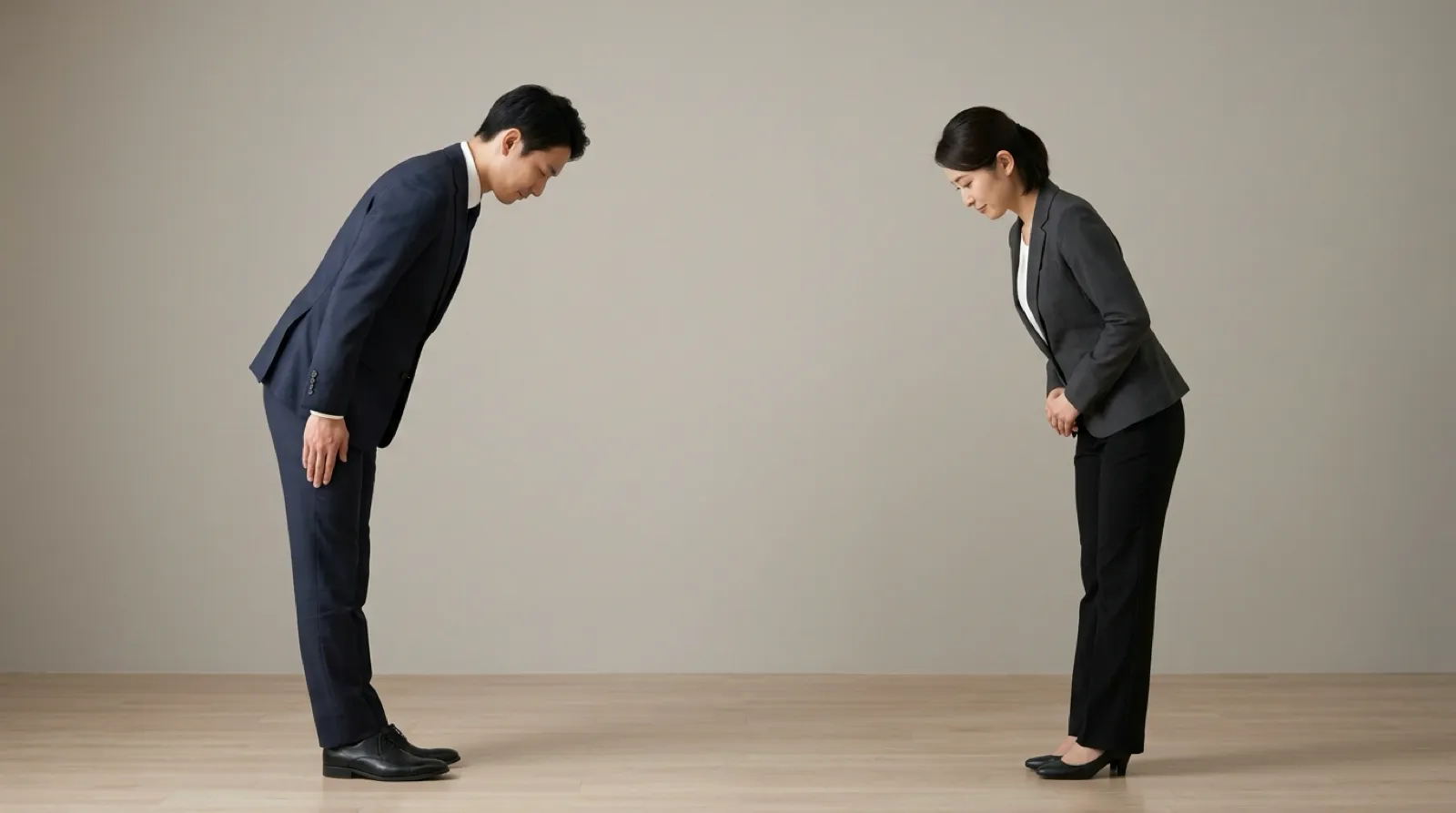
In societies where bowing is customary, how deeply the waist is bent and how long the bow is held function as a refined expression that calibrates social respect. In Japan, traveler guidance from the Japan National Tourism Organization (JNTO) notes that everyday life involves relatively little physical contact and that a polite bow serves as the most standard greeting in most situations. A bow is not a single fixed movement; it varies carefully with the occasion and the degree of formality. A light nod or a slight inclination of the upper body is enough for casual daily encounters with colleagues or friends, while formal business meetings or expressions of deep gratitude call for a deeper bend at the waist, and profound respect, significant ceremonies, or a sincere apology are conveyed by bending lower still. Lowering the head and directing the gaze downward shows humility before the other person while maintaining a comfortable personal distance that remains uninvaded.
It is not appropriate, however, to lump the bowing cultures of Japan and Korea together into one uniform "East Asian bow." In everyday Korean social and workplace life, a polite verbal greeting accompanied by a nod of the head or a slight bend of the upper body predominates, while the full bow performed prostrate on the floor (keunjeol) is largely confined to special occasions such as traditional holidays like Seollal and Chuseok, ancestral rites, or major life rites of passage. In contemporary Korean workplaces and social relationships, a hybrid form is widespread: people exchange a Western-style handshake while also nodding slightly or supporting the right arm with the left hand to show courtesy toward elders or superiors. As visitor guides commonly stress, foreign visitors need not strictly calculate the exact angle of a bow or every detailed rule; it is enough to understand that a greeting expresses careful consideration for the situation and mutual respect rather than submission.
3. How Many Cheek Kisses Are Expected Across Regional Borders?
Few gestures arouse as much curiosity and quiet tension in outsiders as France's signature greeting custom, la bise (a greeting in which the two cheeks are touched alternately with a light sound). Outsiders often take it for a universal national habit practiced identically all across France, but the nationwide survey led by the linguist Mathieu Avanzi and materials from Campus France show that cheek kissing exhibits distinct differences in tendency from region to region. According to the survey data, this appears as a regional tendency rather than a uniform rule: in most French départements (département, France's broad administrative division), exchanging two cheek kisses is the most common standard practice, but in certain départements in the northwest, the center, and the south, a tendency toward one, three, or more rarely four kisses has been observed, in keeping with local tradition.
These variations in the number of cheek kisses go beyond personal preference and act as subtle cultural markers of regional identity, belonging, and pride in one's home region. Residents of particular areas keep their own distinctive kiss count, different from that of the capital, Paris, as a way of expressing attachment to local tradition. Most important, as Campus France explains, la bise is not an absolute obligation imposed in every encounter. In formal business settings or first meetings with strangers, a verbal greeting or a light handshake is the standard default, and locals themselves first gauge how close they are to the other person and read non-verbal cues before acting naturally.
4. Greetings of Shared Breath and Joined Hands: How the Body Inscribes Social Respect in Space
Greetings that combine physical touch or sacred symbolism express through the body a society's deep philosophy of life, community, and the human person. The hongi, the traditional ceremonial greeting of the Māori of New Zealand, takes the distinctive form of pressing noses and foreheads together. As recorded in Te Ara, the New Zealand government's official encyclopedia, the ritual symbolizes sharing te hā, the breath of life, and is rooted in the traditional Māori creation story in which the creator Tāne breathed into the nostrils of Hineahuone, the first woman, whom he had shaped from earth. Because the hongi dissolves the boundary between host and outsider and warmly receives an unfamiliar visitor as a member of the community of that land, it is not a pastime for tourists to imitate at random in daily life but is performed under a host's guidance within the solemn context of the pōwhiri, the formal welcome ceremony held on a marae.
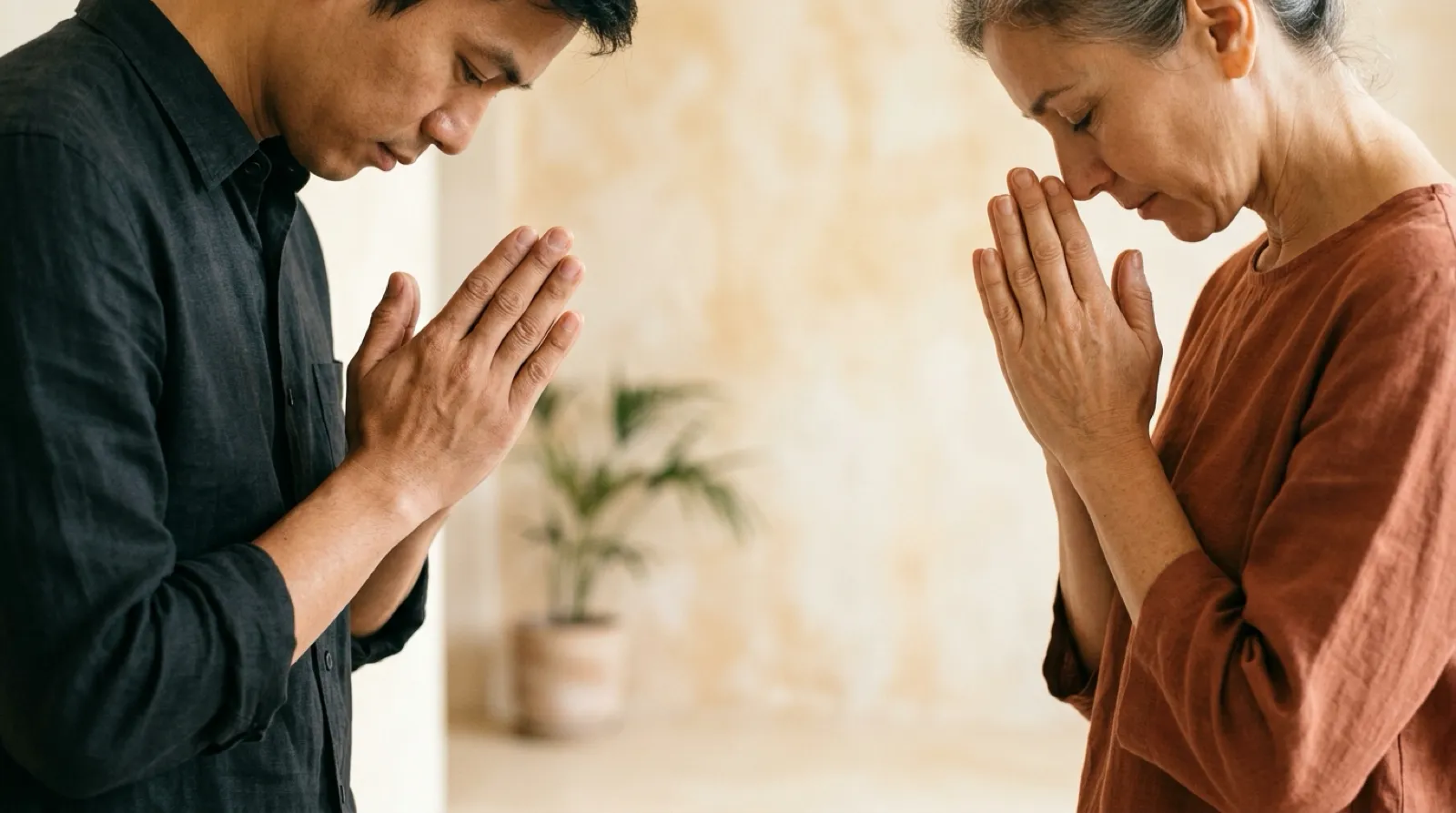
In Thailand, in Southeast Asia, the wai developed as a way of expressing respect through the visual, spatial symbolism of hand height rather than through physical contact. According to cultural guidance from Thailand's Ministry of Foreign Affairs, the wai consists of pressing the palms together in front of the chest and bowing the head slightly. The height to which the joined hands are raised clearly distinguishes the degree of hierarchy and respect shown: placing the thumbs at chest height signals an equal greeting between peers or friends; raising the hands to the chin or the tip of the nose conveys deference toward elders or superiors; and lifting the joined hands as high as the forehead or hairline expresses the highest respect, reserved for monks, the royal family, or sacred Buddha images. By bowing the head deeply into one's own hands, a person lowers the head—regarded as the most sacred part of the body—before the other.
Another leading example of a non-contact greeting that conveys respect is the namaste, which is rooted in ancient Sanskrit tradition. By folding the hands in front of the chest and bowing the head slightly, it acknowledges the inherent dignity within the other person without physical contact or any intrusion into their space. Still, namaste should not be generalized as the single greeting of the entire Indian subcontinent. India is a society of extraordinary cultural, linguistic, and religious diversity, and ways of greeting differ widely according to religious tradition, regional custom, and family context, while Western-style handshakes and everyday verbal greetings are widely used in modern urban workplaces.
5. The Handshake Has Multiple Historical Roots Beyond Weapon Checks
The handshake, regarded today as the most egalitarian and universal standard in the modern business world, likewise has a complex history that cannot be reduced to a single origin. According to historical research compiled by Smithsonian Magazine, the gesture of clasping right hands turns up repeatedly in numerous archaeological artifacts, from ancient Assyrian reliefs of political alliances thousands of years ago to ancient Greek funerary reliefs honoring the deep bonds between spouses or fellow soldiers. In other words, the handshake was not suddenly invented at a single moment in one culture; it evolved in many layers across civilizations as a sacred means of entering binding agreements, concluding commercial treaties, and affirming civic solidarity.
One widely known popular explanation for the handshake's origin is that it began when warriors approached one another and extended an empty hand to prove they carried no hidden weapon, such as a sword or scabbard. Although this martial origin story circulates widely, historians today point to the seventeenth-century Quakers as the group chiefly responsible for establishing across Europe the everyday, egalitarian handshake we use today. Opposed to status-based greetings such as removing one's hat or bowing before aristocrats, they exchanged a simple handshake regardless of rank or gender to express their belief that all people are equal before God. The handshake's varied history shows that even the business etiquette we take for granted today is the product of long political and spiritual struggles and of cultural negotiation.
6. Bodily Autonomy and the Right to Politely Decline Touch
In modern etiquette, respecting an individual's private space begins with acknowledging the right to refuse unwanted physical contact without awkwardness or social penalty. According to an in-depth analysis in TIME Magazine, mature manners mean naturally leaving room for the other person to politely decline a hug or a handshake and fully respecting that choice. Physical boundaries are an important matter of faith and conscience in many religious traditions in particular. In various religious backgrounds, including some Jewish and Islamic traditions, norms strictly forbid or avoid direct skin contact between men and women who are not family members. When such people respond by placing a hand on the heart or offering a polite nod instead of a handshake, they are not ignoring or slighting the other person; it is their own way of showing the highest respect while keeping faith with their religious convictions.
Moreover, for neurodivergent people or those who have experienced psychological trauma in the past, unannounced physical contact can trigger serious sensory overload or anxiety. A mature member of society should be able to respect that distance without prying into the other person's circumstances. When you notice a slight hesitation or a non-verbal keeping of distance, the flexibility to switch to a warm smile and a light nod rather than forcing out your hand is the true measure of international manners.

7. The Structural Changes the Pandemic Left in How We Greet
The COVID-19 pandemic was a historic turning point that forced an abrupt, global reassessment of the touch-centered greeting habits humanity had developed over centuries. As reported in public health and behavioral science research worldwide, hygiene guidelines aimed at preventing the spread of infection defined existing handshakes, cheek kisses, and hugs as potential routes of viral transmission. As a result, non-contact greetings—elbow bumps, fist bumps, or a nod with a hand placed over the heart, and the namaste—rapidly emerged as everyday alternatives.
According to a study published in 2024 in the Journal of the Norwegian Medical Association, the practice of shaking hands among doctors in outpatient care plunged from 94 percent before the pandemic to 23 percent afterward, with infection control the main reason. This change has eased the pressure that treated physical contact in workplaces and daily life as a given, and declining a handshake or preferring a nod is now widely recognized not as rudeness but as a mature choice that takes health and safety into account.
8. Three Guiding Principles for Navigating Unfamiliar Encounters
For travelers, diplomats, and global business professionals, what matters most when facing greetings in an unfamiliar culture is flexible cultural sensitivity rather than memorized rules. The first principle is to read the other person's cues first. Do not rush into physical contact; pause for a moment and observe the other person's posture, gaze, and the spatial distance they keep. If an elder in Bangkok offers a wai or a host in Tokyo bows politely, it is enough to meet the gesture lightly with a composed manner rather than attempting an exaggerated imitation.
The second principle is never to mistake physical distance or a declined touch for personal rejection or coldness. When someone avoids a handshake or keeps a certain physical distance, it is a natural boundary grounded in that society's traditions, religious norms, or the individual's bodily autonomy. A greeting should not be a test that judges the other person, but a warm space in which the dignity of both people is affirmed.
A third principle is recognizing that the depth of a bow or the elevation of a wai reflects situational courtesy and mindful attentiveness rather than social submission or a rigid pecking order. These postures should never be interpreted as marks of servility or superiority; they are balanced expressions of mutual respect grounded in the context of the encounter.