1. Do All Cultures Light Lamps Against the Deepest Winter Darkness?
Every time autumn fades and winter draws near, the popular media offer the same familiar explanation for humanity's tradition of lighting lamps: that communities around the world light lanterns and bonfires in the longest and coldest season of the year as an instinctive cultural response meant to drive back the biting cold and the dark. Many travel guides and popular nonfiction books say that ancient peoples, under harsh skies of dwindling sunlight, all devised rituals of light to comfort one another and soothe their anxiety until spring arrived.
Yet this appealing explanation is closer to a regional interpretation rooted in the particular geography of the high-latitude Northern Hemisphere. In regions near the Arctic Circle or in Northern Europe, winter nights grow extremely long, so the winter solstice (冬至), when night reaches its peak, becomes an enormously dramatic turning point both astronomically and psychologically. Widen the view to the whole globe, however, and the relationship among fire, moonlight, and time looks entirely different. A careful look at the world's major festivals of light shows that they are not simply psychological defenses against winter cold. Rather, they work as 'monuments of the calendar' that precisely record the phases of the moon, the agricultural rhythms of water and harvest, and a community's sacred historical memory.
2. Diwali and the Night of the New Moon (朔): Lamps That Illuminate Spiritual Ignorance
Diwali—or 'Deepavali,' one of the most widely known festivals of light in the world—originally means 'a row of lighted lamps.' Though it is easily mistaken for a year-end winter festival, Diwali centers not on the solar solstice but on Amavasya, the new moon of the month of Kartika in the Hindu lunisolar calendar, the dark night when the moon hides completely. Because the date is set by the lunar cycle, it falls in October or November, in full autumn and far from the solstice on the solar calendar. Historical paintings in the 'songs of the seasons' (Baramasa) tradition held by the British Museum depict Kartika not as harsh winter darkness but as a joyful season of abundant temple worship and homes brightly lit with lamps. In other words, it is merely the darkest new-moon night (朔) of a single lunar month, not the winter solstice, the day of the year with the shortest sunlight.
The cultural meaning of lighting lamps on this autumn night also varies richly by region and religion across India. In northern India, people honor the tale that the populace lit lamps to illuminate the road for Prince Rama as he returned to the capital, Ayodhya, after fourteen years of exile and his defeat of the demon king Ravana. In southern India, especially in Tamil Nadu, celebrations center on Naraka Chaturdashi, the day before the new moon, marking Krishna's victory in slaying the wicked demon king Narakasura. Here the lamps symbolize not an astronomical struggle against winter cold but righteousness victorious over ignorance and injustice, and spiritual illumination.
Moreover, as the official records of India's Press Information Bureau show, Diwali is also shared as a decisive religious anniversary in Jainism and Sikhism. For Jains, the day marks the great dawn when Mahavira, the twenty-fourth Tirthankara (teacher), attained ultimate nirvana (moksha). For Sikhs, it is observed as 'Bandi Chhor Divas,' commemorating the day the sixth Guru, Guru Hargobind, was released from imprisonment in Gwalior Fort together with fifty-two princes. In all these faiths, the lights that illuminate homes and temples are simply rites of remembering sacred history on a particular lunar date; they have nothing to do with a Northern European anxiety about the solstice.
3. Hanukkah and Kislev 25: Sacred History and the Shifting Calendar
Hanukkah, the traditional Jewish festival of light, is likewise bound closely to the flow of sacred history rather than to natural seasonality. Observed by lighting candles on eight consecutive nights, Hanukkah begins on the twenty-fifth day of the Hebrew month of Kislev and continues into the early days of the following month, Tevet. As the records of the Jewish Museum Berlin and Encyclopaedia Britannica make explicit, the Hebrew calendar is a lunisolar system, so the twenty-fifth of Kislev moves each year across the Gregorian calendar between late November and late December. Because it overlaps with the year-end holiday season it is sometimes mistaken for a winter festival, but its essential timetable is fixed to its own religious calendar, not to the solar solstice.
The core tradition of Hanukkah is rooted in a specific historical event rather than in nature's seasonal cycle. Around 164 BCE, the Maccabean rebels led by Judah Maccabee won victory over Antiochus IV of the Seleucid Empire, recovered the defiled Second Temple in Jerusalem, purified it, and rededicated it (Hanukkah). According to tradition, only a single day's worth of holy oil remained to light the temple Menorah (lampstand), yet it miraculously burned without going out for eight days, long enough for new consecrated oil to be prepared. Lighting the Hanukkah menorah by adding one flame each night is a sacred remembrance of this historical rededication and of restored faith—not a magical rite to summon the sun back.
4. Loy Krathong on the Water: Why Light Gathers Under the Brightest Full Moon
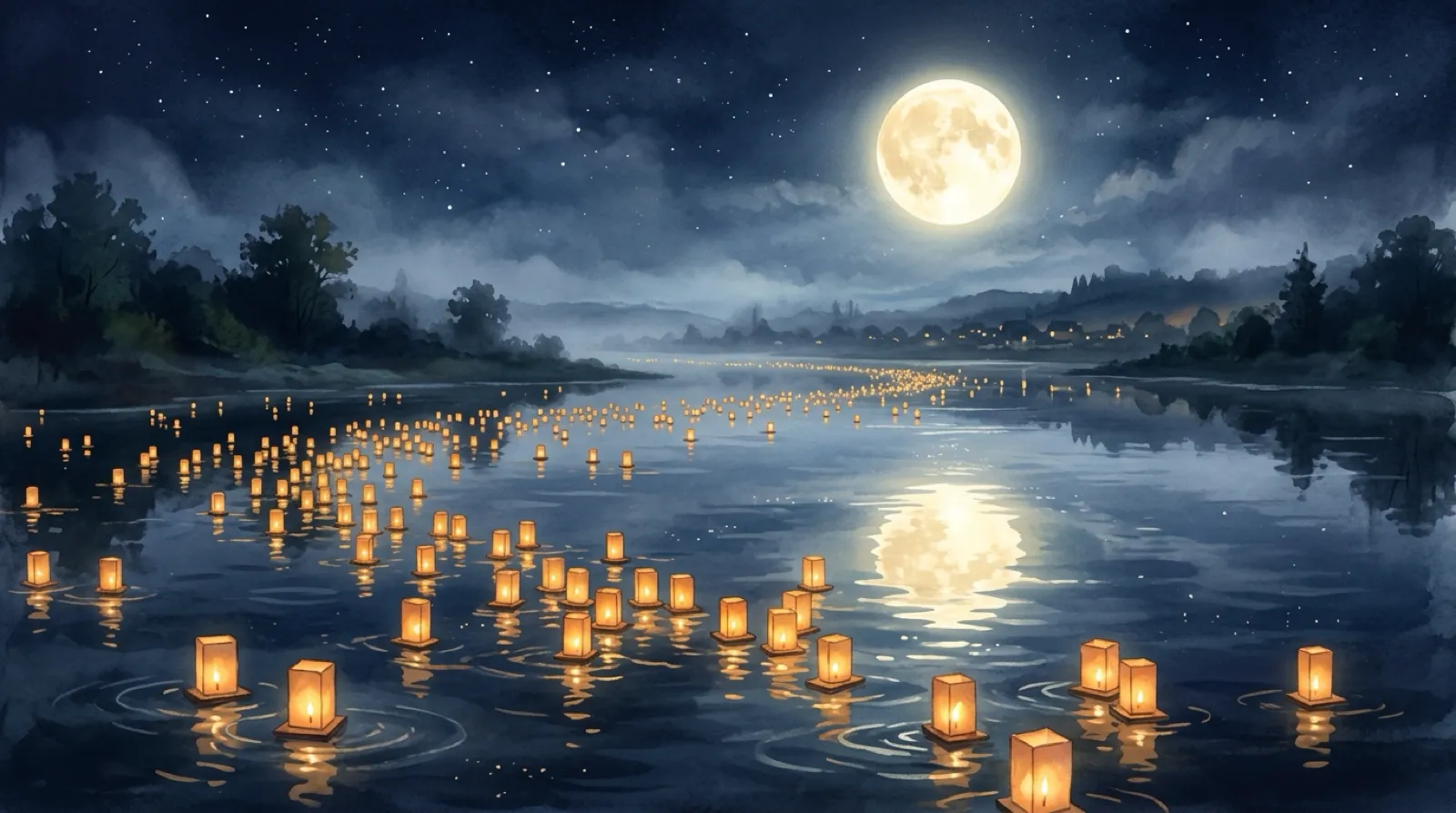
Turning to Southeast Asia, we meet a fascinating festival that directly overturns the conventional idea that "lamps are lit on the darkest night." Loy Krathong, Thailand's signature festival of light, unfolds on the full-moon night of the twelfth month of the traditional Thai lunar calendar—around November on the solar calendar. According to official guidance from the Ministry of Foreign Affairs of Thailand and the Thailand Foundation, the festival is held on the full-moon night when the moon is at its largest and roundest of the month and the night sky shines at its brightest.
Loy Krathong is an agrarian rite rooted in the water resources and the climate of a tropical land where winter cold does not exist at all. This is the time when Southeast Asia's long monsoon rains have just ended and the water in rivers and canals rises to its fullest level of the year. People gather at the water's edge and float 'krathongs,' small boat-shaped vessels carefully made from banana leaves and flowers with candles and incense. Setting these lights adrift is a rite of expressing heartfelt thanks and apology to Phra Mae Khongkha, the goddess of water, for having used and polluted water in farming and daily life over the past year. At the same time, the candle flames swaying away on the current symbolize a purification that sends the past year's accumulated hatred, misfortune, and lingering resentment down the river, signifying a renewal of life in which light and water come together.
5. The Lantern Festival: Welcoming the Spring at the Boundary of the New Year
In East Asian tradition as well, the long cycle of the lunar new year closes with a splendid festival of light held beneath the brightest full moon. The Lantern Festival (元宵節), held on the fifteenth day of the first lunar month, is the day that greets the year's first full moon, and on the solar calendar it arrives in February or early March. According to folk records on the official portal of China's Ministry of Culture and Tourism (chinaculture.org), the Lantern Festival is the day that marks the official grand finale of the fifteen-day Spring Festival (Lunar New Year holiday).
The lanterns of the Lantern Festival are not lights raised to hold off midwinter darkness; they are lights that praise and welcome the energy of spring. The fifteenth day of the first lunar month comes weeks after the winter solstice of late December, and daylight is already noticeably lengthening. People stroll the night streets admiring the colorful lanterns, solve the riddles hung on them (caidengmi), and share round glutinous rice balls resembling the first full moon—'yuanxiao,' rolled in dry flour in the north, and 'tangyuan,' shaped from dough in the south. The round form of the dumplings invokes the completeness of the full moon along with family solidarity, harmony, and a well-rounded start to a new agricultural year.
6. When the Solstice Dictates the Flame: Saint Lucia's Day and the East Asian Winter Solstice
Of course, not every festival of light is unrelated to the winter solstice. There are also cultural cases in which lamplight meshes exactly with the darkness of the astronomical solstice and takes on a life of its own. Saint Lucia's Day, celebrated in Sweden and elsewhere in Scandinavia, is commemorated every year on December 13. According to the historical records on Sweden's official portal (Sweden.se), this feast day preserves a most interesting calendrical history: until Sweden adopted the Gregorian calendar in 1753, December 13 was regarded as the longest night of the year under the old Julian calendar.
In the harsh winter of a Northern Europe bordering the Arctic Circle, December 13 was the dreaded solstice night, when sunlight barely reached the land and ominous spirits were thought to be abroad. Even after the calendar reform moved the actual astronomical solstice to around December 21, the popular folk festival stayed rooted in the date of December 13. This tradition is an exquisite fusion of the Christian devotion honoring Saint Lucy, the martyr of Syracuse whose name means 'light' in Latin, with long-standing native folklore for enduring the harsh solstice darkness of Northern Europe. Today processions led by a Lucia wearing a crown of candles on her head light up schools and churches, and people share saffron buns called lussekatter and ginger cookies called pepparkakor, warmly brightening the deep darkness of the season.
In the long civilizations of East Asia, too, the astronomical turning point of the sun was recorded most clearly through the winter solstice, Dongzhi (冬至), one of the twenty-four solar terms. Around December 21 or 22 on the solar calendar, when the sun's celestial longitude reaches 270 degrees, the Northern Hemisphere meets the day with the shortest daylight and the longest night of the year. As the National Folk Museum of Korea's Encyclopedia of Korean Folk Culture and the texts on chinaculture.org explain, East Asian philosophy saw this solstice day not as the death of the sun but as an auspicious resurrection of the sun, when a new yang (陽) energy sprouts underground and the days begin to lengthen again. In Korea the solstice was called the 'little New Year' (ase, 亞歲), and people cooked and ate red bean porridge, whose red yang color (陽色) was said to drive off evil spirits and yin energy and to strengthen new vitality. In China as well, people in the north ate dumplings (jiaozi) in the hope that their ears would not freeze, while those in the south made tangyuan, celebrating the return of the sun.
7. Conclusion: Festivals of Light Are Festivals of the Calendar
Lining up these traditions from around the world side by side, the explanation that humanity lit lamps merely to endure the year's deepest winter darkness loses its persuasive force. Of the six representative traditions we have examined, only two touch directly on the darkness of the astronomical solstice: Scandinavia's Saint Lucia's Day, which preserves the historical Julian-calendar solstice tradition, and East Asia's winter solstice, one of the twenty-four solar terms. The others point to entirely different coordinates in time. Diwali faces the spiritual darkness of the new moon; Hanukkah testifies to the covenant history of Kislev 25; Loy Krathong gives thanks for the abundance of the rivers under the November full moon; and the Lantern Festival celebrates the first full moon of a spring whose days are growing longer.
In human culture, light is not simply a passive shield against winter cold. It is a sophisticated device of social coordination that navigates time and binds a community together. Whether it is a candle floated on a tropical river, the flames of a menorah lasting eight nights, or a small clay lamp set on an autumn windowsill, people have gathered around the light to remember history, give thanks to nature, and align their lives with the rhythms of the cosmos. Festivals of light, therefore, are not merely seasonal festivals for getting through winter; they are the great 'festivals of the calendar' through which humanity has inscribed the order of time and space upon the earth.
Sources
- British Museum — Painting; album leaf. Festival of Diwali in the month of Kartik (Accessed: 2026-09-07)
- Press Information Bureau (Government of India) — Festivals of India: Deepavali (Accessed: 2026-09-07)
- Encyclopaedia Britannica — Hanukkah | Celebration, Story, Menorah, Candles, History, Customs, & Food (Accessed: 2026-09-07)
- Jewish Museum Berlin — Hanukkah | Jewish Museum Berlin (Accessed: 2026-09-07)
- Ministry of Foreign Affairs of Thailand — Loy Krathong Festival: Expressions of Gratitude to Water (Accessed: 2026-09-07)
- Thailand Foundation — Loy Krathong: The Festival of Floating Lights (Accessed: 2026-09-07)
- Ministry of Culture and Tourism of China (chinaculture.org) — Lantern Festival food: 'Tangyuan' or 'yuanxiao' (Accessed: 2026-09-07)
- Sweden.se (Swedish Institute) — Lucia in Sweden (Accessed: 2026-09-07)
- National Folk Museum of Korea (Encyclopedia of Korean Folk Culture) — 동지 (Dongji / Winter Solstice) (Accessed: 2026-09-07)
- Ministry of Culture and Tourism of China (chinaculture.org) — 24 Solar Terms: 9 things about Winter Solstice (Accessed: 2026-09-07)