The short answer
The four great gates of Hanyangdoseong (漢陽都城) were built to defend the capital. According to the Seoul City Wall Museum, work on the wall began in 1396 with exactly that purpose, and the wall ran 18.6 km with eight gates and two water gates. The same exhibition text describes the walled capital as a physical boundary between the capital and the provinces as well as a symbol of royal authority. The four gates can therefore be seen as structures that served both defense and the marking of a boundary.
The four gates are Sungnyemun, Heunginjimun, Sukjeongmun and Donuimun, which Korea.kr, the government's policy briefing service, presents as the most central remains of Hanyangdoseong. The bell of the Jongnu pavilion fixed the hours at which the gates opened and closed, and those moments come down to us under the names injeong and paru.
Taejo's 1395 wall construction office and Sejong's 1422 rebuilding
Taejo moved the capital to Hanyang in 1394, according to the Korea Heritage Service's monthly magazine. He first set up the Office for the Construction of the New Capital's Palaces (新都宮闕造成都監) to fix the sites of the royal ancestral shrine, the altar of earth and grain, and the palace; then, in 1395, he established the Office for the Construction of the City Wall (都城造築都監) and began building. From 9 January to 28 February 1396, 118,070 workers finished the first phase in 49 days, and from 6 August to 24 September another 79,400 completed the wall in 55 days.
The Seoul Metropolitan Government's Hanyangdoseong website explains that the original build was divided into 97 work sections, each named in the order of the Thousand Character Classic, from cheon (天) to jo (弔). The work did not go entirely smoothly. An entry in the Annals of the Joseon Dynasty for the fifth year of Taejo (1396) notes that water welled up where sections had been built in spring and that parts of the wall collapsed; those places were rebuilt as stone wall (石城), with earthen wall (土城) in the stretches between. Once the wall work was finished, the same entry records, the labourers (丁夫) were sent home.
The rebuilding came under Sejong. The New History of Korea, published on the National Institute of Korean History's Our History Net, records that Taejong planned a reconstruction while still on the throne but held back out of concern for the hardship it would cause the people, then took the project on himself after abdicating in favour of Sejong. The wall reconstruction office calculated that 403,755 workers would be needed for 40 days. The Korea Heritage Service records that 322,400 able-bodied men from Joseon's eight provinces were mobilized for 30 days, from 15 January to 15 February, and Our History Net dates the completion of the rebuilt wall to 23 February 1422, in Sejong's fourth year.
Gate names and nicknames in the Annals entry for Taejo's fifth year
The primary record of the gate names is the Annals of the Joseon Dynasty. The entry for the fifth year of Taejo (1396) reads, "The gate due south (正南) is Sungnyemun (崇禮門), commonly called Namdaemun," and the same entry also contains the line, "The gate due east (正東) is Heunginmun (興仁門), commonly called Dongdaemun (東大門)." It names the gate due west Donuimun (敦義門) and the one to the northwest Changuimun (彰義門). Gwanghuimun (光熙門) to the southeast appears with the nickname Sugumun (水口門), and Sodeokmun (昭德門) with the nickname Seosomun. Both the original text and a translation can be looked up directly in the National Institute of Korean History's Annals of the Joseon Dynasty database.
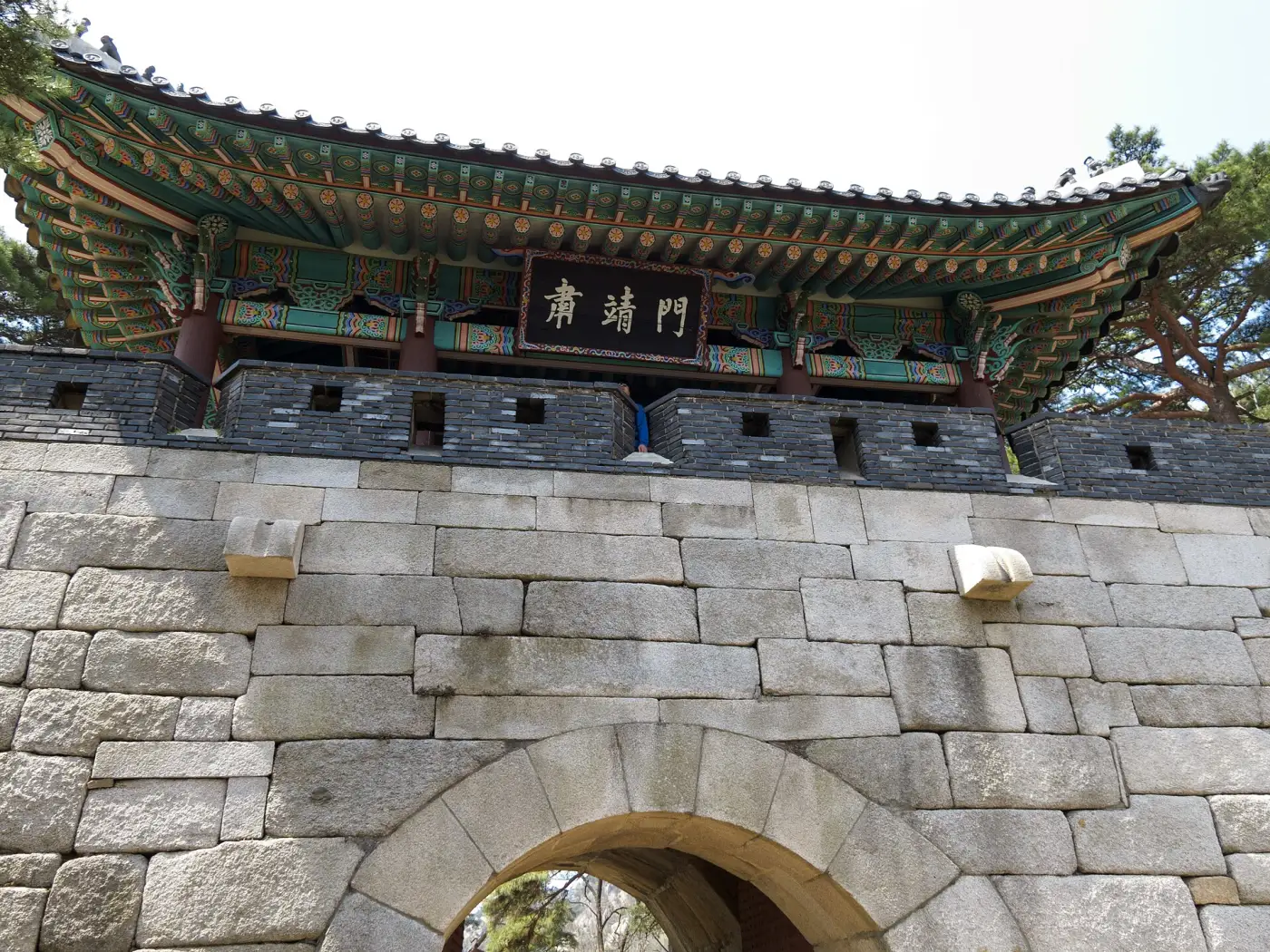
The records for the four gates line up item by item. Sungnyemun is the gate due south in the Annals, nicknamed Namdaemun. Heunginjimun appears there as Heunginmun, nicknamed Dongdaemun. Donuimun is the gate due west, and Our History Net records that under Sejong, Seojeonmun was closed and Donuimun opened. For the north, the Encyclopedia of Korean Culture explains that Sukcheongmun (肅淸門) was renamed Sukjeongmun (肅靖門) after 1523.
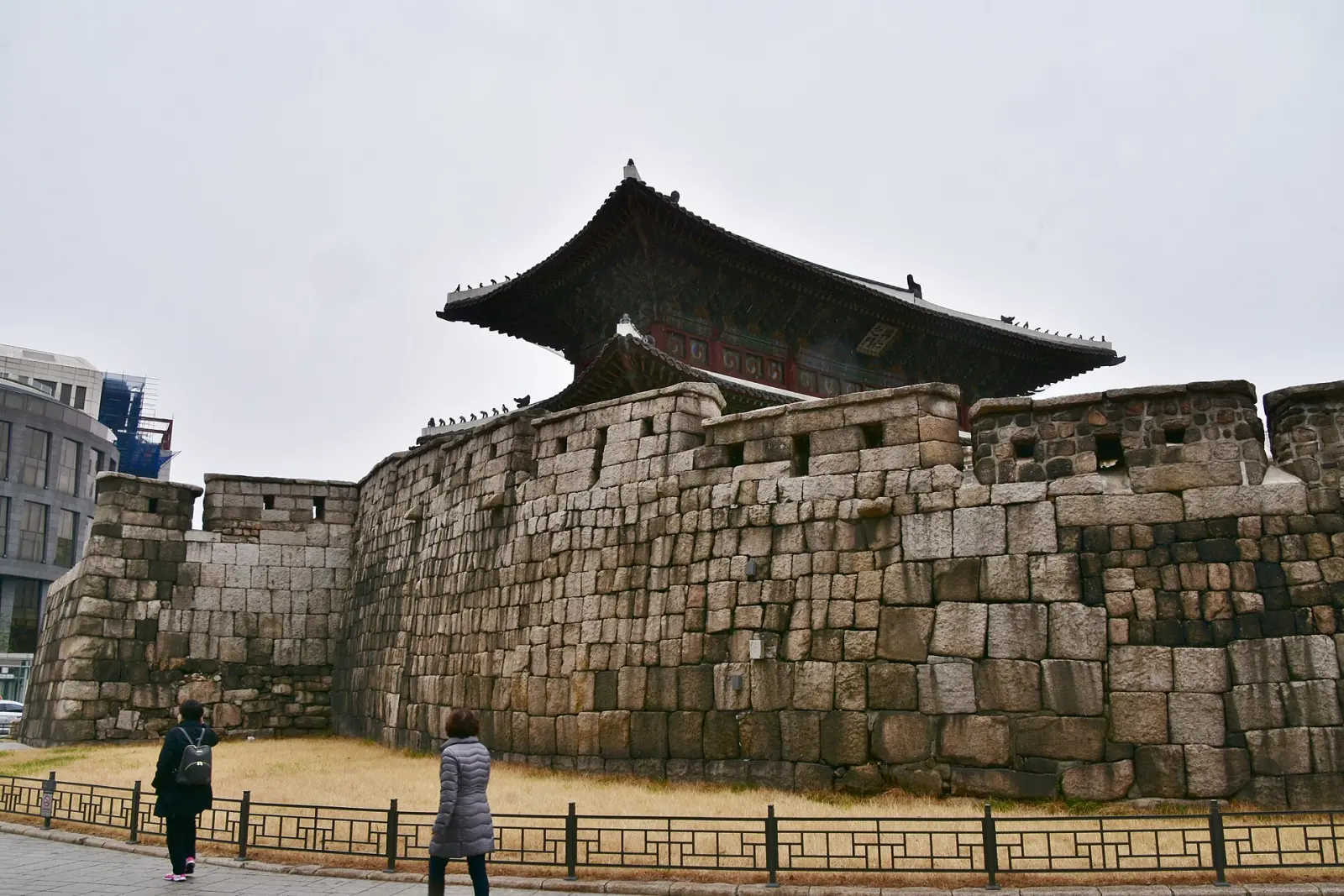
Records of the four smaller gates survive as well. The Seoul Metropolitan Government's Hanyangdoseong website notes that Changuimun is the only one of them whose Joseon-era gate pavilion remains intact; that pavilion burned down during the Imjin War and was rebuilt in 1741, the seventeenth year of Yeongjo. Our History Net records that work to repair Namdaemun began in Sejong's thirtieth year, and that Dongdaemun was repaired in the first month of Munjong's first year (1451) with unsatisfactory results, so rebuilding started again that October. The Korea Heritage Service's English description cites the seventeenth-century Jibong yuseol (芝峰類說) for the claim that Prince Yangnyeong (1394–1462) wrote the calligraphy on the Sungnyemun signboard.
Injeong at 10 p.m., paru at 4 a.m., and the three commands that patrolled the wall
The Encyclopedia of Korean Culture, published by the Academy of Korean Studies, explains how the gates were opened and closed. Taejo built the city wall in 1395, opened four great gates and four small gates, and then had all eight open and close to the sound of the bell at the Jongnu pavilion, which stood at the crossroads where today's Jongno and Namdaemun-ro meet. Injeong was the striking of the bell 28 times each night around 10 p.m. to close the gates and announce the curfew; paru (罷漏) was the striking of the bell 33 times each morning at 4 a.m. to announce that the curfew had lifted.
Breaking the hours carried a penalty. Anyone caught moving about after injeong, the same encyclopedia records, was detained at a guard post (警守所) and beaten with a paddle the next day, the number of strokes ranging from 10 to 30 depending on how far past the hour the offender had been caught. The Seoul City Wall Museum explains that access to the wall was strictly controlled during the Joseon period and that daily routines were organized around the hours the gates opened and closed. Which gates merchants or woodcutters used is not confirmed in these materials.
The Seoul Metropolitan Government's Hanyangdoseong website also describes patrols in the later Joseon period: three military commands — the Eoyeongcheong, the Geumwiyeong and the Hullyeon Dogam — each sent out eight squads to patrol the area around the wall. Today the Baegaksan–Sukjeongmun stretch runs 4.7 km from Changuimun to Hyehwamun and takes about three hours. Baegak (Bugaksan) is 342 m high, the tallest of the four inner mountains. Access to this stretch was restricted after the January 21 Incident of 1968, and it was opened to the public in 2007.
Donuimun's demolition in 1915 and Sungnyemun's 2008 fire and 2013 restoration
The Seoul City Wall Museum records that in 1907 the Japanese forced Emperor Gojong to abdicate and set up the City Wall Disposal Committee. The colonial authorities then demolished gates and stretches of wall in the name of modernization and urban development, taking down Souimun in 1914 and Donuimun in 1915. Colonial facilities rose on the cleared sites, among them the Joseon Shrine (1925), the Gyeongseong Stadium (1925) and the Gyeongseong Weather Station (1932). The Korea Heritage Service records that Hyehwamun was demolished in 1939 when a streetcar line was laid and newly built in 1994 on a site moved to the north.
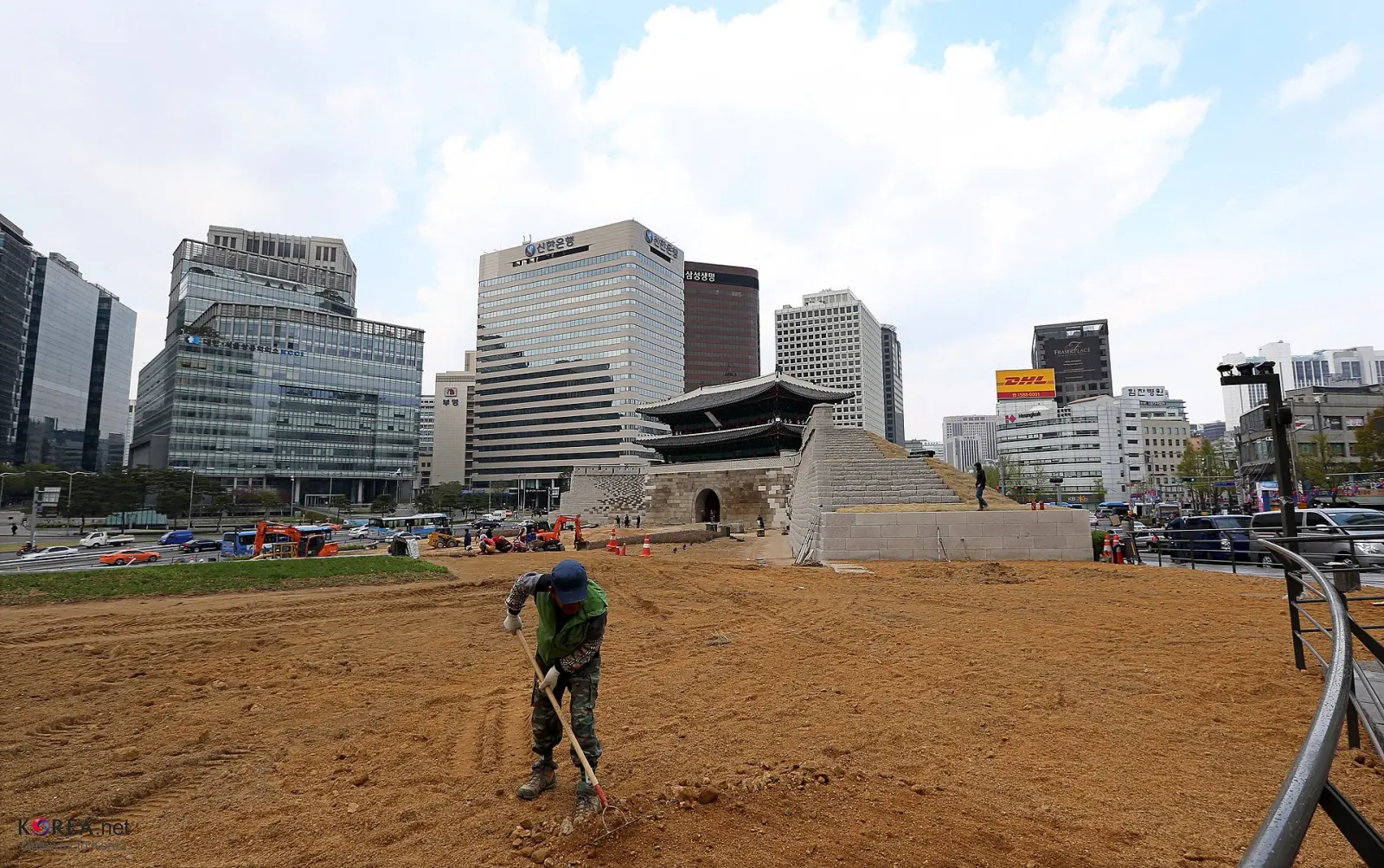
Donuimun no longer stands. Korea.kr states that the gate was forcibly demolished during the colonial period to make way for road widening and does not survive, and that the government later pursued a reconstruction, which collapsed over problems such as the enormous budget and the traffic disruption it would cause. Instead, Donuimun was digitally restored in 2019 and can now be viewed on a kiosk or a smartphone. The Korea Heritage Service records that the gate pavilion of Sukjeongmun, the northern great gate, was newly built in 1976.
Sungnyemun followed a different path. The Korea Heritage Service describes it as the oldest wooden building in Seoul, begun in 1396 and completed in 1398; the monthly magazine records that it was rebuilt in 1448 and remodelled again in 1479. According to the Korea Heritage Service, the fire broke out at 20:40 on 10 February 2008. The second-storey roof was lost around 00:40, and by about 01:55 everything but the stone base had burned. The restoration took five years and two months and, the monthly magazine records, was completed in 2013.
| Gate | Direction and nickname in the Annals | Years in the record | Status today |
|---|---|---|---|
| Sungnyemun (Namdaemun) | Due south, commonly called Namdaemun | Begun 1396, completed 1398, rebuilt 1448, remodelled 1479 | Burned in 2008, restored in 2013 |
| Heunginjimun (Dongdaemun) | Due east, Heunginmun, commonly called Dongdaemun | Repaired in the first month of Munjong's first year (1451); rebuilding begun that October | Not confirmed |
| Donuimun (Seodaemun) | Due west | Seojeonmun closed and Donuimun opened during the rebuilding of 1422 (Sejong 4) | Demolished in 1915, digitally restored in 2019 |
| Sukjeongmun (Bukdaemun) | Due north, Sukcheongmun | Renamed Sukjeongmun after 1523 | Gate pavilion newly built in 1976 |
| Changuimun | Northwest | Gate pavilion rebuilt in 1741 (Yeongjo 17) | The only one of the four small gates with its Joseon-era pavilion intact |
Summing up
The four great gates of Hanyangdoseong did two jobs at once. The first was defense of the capital: the Seoul City Wall Museum records that construction began in 1396 to protect it. The second was marking a boundary and asserting authority, and the same museum describes the walled capital as a physical boundary between the capital and the provinces and a symbol of royal power. The Korea Heritage Service puts the total length at 18.627 km, of which 13.1 km is managed as a national historic site.
The gates changed shape over time. Donuimun was demolished in 1915 and no longer stands, though it was digitally restored in 2019; Sungnyemun burned in 2008 and was restored in 2013; the gate pavilion of Sukjeongmun was newly built in 1976. Readers who want to dig further should consult the National Institute of Korean History's Annals of the Joseon Dynasty database alongside the Korea Heritage Service's materials.