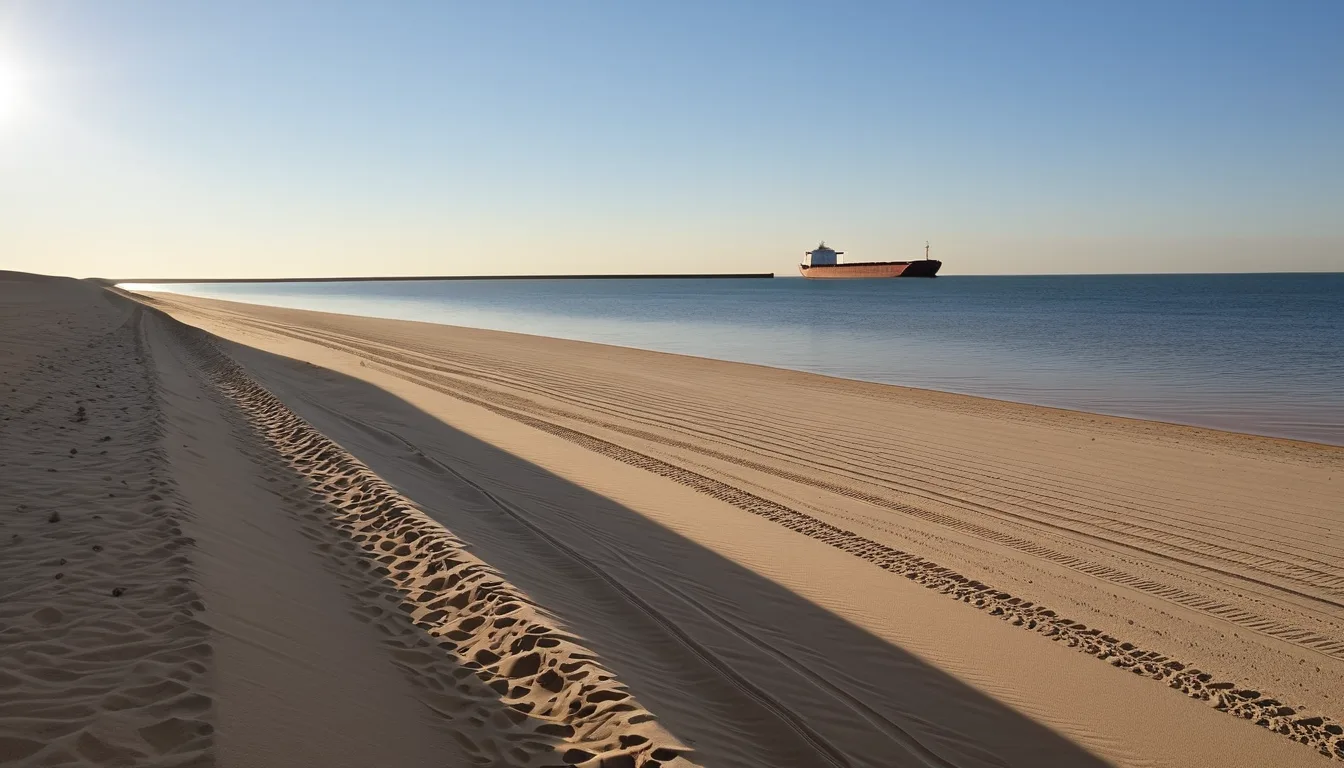
The short answer: Panama rises to a lake's level, Suez is measured by depth
The Panama Canal lifts ships from sea level to 26 meters above it. The Panama Canal Authority (Panama Canal Administration) describes these locks as water lifts. The surface of Gatun Lake sits 26 meters above sea level. Suez, by contrast, is described through figures for depth, cross-sectional area and draft. The two canals start from different measuring conventions altogether.
Every number in this article comes from documents published by the two canal authorities. On the Panama side, those are the canal history page and the financial results for fiscal year 2024. On the Suez side, it is the canal characteristics page. Anything not in those documents is not confirmed here.
About 80 km and 26 meters above sea level on the Panama Canal Authority's history page
The Panama Canal runs about 80 km between the Atlantic and the Pacific. The authority's document describes a lock as a chamber with an entry gate and an exit gate. Those chambers raise ships from sea level to the surface of Gatun Lake, which lies 26 meters above sea level. From that height, ships cross the channel cut through Panama's central mountain range.
The passage describing the locks reads: "The locks function as water lifts: they raise the ships from sea level (either Pacific or Atlantic) to the level of Gatun Lake (26 meters above sea level)." The Korean rendering of that sentence is the author's own translation. The original wording can be read directly on the canal history page of the Panama Canal Authority website.
The authority explains that each set of locks was named after the town built at the site. On the Atlantic side that is Gatun. On the Pacific side they are Pedro Miguel and Miraflores. The same document states that 13,000 to 14,000 ships use the canal each year.
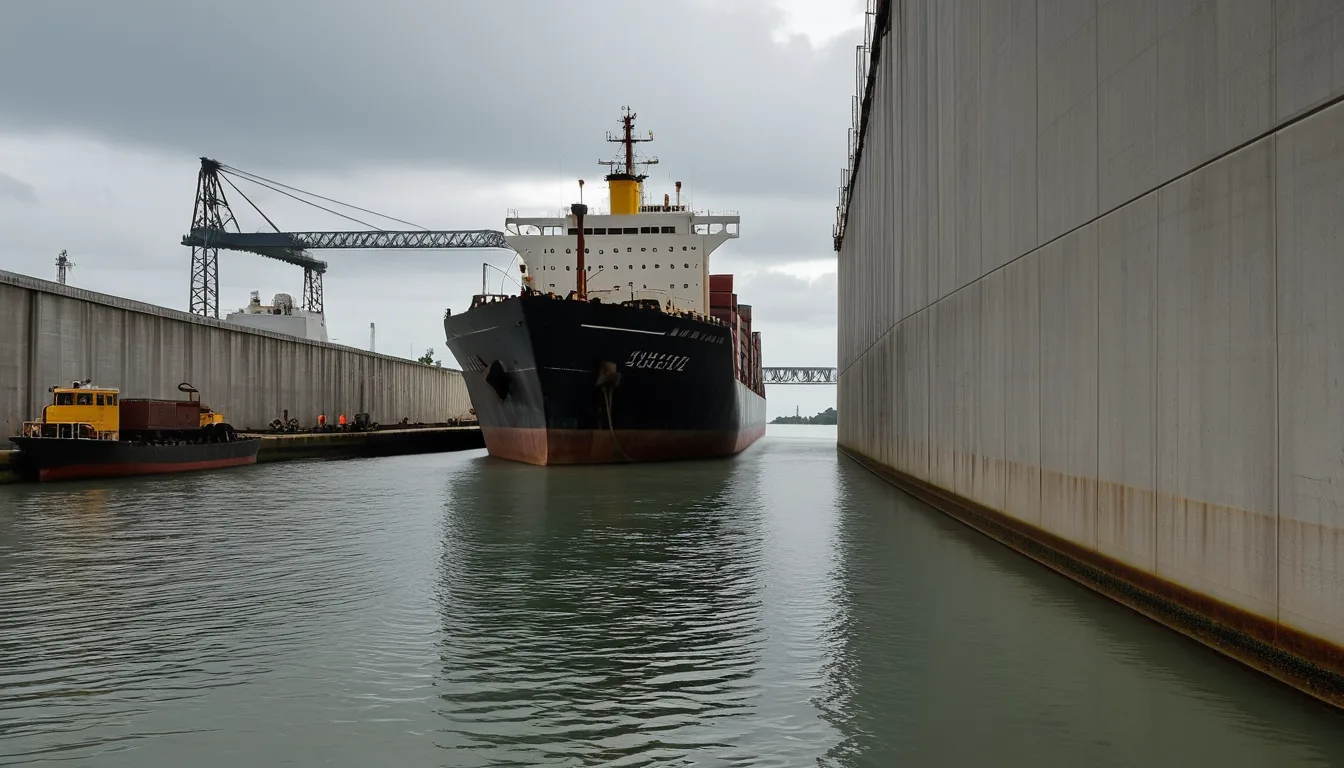
Each chamber is 33.53 m wide and 304.8 m long, and the water comes down from the lake
A lock chamber amounts to a single step. The authority gives each chamber as 33.53 meters wide and 304.8 meters long. The water that raises and lowers ships comes from Gatun Lake, fed by gravity. The document explains that the water enters the locks through main culverts that run beneath the chambers, leading in from the side walls and the center wall.
The narrowest stretch of the canal is the Culebra Cut, about 13.7 km long. It was carved by excavating the rock and limestone of the central mountain range. The Panama Canal, then, can be read as a structure built with locks to exploit a lake's elevation and with excavation to get through a mountain range.
FY2024 drought, 9,944 deep-draft transits and 4.99 billion PAB in revenue
The Panama Canal Authority reported a prolonged drought in FY2024. The drought pushed the levels of Gatun Lake and Alhajuela Lake down to a point rarely seen in 110 years. The authority adjusted drafts and transits, and states that in doing so it gave priority to the more than 50% of the population that draws water from the two lakes. Because of those water-saving measures, the authority explains, FY24 deep-draft transits came to 9,944, 21% fewer than in FY23.
The same document carries the financial figures. Total FY2024 revenue was 4.99 billion PAB — 209 million PAB above budget and 18 million PAB above FY23. Operating costs fell 5%, and net income rose by 300 million PAB year on year. The authority cited the freshwater charge (CAD), better water efficiency through structural and operational improvements, and an improved booking and auction system as its strategies for securing revenue.
Panama's numbers are written in terms of elevation and chamber dimensions. Suez's numbers are written in terms of depth and cross-sectional area. So any comparison of the two has to begin by stating which standard a figure belongs to. The same approach of putting numbers on a common footing appears in another article on area rankings.
The Suez Canal Authority's characteristics page: 8 meters deep in 1869, 191.80 km long
The Suez Canal was dredged by Egyptian labor over roughly a decade, and it first opened to navigation on 17 November 1869. At the opening its depth was about 8 meters and its cross-sectional area 304 m², and the largest tonnage able to pass was 5,000 tons. By May 1962 the cross-sectional area had reached 1,800 m² and the permissible depth 38 feet. The expansion program that followed was halted by the war that broke out on 5 June 1967.
After ships sunk during the wars of 1967 and 1973 were cleared, the canal reopened to international navigation in June 1975. Expansion work brought the cross-sectional area to 4,800 m², the draft to 62 feet and the length to 191.80 km, according to the page. Every bend was also redesigned with a radius of at least 5,000 m. The Suez Canal Authority states that this work allowed the canal to accept vessels of 210,000 tons, and that the permissible draft reached 66 feet in 2010, making the canal accessible to every bulk carrier in the world and to some 17,000 container ships. Events reshaping numbers also turn up in another article on time zones.
Lining the two sets of figures up item by item makes the differences clear. The documents themselves are the Panama Canal Authority's canal history page and the Suez Canal Authority's canal characteristics page. On length, Panama is about 80 km and Suez is 191.80 km after expansion. On water level, Panama is built to lift ships to a lake 26 meters above sea level, while Suez is given as a 66-foot draft as of 2010. On scale, Panama lists chambers 33.53 m wide and 304.8 m long, while Suez lists a cross-sectional area of 4,800 m² and vessels of 210,000 tons. On chronology, Panama records the FY2024 drought, while Suez records the 1869 opening and the 1975 reopening.
| Item compared | Length or section | Water level or depth | Transit scale |
|---|---|---|---|
| Panama Canal | About 80 km, Atlantic to Pacific | Lifts ships from sea level to Gatun Lake, 26 m above sea level | 13,000–14,000 ships a year |
| Panama lock chamber | 304.8 m long per chamber | Water fed by gravity from Gatun Lake | 33.53 m wide per chamber |
| Culebra Cut | About 13.7 km | Section excavated through rock and limestone | Not specified |
| Suez Canal (at its opening on 17 November 1869) | Not specified | Depth about 8 m, cross-sectional area 304 m² | Maximum tonnage 5,000 tons |
| Suez Canal (May 1962) | Not specified | Permissible depth 38 feet, cross-sectional area 1,800 m² | Not specified |
| Suez Canal (after expansion work) | 191.80 km, bend radius at least 5,000 m | Cross-sectional area 4,800 m², draft 62 feet, 66 feet in 2010 | 210,000-ton class, about 17,000 container ships |
Wrap-up
The Panama Canal is built to lift ships by locks to Gatun Lake, 26 meters above sea level. The Suez Canal Authority's documents describe the canal through depth, cross-sectional area and draft. That makes the two hard to compare directly in the same terms. In Panama, a lake's water sets the operating conditions. In Suez, cross-section and depth can be seen as setting them.
The figures for both canals can be checked directly in the authorities' published documents. For Panama, those are the canal history page on the Panama Canal Authority website and the FY2024 financial results. For Suez, it is the canal characteristics page on the Suez Canal Authority website. Numbers absent from those three documents are not covered here.