The short answer
The most widely accepted view is that Kim Si-seup (金時習) wrote Geumo sinhwa (金鰲新話, New Tales of Mount Geumo) in his thirties, while living on Mount Geumo in Gyeongju. Yet for a long time no copy of the book could be found in Korea. The text read today became known again through an edition printed in Japan and a Joseon-printed edition held by the Dalian Library in China. The opening scene of “Manboksa jeopogi” must also be read through this transmitted text. This is Part 1 of a three-part series.
This article covers how the book was written, the history of its editions, its five tales, its relationship to Jiandeng xinhua, and the opening scene of “Manboksa jeopogi.” It considers Kim Si-seup's life only during his Gyeongju years. Scenes from the other tales are left for later parts.
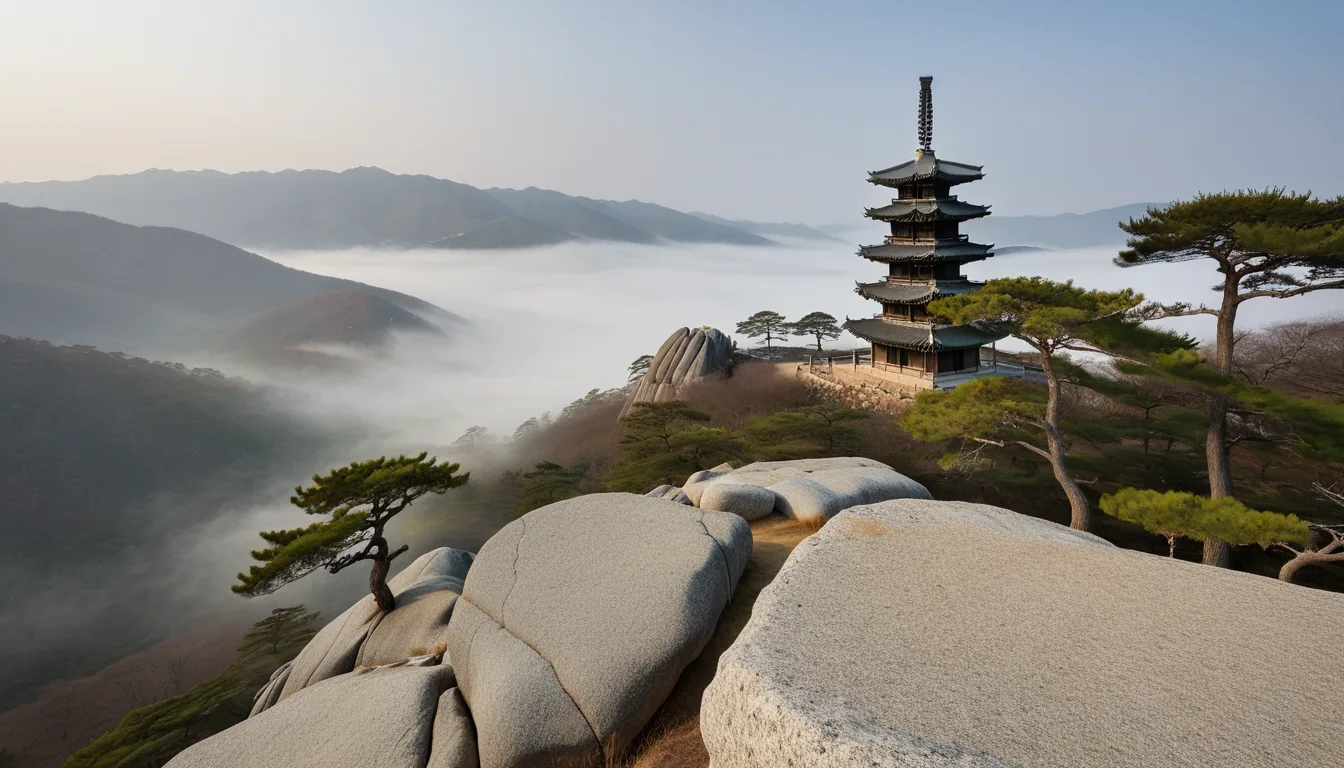
Kim Si-seup and Yongjangsa Temple on Mount Geumo, Gyeongju
Kim Si-seup was born in 1435 (the 17th year of King Sejong's reign) and died in 1493 (the 24th year of King Seongjong's reign). The Encyclopedia of Korean Culture, published by the Academy of Korean Studies, describes his Gyeongju years in its entry on him: “In the spring of 1465 (the 11th year of King Sejo), at the age of 31, he went down to Gyeongju, built Geumosansil (金鰲山室) on Mount Geumo (金鰲山), Gyeongju's Namsan, and lived there in seclusion.” The same entry adds that he wrote Geumo sinhwa and a body of poems there between 1465 and 1471.
The passage identifies Mount Geumo with Gyeongju's Namsan. The book's title and the mountain's name share the same characters, 金鰲 (Geumo). Arguably, the title alone lets us guess at a link between the work and the place. The encyclopedia's entry on Geumo sinhwa narrows the location further. The most widely accepted view, it says, is that the author wrote the book in his thirties while living in seclusion at Yongjangsa Temple (茸長寺) on Mount Geumo. The entry also notes, however, that there are several theories about when and where it was written.
Kotobank (コトバンク), a Japanese reference site, gives slightly different dates. Its leading view places the writing between the ages of 31 and 36, that is, between 1466 and 1471. The Korean encyclopedia puts age 31 in 1465 and ends the period in 1471, at age 37. Set side by side, the two sources differ by a year in both the starting date and the age reckoning. The gap can be read as a reminder that the dating is a “leading theory,” not settled fact.
Lost until the Korean Empire's final years: Choe Nam-seon's 1927 introduction
Readers may assume Geumo sinhwa is a classic that has always been read. The Encyclopedia of Korean Culture's entry on the book says otherwise: “This text was a rare book even in its own day; references to it occasionally turn up in other writings, but no physical copy was found until the final years of the Korean Empire.”
The passage separates the name from the object. The title survived through mentions in other writings, but no one could hold the book itself. This arguably shows that the work's reputation and its physical existence went separate ways. That is why the history of its editions begins with a question: how did the book reappear?
According to the same entry, Choe Nam-seon (崔南善) discovered a woodblock edition that had been printed and handed down in Japan. In 1927 he introduced the book to Korean readers in issue 19 of the magazine Gyemyeong (啓明). The encyclopedia also traces that edition's lineage. The woodblock edition published in 1884 reprinted an edition printed in Japan in 1653 (the 4th year of King Hyojong). The 1653 edition, in turn, was based on material long handed down in the family of Otsuka Hikotarō (大塚彦太郎). Kotobank likewise says the book reached Japan and was printed there in 1653 (Jōō 2) as a Japanese woodblock edition.
The Korean encyclopedia dates the year by a Joseon king's reign, and the Japanese one by a Japanese era name. Yet both arrive at 1653. This lineage shows that Korean readers rediscovered the work through a Japanese edition.
The Dalian Library's Joseon edition and Yun Chun-nyeon
Understanding of the editions shifted once more. According to the encyclopedia, a woodblock edition printed in Joseon, earlier than the Japanese one, became known in Korea in the late 1990s. It is held by the Dalian Library in China. The encyclopedia describes it as follows: “The Joseon edition held by the Dalian Library appears to have been printed during the reign of King Myeongjong, and the lower part of the first page of the first volume bears the words ‘compiled (編輯) by Yun Chun-nyeon (尹春年), a later scholar of Papyeong (坡平後學).’”
The key word here is “compiled” (編輯). The first page states that a man named Yun Chun-nyeon put the book together. The phrase suggests that an edited edition was also printed in Joseon itself. Yet the encyclopedia calls the book a rarity. Taken together, these facts show that the work had been printed in Joseon, but no copy survived in Korea.
Collectors' seals explain how the book ended up in China. The Dalian copy bears seal impressions including 養安院藏書 (Collection of Yōan'in) and 栗田萬次郞所藏 (Owned by Kurita Manjirō). On this basis, the encyclopedia regards it as a book looted by Japanese troops during the Imjin War. According to the encyclopedia, the book appears to have moved to the Dalian Library sometime after the late 19th or early 20th century. The case shows how collectors' seals can offer clues to the path an edition traveled.
Printed editions were not the only way the work survived. The encyclopedia's entry on “Manboksa jeopogi” cites a copy made in Korea: an anthology of Classical Chinese fiction compiled by Kim Jip (金集). In it, “Manboksa jeopogi” is copied by hand together with “Isaeng gyujang jeon” (李生窺牆傳). This suggests the work also circulated in handwritten copies, apart from woodblock printing.
The five tales and the word “gapjip” (甲集) at the end of the second volume of the Japanese edition
Kotobank lists five tales: “Manboksa jeopogi” (萬福寺樗蒲記), “Isaeng gyujang jeon,” “Chwiyu bubyeokjeong gi” (酔遊浮碧亭記), “Namyeombuju ji” (南炎部洲志) and “Yonggung buyeon rok” (竜宮赴宴録). The Encyclopedia of Korean Culture's entry on Kim Si-seup gives the same number: “As far as is known to date, Geumo sinhwa consists of only five tales, including ‘Manboksa jeopogi’ (萬福寺樗蒲記), and these have served as good material (好材) for examining Kim Si-seup's thought.”
The encyclopedia's entry on Geumo sinhwa finds a different clue in the Japanese edition: “At the end of the second volume there is a note calling this book ‘gapjip’ (甲集, the first collection), which shows that the original number of tales was more than five.” Kotobank likewise says that, according to other sources, there was a sequel, though it has not survived.
The two references point the same way on different grounds. The Korean encyclopedia relies on a note inside the book itself. The Japanese one relies on reports in other sources. This can be read as a reason not to treat today's five tales as a set closed from the beginning. The phrase “as far as is known to date” in the Kim Si-seup entry reflects the same caution.
Ming author Qu You's Jiandeng xinhua: Volume 2 and “The Peony Lantern”
Jiandeng xinhua (剪燈新話) is a collection of short tales of the marvelous. Qu You (瞿佑) of the Ming dynasty wrote it around 1378. According to Kotobank, Geumo sinhwa was influenced by Goryeo-period tales of the marvelous and, most directly, by Jiandeng xinhua in its structure. The Korean encyclopedia is more cautious: “There are similarities in subject matter and content between Jiandeng xinhua and Geumo sinhwa, so influence can be acknowledged in principle, but not every similarity can be regarded as the result of influence.”
This sentence asks readers to separate influence from similarity. A resemblance between two scenes does not mean one borrowed from the other. Read together, the two references accept influence but insist that its extent be judged separately.
“The Peony Lantern” (牡丹燈記), in Volume 2 of Jiandeng xinhua, begins: “至正庚子之歲,有喬生者,居鎮明嶺下,初喪其耦,鰥居無聊” In English: “In the gengzi year of the Zhizheng era, there was a man named Qiao who lived below Zhenming Ridge. He had just lost his wife and was living as a widower, idle and listless.” Of the woman Qiao meets, the text says: “此奉化州判符君之女也,死時年十七,權厝於此” In English: “This is the daughter of Fu, assistant magistrate of Fenghua Prefecture; she died at seventeen and was laid here temporarily.”
“Teng Mu zuiyou Jujingyuan ji” (滕穆醉遊聚景園記), in the same volume, features a similar woman: “芳華姓衛,故宋理宗朝宮人也。年二十三而歿,殯於此園之側。” In English: “Fanghua, surnamed Wei, was a palace lady at the court of Emperor Lizong of the former Song. She died at twenty-three and was laid to rest beside this garden.” The story is set in the Jujing Garden forty years after the fall of the Song, its pavilions all in ruins. Both tales state plainly the woman's age and where she has lain since her death.

The opening of “Manboksa jeopogi”: Yang-saeng of Namwon and the jeopo wager
The Classical Chinese text of “Manboksa jeopogi” can be read in the Geumo sinhwa entry on Chinese Wikisource (維基文庫). The tale opens: “南原有梁生者,早喪父母,未有妻室,獨居萬福寺之東.” In English: “In Namwon there was a man named Yang-saeng. He had lost his parents early and had no wife, and he lived alone to the east of Manbok Temple.”
The first sentence gives the place, the name, the family situation and the dwelling, in that order. Yang-saeng has neither parents nor wife, and the text notes that he lives east of the temple. This setup arguably ties in with the wager being made before the Buddha.
The original text of the wager passage reads: 日晩梵罷人稀,生袖摴蒲,擲於佛前曰: “吾今日,與佛欲鬪蒲戱,若我負,則設法筵以賽,若不負,則得美女,以遂我願耳.” In English: “As the day grew late, the service ended and the people thinned out, Yang-saeng took jeopo sticks from his sleeve, threw them before the Buddha and said:” “Today I wish to play a game of jeopo against the Buddha. If I lose, I will hold a Buddhist service to repay you; if I do not lose, I will get a beautiful woman and have my wish.”
In this wager, Yang-saeng arguably treats the Buddha not as an object of reverence but as an opponent in a game. The stakes: if he loses, he holds a service; if he wins, he gets a beautiful woman. The encyclopedia's entry on “Manboksa jeopogi” summarizes the passage: “Grieving that he had no mate, he played jeopo with the Buddha and, as the prize for winning, obtained a beautiful maiden.” The Wikisource text writes the game's name as 摴蒲, while the encyclopedia's title uses 樗蒲, a slight difference in characters. This difference shows why editions and spellings must be examined together.
The woman's prayer in “Manboksa jeopogi”: how it departs from Jiandeng xinhua
The encyclopedia's entry on “Manboksa jeopogi” sums up the story of the maiden Yang-saeng wins: “During the Japanese pirate raids, the maiden was separated from her parents and, keeping her chastity, had lived hidden in a remote place for three years, all the while seeking a mate.” In the original, the woman offers the Buddha a written prayer.
In English, the passage reads: “Some time ago the frontier defenses collapsed and Japanese pirates invaded. Spears and shields filled our sight, and beacon fires were lit year after year. They burned houses and plundered the people, so that people fled east and west and hid left and right.”
Yang-saeng's wager springs from one man's loneliness. The woman's prayer speaks of a war suffered by a whole region. Both the encyclopedia's summary and the original text set the story against the Japanese pirate invasions. The passage can be read as placing a private wish and the memory of war in the same space. The “Manboksa jeopogi” entry describes the work as “a love story about a living man and a dead woman, which in terms of structural type is also called a ghost-marriage tale (冥婚小說) or a tale of love with the dead (屍愛小說).” Because it deals with love between the living and the dead, it pairs well with our guide to traditional Korean ghosts: their types and origins.
Compared point by point, the Chinese and Korean works differ as follows. “The Peony Lantern” opens with a date; “Manboksa jeopogi” opens with a place name. Qiao, the male lead of the first, is a widower who has lost his wife; Yang-saeng lost his parents early and has no wife. In the two Jiandeng xinhua tales, the woman's backstory states her age at death and where she rests; in “Manboksa jeopogi,” the woman's prayer leads with the war waged by Japanese pirates. On war itself, “Teng Mu zuiyou Jujingyuan ji” depicts the ruins of a fallen dynasty, while “Manboksa jeopogi” depicts an invasion of the frontier. This contrast arguably supports the Korean encyclopedia's view that differences within a similar framework must be read on their own terms.
| Text | Publication and transmission | Passage used in this article | Difference from other texts |
|---|---|---|---|
| Geumo sinhwa, Joseon edition held by the Dalian Library | Apparently printed during King Myeongjong's reign; held by the Dalian Library, China | The words “compiled by Yun Chun-nyeon, a later scholar of Papyeong” at the bottom of the first page | A Joseon woodblock edition earlier than the Japanese one; became known in Korea in the late 1990s |
| Geumo sinhwa, 1653 Japanese edition | Printed in Japan in 1653 (4th year of King Hyojong; Jōō 2) | Based on material handed down in the Otsuka family | Reprinted in the 1884 woodblock edition |
| Geumo sinhwa, 1884 woodblock edition | Printed in 1884 | A reprint of the 1653 Japanese edition | A later edition based on the earlier Japanese edition |
| Anthology of Classical Chinese fiction compiled by Kim Jip | Handwritten copy made in Korea | Hand-copied text of “Manboksa jeopogi” | Copied together with “Isaeng gyujang jeon” |
| Jiandeng xinhua | Written around 1378 by Qu You of the Ming dynasty | “The Peony Lantern” and “Teng Mu zuiyou Jujingyuan ji” in Volume 2 | Shares similarities with Geumo sinhwa, but not every similarity can be regarded as the result of influence |
Related reading: Gwisin and Dokkaebi: Korea's Traditional Ghosts and Where They Came From · What Did the Origin Myths in Soushenji Volume 14 Set Out to Explain? (3/3)
Conclusion
What this discussion has shown is that the text of Geumo sinhwa rests on two axes: place and edition. Mount Geumo in Gyeongju is the most widely accepted place of composition, but the sources' dates differ by a year. The book vanished from Korea and reappeared through the Japanese edition and the Dalian Library copy. At the start of “Manboksa jeopogi,” the jeopo wager and the woman's prayer can be read as holding a private wish and the memory of war together.
Some questions remain. What were the other tales implied by the note “gapjip”? How closely does the text of the Joseon edition from King Myeongjong's reign match that of the 1653 Japanese edition? These questions show that reading the work and reading its editions cannot be separated. The next part widens the view to the other tales.