The short answer: founded in 1395, burned in 1592, rebuilt in 1867
Gyeongbokgung (景福宮) was first built in 1395. The Royal Palaces and Tombs Center of the Korea Heritage Service describes it as the foremost royal palace (法宮) of the Joseon dynasty, founded in 1395 (the 4th year of King Taejo). It then burned during the Japanese invasions of 1592. Some 270 years later, in 1867 (the 4th year of King Gojong), it was rebuilt. These three years form the backbone of the palace's history. This article is the first of a seven-part series.
The story does not end with the 1867 rebuilding, however. The number of halls shrank dramatically with the Joseon Industrial Exposition of 1915 and the construction of the Japanese Government-General building in 1926. That building was demolished in the 1990s. Restoration has continued through a government project launched in 1990.
The founding year of 1395, as given by both the Royal Palaces and Tombs Center and the National Archives
The Royal Palaces and Tombs Center of the Korea Heritage Service presents Gyeongbokgung as the principal palace of Joseon. Its description of the palace includes the phrase "the foremost royal palace (法宮) of the Joseon dynasty, founded in 1395 (the 4th year of King Taejo)." The same institution's English-language guide also describes it as Joseon's premier palace, built in 1395 (the 4th year of King Taejo) after the dynasty was founded in 1392. Both guides give the same founding year.
The National Archives of Korea, under the Ministry of the Interior and Safety, also dates the founding to 1395 (the 4th year of King Taejo), adding that this was only four years after Joseon was established. All three sources agree on 1395. The palace's original size and the layout of its halls cannot be confirmed from these sources alone.
The Revised Annals of King Seonjo on the loss of three palaces in the fourth month of 1592
Gyeongbokgung burned in 1592, and the record appears in the Revised Annals of King Seonjo under the fourth month of that year. The entry states that "the three palaces of Gyeongbokgung (景福宮), Changdeokgung (昌德宮) and Changgyeonggung (昌慶宮) all burned down at once." The same entry also describes the situation after the king's procession had left. It records that rioting broke out on a large scale and that the rioters first set fire to the Jangnyewon (掌隷院) and the Hyeongjo (刑曹). The annals explain that this was because the two offices held the registers of public and private slaves.
The annals go on to say that the palace storehouses were extensively looted and then set alight to erase the traces. They also note that the commander left in charge of the capital beheaded several people to warn the crowd, but could not stop the rioters. The original text can be read directly in the Database of the Annals of the Joseon Dynasty maintained by the National Institute of Korean History. The National Archives of Korea explains that Gyeongbokgung, burned during the Japanese invasions, was left in ruins without being rebuilt, and that after the war Changdeokgung was Joseon's primary palace.
The 1867 rebuilding and its funding: 5 million nyang in wonnapjeon, 16 million nyang in dangbaekjeon
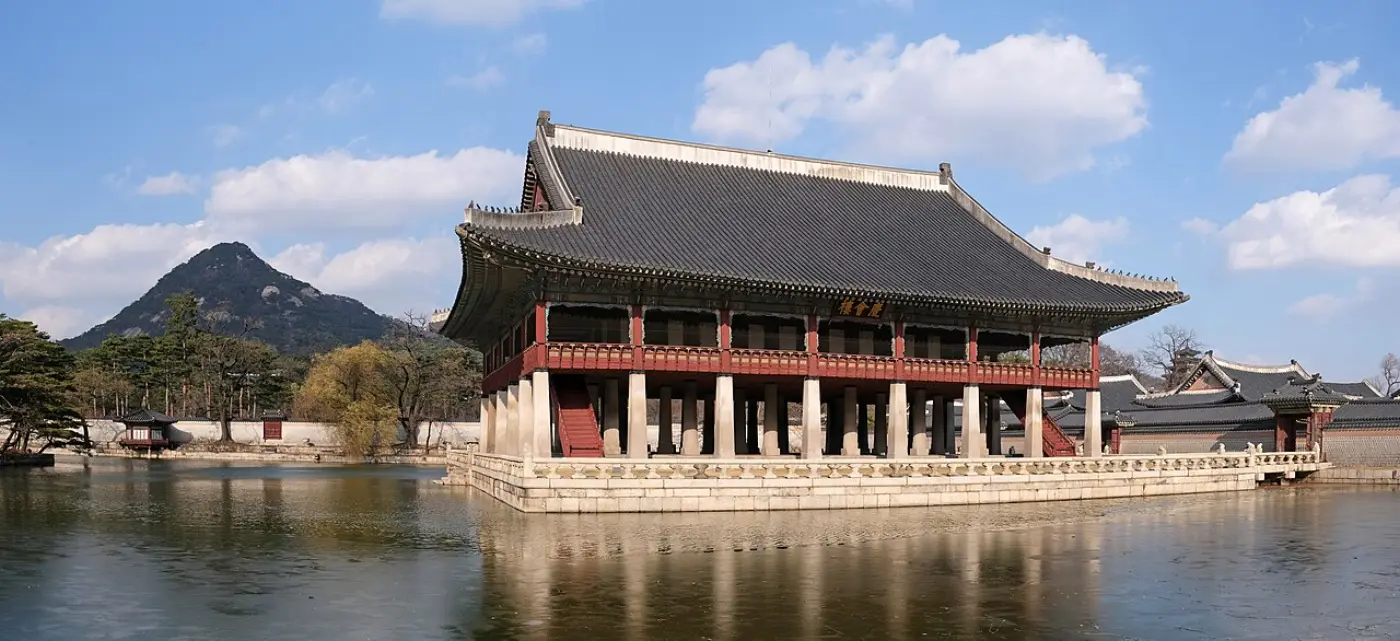
The Royal Palaces and Tombs Center explains that after the palace was lost in 1592 (the 25th year of King Seonjo), it remained unrestored until it was rebuilt in 1867 (the 4th year of King Gojong), more than 270 years later. Uriyeoksanet, run by the National Institute of Korean History, notes that proposals to rebuild came up repeatedly but were hard to realize because of the burden of such a large project and the difficulty of raising funds. The National Archives of Korea states that reconstruction began in 1865 (the 2nd year of King Gojong) under the direction of Heungseon Daewongun and was completed in 1868. The *Gyeongbokgung Yeonggeon Ilgi* recorded the daily progress of the works from April 1865 to July 1868. Uriyeoksanet reports that the project began by clearing away traces left untouched for roughly 300 years. The first task was to dig out the silt that had built up in the two ponds in the rear garden and at Gyeonghoeru and bring the ponds back.
The funds came from wonnapjeon contributions and dangbaekjeon coins. Uriyeoksanet records that on 4 April 1865 Heungseon Daewongun provided 30,000 nyang and the royal house put up 100,000 nyang from its privy purse, which set the contribution drive in motion in earnest. Wonnapjeon receipts exceeded 5 million nyang in 1865, but fell to 1 million nyang the next year and 600,000 nyang the year after that. The Academy of Korean Studies explains that the dangbaekjeon (當百錢) was a coin minted in November 1866 (the 3rd year of King Gojong) that circulated for a little over six months. Its shape and weight were five to six times those of the sangpyeongtongbo, yet it was minted to circulate at a face value 100 times greater. The Geumwiyeong (禁衛營) minted 16 million nyang between November 1866 and April of the following year.
Uriyeoksanet notes that the dangbaekjeon, inflated only in nominal value, threw prices into disarray. The same account reports that the collection of miscellaneous levies, including a toll for passing through the capital's gates, drew public resentment. It also records that timber shortages were met by felling trees in the forests of scholar-official burial grounds, which stirred anger among the yangban as well. The government halted minting of the dangbaekjeon in April 1867, and in October of the following year, prompted by a memorial from the censor Choe Ik-hyeon (崔益鉉), banned its circulation as well. The Construction Directorate was not dissolved until 1872 (the 9th year of King Gojong), even after opposition had grown. As for the workforce, the records show that 616,114 volunteers took part and that some 3,000 laborers worked for wages each day.
The 1915 exposition, the 1926 Government-General building, and demolition dates that differ by source
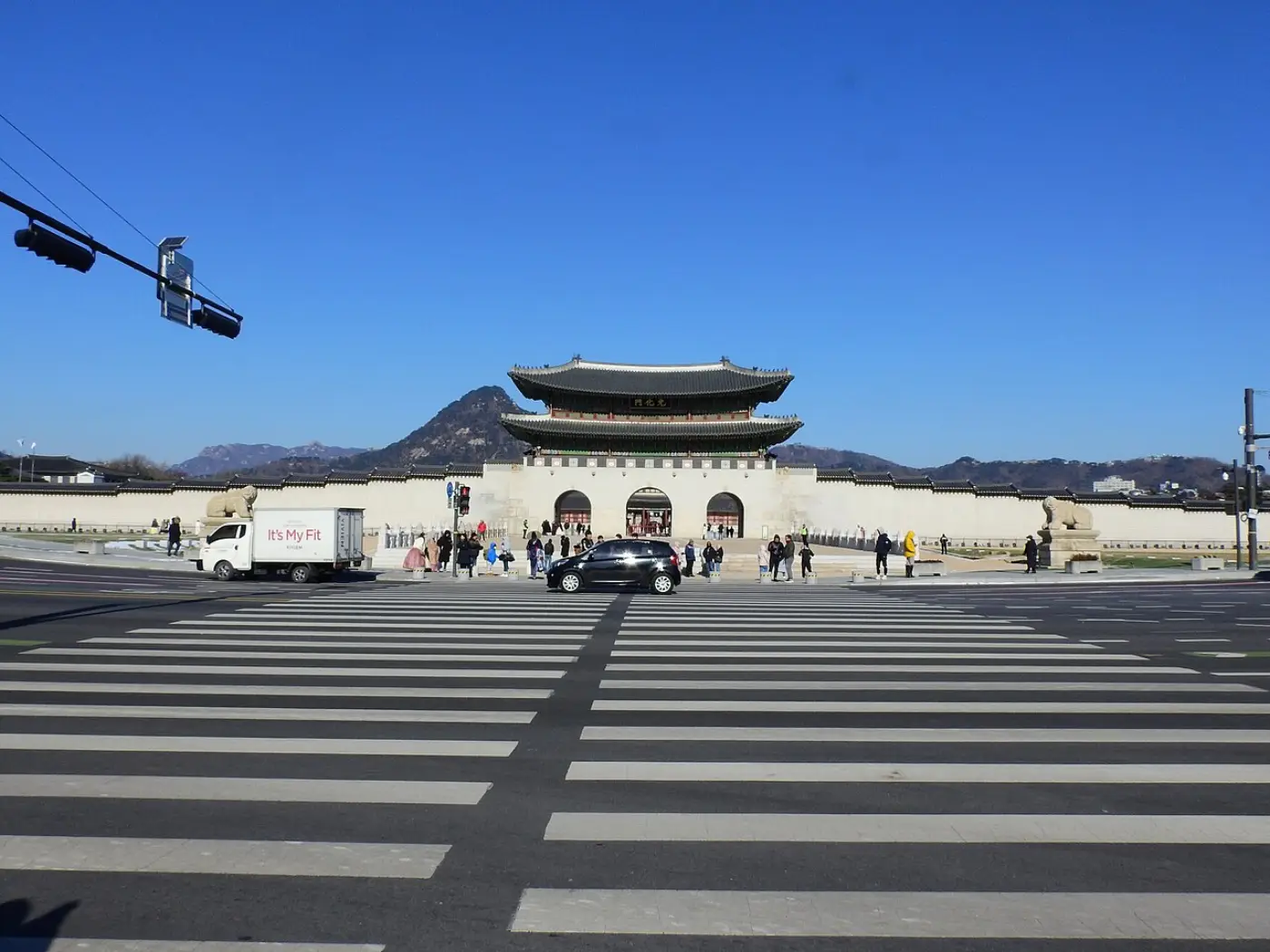
The Royal Palaces and Tombs Center explains that systematic destruction of Gyeongbokgung began after Japan's annexation of Korea in 1910. Most of the halls were pulled down on the pretext of staging the Joseon Industrial Exposition in 1915. The National Archives of Korea records that more than 4,000 bays of buildings were torn down at that time and 18 exhibition halls covering more than 5,200 pyeong were put up. The Japanese Government-General had used the Residency-General building erected at Waeseongdae on Namsan in 1907, then in 1926 built a new headquarters on ground cleared by demolishing the Heungnyemun area of Gyeongbokgung. When the building was completed, Gwanghwamun was moved to the east side of the palace and a plaza was laid out in front of the headquarters.
A separate record survives for Geoncheonggung. The Korea Herald reports that King Gojong drew on his personal funds to push the construction of Geoncheonggung forward, and that it was completed in 1873. The Royal Palaces and Tombs Center explains that Okhoru at Geoncheonggung was the site where Empress Myeongseong was assassinated in the Eulmi Incident of 1895. The Korea Herald likewise states that Japanese troops broke into Gyeongbokgung in 1895 and killed Empress Myeongseong at Geoncheonggung. The same article reports that Geoncheonggung was destroyed in 1909 and replaced by an art museum, and that it was restored in 2007.
Records differ in how much of the demolition and restoration timeline they cover. The Korean-language guide from the Royal Palaces and Tombs Center says the Government-General building was demolished between 1995 and 1997. The same institution's English-language guide says the building was demolished in 1996. The National Archives of Korea states that the demolition date was set for 15 August 1995, the 50th anniversary of liberation, and that demolition of the above-ground portion was finished on 13 November 1996. The National Archives also explains that the government launched the first phase of its restoration and maintenance project in 1990 as a 20-year plan, restoring 89 buildings covering 8,987 square meters by 2010. The three accounts can be read as describing different stages of the same undertaking.
| Year | Event | Source institution |
|---|---|---|
| 1395 (4th year of King Taejo) | Founding; foremost royal palace of the Joseon dynasty | Royal Palaces and Tombs Center, Korea Heritage Service; National Archives of Korea |
| 1592 | Gyeongbokgung, Changdeokgung and Changgyeonggung all destroyed by fire | National Institute of Korean History, Annals of the Joseon Dynasty (Revised Annals of King Seonjo) |
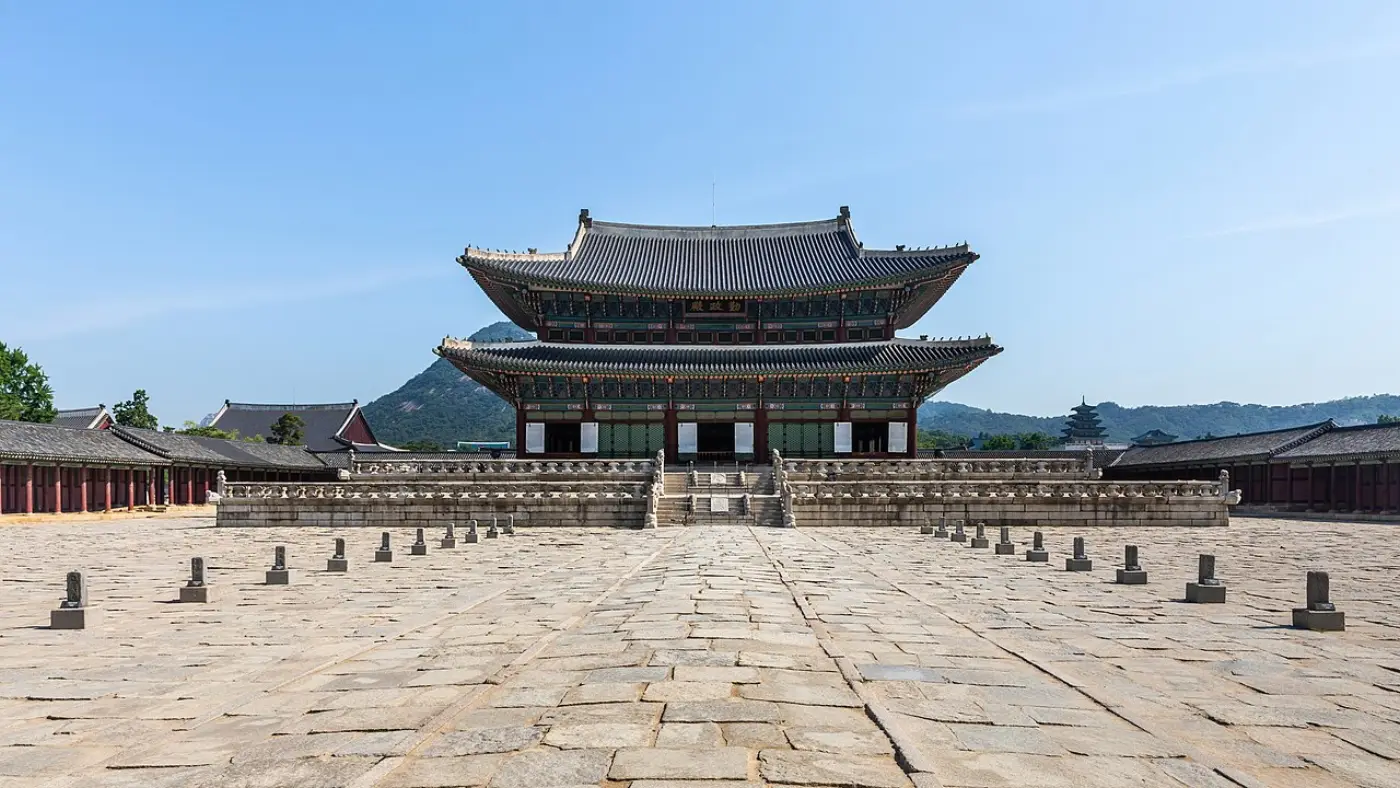
| 1867 (4th year of King Gojong) | Rebuilt after more than 270 years; ridge-beam ceremonies at Geunjeongjeon and Sajeongjeon | Royal Palaces and Tombs Center, Korea Heritage Service; Uriyeoksanet |
| 1915 | More than 4,000 bays demolished for the Joseon Industrial Exposition; 18 exhibition halls erected | National Archives of Korea (Ministry of the Interior and Safety) |
| 1926 | New Japanese Government-General headquarters built on the cleared Heungnyemun site | National Archives of Korea (Ministry of the Interior and Safety) |
| 1996 | Demolition of the above-ground portion of the Government-General building completed (13 November) | National Archives of Korea (Ministry of the Interior and Safety) |
In summary
Gyeongbokgung's history can be summed up as founding in 1395, destruction in 1592, rebuilding in 1867, damage in 1915 and 1926, and restoration from the 1990s onward. The individual years are spread across materials from the Royal Palaces and Tombs Center of the Korea Heritage Service, the National Institute of Korean History, the National Archives of Korea and the Academy of Korean Studies. This article conveys only what each institution has recorded. Any assessment beyond that cannot be confirmed from the sources used.
A visit to Gyeongbokgung today can be built around the halls whose names appear in the records. Geunjeongjeon and Sajeongjeon, where the ridge-beam ceremony took place in 1867; the Gyeonghoeru pond, brought back to life by dredging during the rebuilding; and Okhoru at Geoncheonggung, the site of the 1895 Eulmi Incident, are all examples. Records state that Gwanghwamun was moved eastward when the Government-General building was completed, so its location has a history of its own. Visitor information is available from the Gyeongbokgung Management Office (161 Sajik-ro, Jongno-gu, Seoul; 02-3700-3900). The original annals can be read in the Database of the Annals of the Joseon Dynasty at the National Institute of Korean History, and the records of the rebuilding on Uriyeoksanet.