The short answer: dancheong both protects and signals rank
Dancheong (丹靑) is decorative painting that protects the surfaces of wooden buildings and shows their grade and rank. The National Folk Museum of Korea's Encyclopedia of Korean Folk Culture states both purposes in a single sentence. The lowest grade, gachil dancheong, applies only base colors; the highest, geum dancheong, went mainly on main Buddha halls.
This article covers dancheong's purposes, the five colors and the Five Elements, its grades and where each was used, the process and pigments, the artisans, and its relationship to China and Japan. It draws on the Academy of Korean Studies' Encyclopedia of Korean Culture, the Encyclopedia of Korean Folk Culture, the Korea Heritage Service's description and the English Wikipedia article "Dancheong." Because these sources do not confirm the detailed styles of Chinese xuanzi caihua (旋子彩画) or Japanese temple painting, the comparisons stay within what they say.
Dancheong's main purpose: protecting the wood
The Encyclopedia of Korean Culture traces dancheong's origins to wood itself, saying it developed as a way to offset the weaknesses of timber and make it last longer. The Encyclopedia of Korean Folk Culture is more specific: dancheong's main purpose "lies in protecting the wood surface from rain, wind, insects and the like to increase its durability." The passage matters because it defines dancheong first as a protective coating and only then as a picture.
The same sentence continues: "At the same time, there is also the purpose of showing the building's grade and rank and decorating it majestically." The key phrase is "at the same time," which can be read to mean that protection and the display of rank work together rather than one after the other. The Korea Heritage Service takes a similar view, describing dancheong as a surface coating that compensates for the weaknesses of wood while expressing a building's dignity and sanctity. English Wikipedia adds that dancheong protects surfaces from temperature and makes rough patches in the material less visible.
Early forms of dancheong also survive. The Encyclopedia of Korean Folk Culture points to Anak Tomb No. 3, built in 357 (27th year of King Gogugwon), whose stone chamber walls and ceiling show the painted columns, bracket sets and lintels of a wooden building. The encyclopedia calls this "a very precious example in which the dancheong style of wooden architecture of the time can be seen as it was." Because the decoration of a timber building was painted inside a stone tomb, the painting can be seen as a record of dancheong in that period. The earliest dancheong on actual buildings survives in late Goryeo architecture, including Geungnakjeon Hall at Bongjeongsa Temple, Muryangsujeon Hall and Josadang Hall at Buseoksa Temple, and Daeungjeon Hall at Sudeoksa Temple.
The five colors and the Five Elements
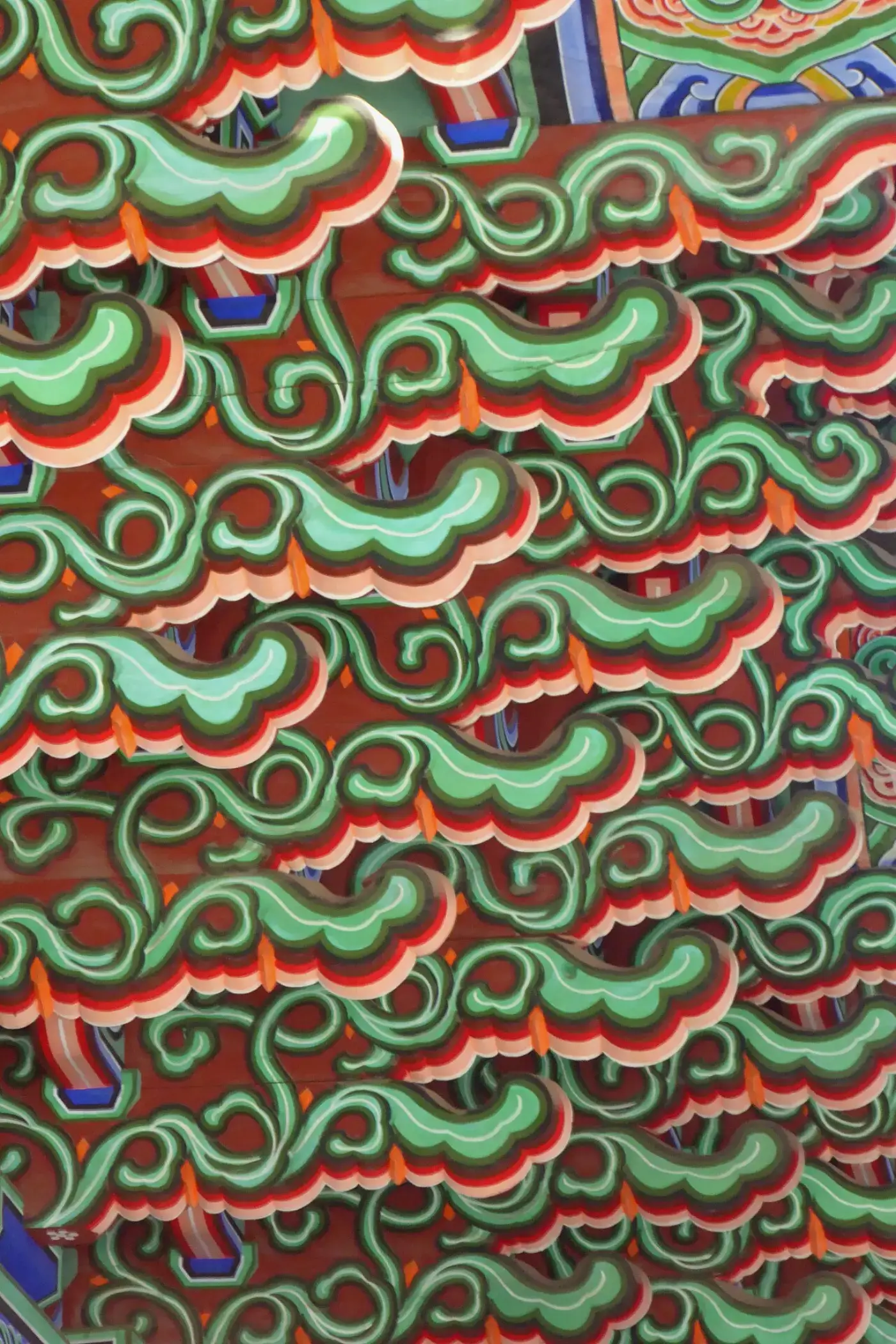
The word dancheong combines dan (丹, red) and cheong (靑, blue-green), but a two-color name does not mean only two colors are used. As the Encyclopedia of Korean Folk Culture puts it: "In fact, dancheong is based on five colors—blue, red, yellow, white and black—that is, the five colors (五彩, ochae)." The name, in other words, differs from the actual color system. The Korea Heritage Service likewise defines dancheong as patterns and pictures drawn in five basic colors.
The same encyclopedia grounds the five colors in philosophy: "This is rooted in the Five Elements (五行) thought and means that dancheong is very closely connected with colors, directions, seasons, sacred animals (神獸) and so on." The colors, then, were not chosen for decorative taste alone; they belonged to an order that included direction and season. English Wikipedia spells out the directional pairings: blue with east, white with west, red with south, black with north and yellow with the center. The sources do not confirm the specific pairings with seasons and sacred animals.
On actual buildings, the color that stands out most may be green. English Wikipedia explains that Joseon-era dancheong typically used green as the base, with elaborate patterns in contrasting colors painted over it. These sources say nothing more about how the five basic colors relate to the green base, but the separate documentation of a green pigment, noerok, hints at how important the base color was.
Gachil, geutgi, moro and geum: how the two encyclopedias divide the grades
The Encyclopedia of Korean Folk Culture sets out four grades: "The grades of dancheong are broadly divided into four: gachil dancheong (假漆丹靑), geutgi dancheong, moro dancheong (毛老丹靑) and geum dancheong (錦丹靑)." The Encyclopedia of Korean Culture counts differently, saying dancheong styles from the 17th century to the present can be divided into five grades and eight types. The difference in counting suggests that the grading system is not a single fixed list. This source does not name the eight types.
The lowest grade is gachil dancheong, whose main aim, according to the Encyclopedia of Korean Culture, is to make building members last. It is "finished by applying only two or three colors two or more times, without painting any lines or patterns at all." Strip away every pattern, in other words, and the protective paint remains as dancheong's most basic layer. The grades are thus defined by how much decoration is added on top of that protection.
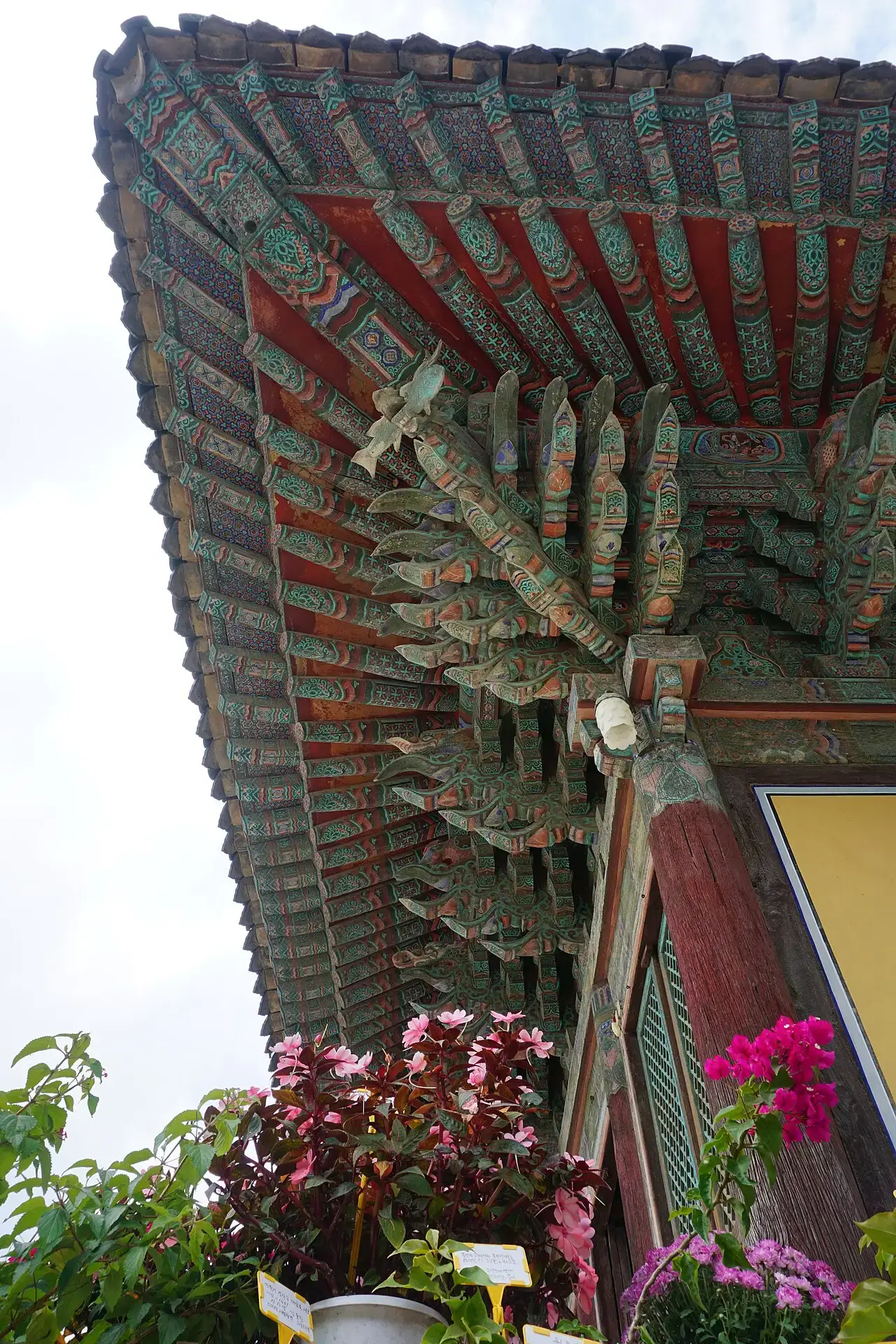
The highest grade is geum dancheong, which the Encyclopedia of Korean Folk Culture subdivides into eolgeum dancheong and gajeun geum dancheong. Eolgeum dancheong is a simplified intermediate stage between geum and moro dancheong, with less decoration; gajeun geum dancheong is more ornate and three-dimensional than geum dancheong. The Encyclopedia of Korean Culture also introduces geummoro dancheong, which places meoricho (end motifs) at both ends of horizontal members and fills the center with geum patterns. According to English Wikipedia, moro-cho patterns are painted mostly at edges such as beam ends and eaves, and depict natural forms such as water lilies, pomegranates and feathers.
Dancheong grades on palaces, temples and Confucian buildings
Geum dancheong is described as being used on temple buildings. The Encyclopedia of Korean Folk Culture says it "is used mainly on the main Buddha halls of temples that enshrine the Buddha, such as Daeungjeon, Geungnakjeon and Birojeon." The word "mainly" describes typical use; the passage does not say whether it appeared on other buildings. English Wikipedia also mentions temple decoration: byeoljihwa, painted between moro-cho patterns, depict auspicious animals or scenes from Buddhist scriptures. Wikipedia says they were used mainly in temples and not on palace buildings.
Moro dancheong, also called meori dancheong, is linked to the principal buildings of palaces and Confucian institutions. The Encyclopedia of Korean Folk Culture says it was used mainly on the principal buildings of palaces, hyanggyo (local Confucian schools) and seowon (private academies), while the Encyclopedia of Korean Culture describes it as the style painted on the exterior of almost every building in Joseon palaces. The two encyclopedias differ slightly on the middle section: the Encyclopedia of Korean Folk Culture says it is finished with geutgi lines after the base coat, while the Encyclopedia of Korean Culture says the center receives only gachil.
Sometimes a lower grade was chosen on purpose. The Encyclopedia of Korean Folk Culture states: "Geutgi dancheong, together with gachil dancheong, is also used in Confucian architecture to express frugality, solemnity and the like." A lower grade, then, does not necessarily mean a less important building. The Encyclopedia of Korean Culture likewise cites exceptions: some halls of the highest rank were finished in gachil dancheong. Because these were "buildings symbolizing solemnity and frugality, all pattern decoration was excluded," the encyclopedia explains, and only a limited range of colors was used. The passage does not say which buildings these were. In such cases, the dancheong grade can be seen as reflecting not only a building's rank but also the character it was meant to express.
Chulcho, cheoncho and tacho: the dancheong painter's process
The Encyclopedia of Korean Folk Culture sums up the sequence in one sentence: "The application of dancheong proceeds in the order of posu and base coating; chulcho, cheoncho and tacho; and dochae and protective coating." The work falls into three stages: preparing the ground, transferring the patterns, and applying and protecting the color. The passage does not explain what posu involves.
Patterns are transferred with paper stencils. In the encyclopedia's words, "Transferring the designed draft (草圖) onto pattern paper (草紙) is called 'chulcho (出草).'" Piercing holes along the outlines with a large needle is called cheoncho (穿草). Finally, the painter holds the paper pattern against the dried gachil surface and taps it with a powder bag, so that "the outline of the pattern comes through the holes as a dotted line of white powder, and this is called 'tacho (打草).'" Since one stencil can print the same pattern on many members, the method can be seen as well suited to repeating motifs.
The Korea Heritage Service describes the same sequence in different terms. Painters brush a thin, boiled mixture containing animal glue onto the surface and repeat gachil five times to prepare the ground. Next comes cheongto-bareugi, coating the whole surface with blue-green earth. After the powder-tapping work (打粉作業), the five colors—blue, red, yellow, white and black—go on in mineral pigments. The artisans "each seek out only the color assigned to them and fill in the sections to finish the dancheong," so coloring was divided among them by color. The Encyclopedia of Korean Folk Culture adds that once the coloring is done, refined vegetable oil is spread evenly over the painted surface to protect it.
Pigments and repairs are documented as well. According to the Encyclopedia of Korean Culture, the green pigment noerok was a mineral pigment produced only in Korea, best known from Noeseongsan Mountain in Janggi-hyeon, Gyeongsang-do, and chemically synthesized inorganic pigments began entering Korea in the 19th century. English Wikipedia distinguishes two repair techniques: gosae dancheong repaints the entire building, while gosaekttaem dancheong paints only recently damaged areas.
Seongonggam artisans and monk painters: the people behind dancheong
The Encyclopedia of Korean Culture defines a dancheongjang (丹靑匠) as an artisan who paints structural members such as ceilings, columns and walls in the five directional colors and draws patterns and pictures on them. The Korea Heritage Service lists several names for people in the trade: dancheongjang, hwasa, hwawon, hwagong, gachiljang and dochaejang. Dancheong itself goes by other names too, including danbyeok, danrok, jinchae, dangchae, ochae, hwachae and danchil. According to the Encyclopedia of Korean Culture, dochaejang handled palace dancheong and the coloring of various objects.
We also know who was in charge of palace dancheong. The Encyclopedia of Korean Culture says that in the Joseon period it was carried out mainly by gyeonggongjang (京工匠), capital-based artisans attached to the Seongonggam (繕工監), the office of public works. Yet the same encyclopedia cites cases involving monk artisans. When Jeoseungjeon Hall (儲承殿) at Changgyeonggung Palace was rebuilt in 1647 (25th year of King Injo), 66 monk dancheong painters worked on it under Dohwaseo court painter Kim Myeong-guk (金明國). And "in the dancheong of Hwaseong Fortress in Suwon, completed in 1796 (20th year of King Jeongjo), monks accounted for 40 of the 46 dancheong painters." These two cases suggest that monks made up a large share of the workforce on palace and fortress dancheong.
Monk artisans had their own hierarchy. The Encyclopedia of Korean Culture explains that among temple painters, those who painted Buddhist paintings were held in the highest regard, while those who did only dancheong were valued less. "In particular, monks skilled in Buddhist painting were called geumeo (金魚), and monks who simply worked on dancheong were called eojang (魚杖)," it writes. Though both were painting work, Buddhist painting and dancheong carried different titles and status. The source does not say when this distinction came into use.
Dancheong and its neighbors: Chinese danqing, xuanzi caihua and Japanese temple painting
English Wikipedia describes dancheong as an adoption of the Chinese practice of danqing, which in China refers both to painting on silk and paper and to wooden decoration. Dan (丹), it says, refers to the red mineral pigment dansha (丹砂), and qing (青) to the blue-green mineral pigment qinghuo (青雘). Wikipedia also says the term 丹青 is recorded in the Rites of Zhou (周礼), a Chinese text written between 300 and 200 BCE.
The Korea Heritage Service describes dancheong's geographic reach this way: "Dancheong was popular in Korea, China and Japan, where Buddhism or Confucianism flourished, but Korea is the only country where the tradition of dancheong culture continues to this day." The statement acknowledges dancheong as a culture shared by three East Asian countries. It does not, however, explain what counts as the tradition "continuing," nor does it describe present-day examples in China and Japan.
Within the limits of these sources, the comparison runs as follows. First, the name: Wikipedia explains that Korean dancheong and Chinese danqing use the same Chinese characters. Second, scope: Wikipedia's Chinese danqing covers both silk and paper painting and wooden decoration, while the Korea Heritage Service defines Korean dancheong in terms of patterns and pictures on palaces, temples and shrines. Third, grades: Korean sources rank dancheong from gachil to geum dancheong, but these sources do not confirm the grades or pattern system of Chinese xuanzi caihua. Fourth, Japan: the only evidence is the Korea Heritage Service's statement that dancheong was popular there, and the styles of Japanese temple painting remain unconfirmed.
| Grade | How it is painted | Main buildings | Source |
|---|---|---|---|
| Gachil dancheong | Base colors only, with no lines or patterns; two or three colors applied two or more times | Temple living quarters, side gates of palaces and royal tombs, ordinary houses | Encyclopedia of Korean Folk Culture, Encyclopedia of Korean Culture |
| Geutgi dancheong | Painting method not separately explained in these sources | Used with gachil dancheong in Confucian architecture to express frugality and solemnity | Encyclopedia of Korean Folk Culture |
| Moro dancheong | Patterns only at the ends of members; the middle is either finished with geutgi lines after the base coat or given gachil only | Principal buildings of palaces, hyanggyo and seowon; exteriors of almost all Joseon palace buildings | Encyclopedia of Korean Folk Culture, Encyclopedia of Korean Culture |
| Geum dancheong | Highest grade; subdivided into eolgeum dancheong and gajeun geum dancheong | Mainly main Buddha halls of temples, such as Daeungjeon, Geungnakjeon and Birojeon | Encyclopedia of Korean Folk Culture, Encyclopedia of Korean Culture |
Related reading: Why Tuho Was Called Not Play but an Instrument for Ordering the Mind · Gakgung: How Korea's Traditional Horn Bow Differs From Other Traditional Bows
Conclusion
Dancheong unites a protective coating for timber with decoration that displays a building's rank. The lowest grade, gachil dancheong, keeps only the protection, while moro and geum dancheong add patterns on top. Yet, as Confucian buildings show, a lower grade was sometimes chosen to express solemnity and frugality. Dancheong grades can therefore be seen as clues not only to cost or rank but to a building's character.
Readers can find the passages quoted here in the Academy of Korean Studies' Encyclopedia of Korean Culture, the National Folk Museum of Korea's Encyclopedia of Korean Folk Culture and the Korea Heritage Service website's description of dancheong. The English Wikipedia article "Dancheong" covers the pairing of colors and directions and the relationship with Chinese danqing in English. The two encyclopedias differ slightly on the number of grades and on how the middle section of moro dancheong is treated; opening the entries side by side makes these differences easy to check.