The short answer: from a palace for queen dowagers to Changgyeongwon and back again
Changgyeonggung is a palace that King Seongjong expanded to house three queen dowagers. During the Japanese colonial period it became Changgyeongwon, and in 1983 it regained the name Changgyeonggung. In between, in 1762, King Yeongjo deposed the crown prince. Many sources identify Munjeongjeon Hall in Changgyeonggung as the place where this prince, known as Crown Prince Sado, died. This article is Part 3 of a seven-part series.
Four years sum up the palace's history: 1418, Suganggung; 1483, Changgyeonggung; 1911, Changgyeongwon; and 1983, the return of its name. Together they trace a palace that swung back and forth between royal residence and pleasure ground. That is why traces of both eras survive there today.
Suganggung in 1418 and Changgyeonggung in 1483: the Royal Palaces and Tombs Center's account
Suganggung (壽康宮) originally stood on the site of Changgyeonggung. According to the Royal Palaces and Tombs Center of the Korea Heritage Service, King Sejong built it in 1418 for the retired King Taejong. In 1483 (the 14th year of his reign), King Seongjong greatly expanded Suganggung to house three queen dowagers. He named the enlarged palace Changgyeonggung. The three were Queen Jeonghui, wife of King Sejo; Queen Sohye, wife of King Deokjong; and Queen Ansun, wife of King Yejong.
The palace burned down during the Japanese invasion of 1592 and was rebuilt in 1616 (the 8th year of Gwanghaegun's reign). In 1830 (the 30th year of Sunjo's reign), a great fire destroyed most of its buildings. They were rebuilt four years later.
Sources differ slightly on the founding year. The Royal Palaces and Tombs Center and the Encyclopedia of Korean Culture, published by the Academy of Korean Studies, give 1483. The National Archives of Korea, under the Ministry of the Interior and Safety, dates the name change to 1484, the 15th year of Seongjong's reign. In its account, Suganggung was renovated that year to house Queen Ansun. Whichever year one follows, the sources agree that the palace began as a residence for queen dowagers. To compare it with another palace, read this alongside Part 1 of the series, on the history of Gyeongbokgung Palace.
The Annals of King Yeongjo: the 1762 entry for the 13th day of the leap fifth month, and Munjeongjeon
The Annals of King Yeongjo, the part of the Annals of the Joseon Dynasty covering his reign, describe the events of the 13th day of the leap fifth month in his 38th year (1762). The king went to Changdeokgung, deposed the crown prince and reduced him to a commoner (庶人). He then had the prince strictly confined within the palace. The crown prince met the king outside Jibyeongmun Gate (集英門) and followed the royal procession to Hwiryeongjeon Hall. The king ordered him to remove his headgear, go barefoot and bow his head to the ground. He then pressed the prince to take his own life.
The same entry contains this passage: "The king then issued a royal decree and proclaimed (頒示) it at court and throughout the country, but the historians (史官) were reluctant and dared not write it down." A translation of the entry is available on the Annals of the Joseon Dynasty website, run by the National Institute of Korean History.
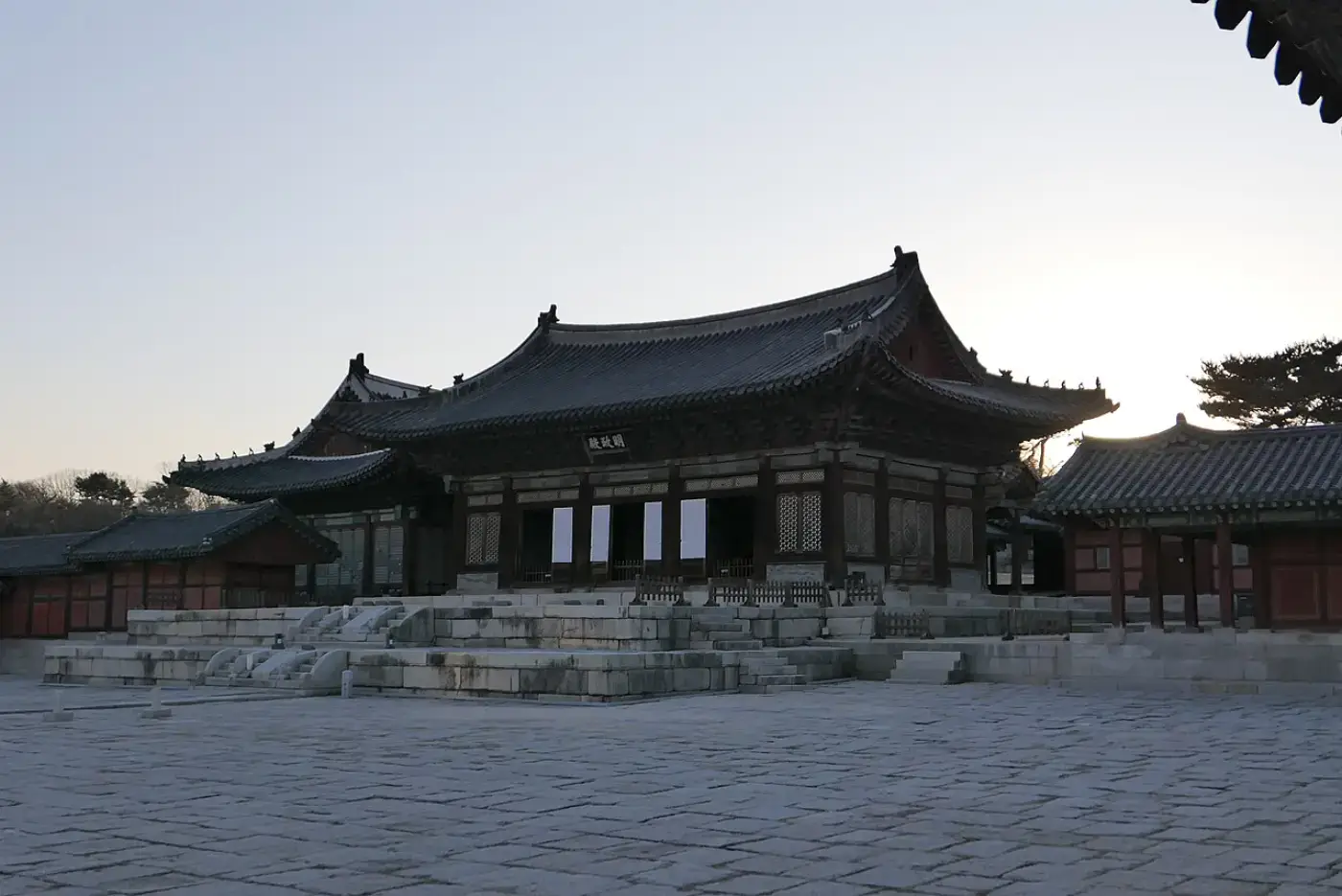
This passage can be read as the record itself acknowledging that the Annals did not preserve the content of the king's order. Other sources supply the place and the outcome. The National Archives describes Munjeongjeon as the place where Crown Prince Sado was locked in a rice chest and met a tragic death. The Korea Times and the Korea JoongAng Daily write that he died eight days after being shut in the chest. The quoted passage of the Annals, however, names Hwiryeongjeon, and the sources consulted for this article do not establish how Hwiryeongjeon relates to Munjeongjeon. The discrepancy is a reminder to distinguish the hall names in the Annals from those on today's signs.
Changgyeongwon from 1911: night cherry blossom viewing from 1924 and the 1909 Grand Greenhouse
In the early 20th century, Changgyeonggung stopped being a palace and became a park. The Encyclopedia of Korean Culture says that from 1907 most of its buildings were torn down. A zoo and a botanical garden were built and opened to the public. The Korea JoongAng Daily gives a different year. It writes that in 1909 the Japanese colonial authorities demolished part of the palace and built a zoo, a botanical garden and a museum. In 1911 the palace was demoted in name to Changgyeongwon. The Royal Palaces and Tombs Center writes the name in Chinese characters as 昌慶苑; the Encyclopedia of Korean Culture uses 昌慶園. The National Archives reports that more than 60 halls and walls were demolished or altered.
According to Weekly Kyunghyang, Changgyeongwon became a famous cherry blossom spot from 1918, once the trees had grown. From the 1924 blossom season onward, it opened at night every year. The Korea JoongAng Daily says 150,000 people visited during one week in April 1924. The National Archives reports an average of 250,000 visitors a day on weekends in April 1971. It adds that 918 children went missing during the 1972 cherry blossom season. These figures show that for a long time the place was remembered more as an amusement park than as a palace.
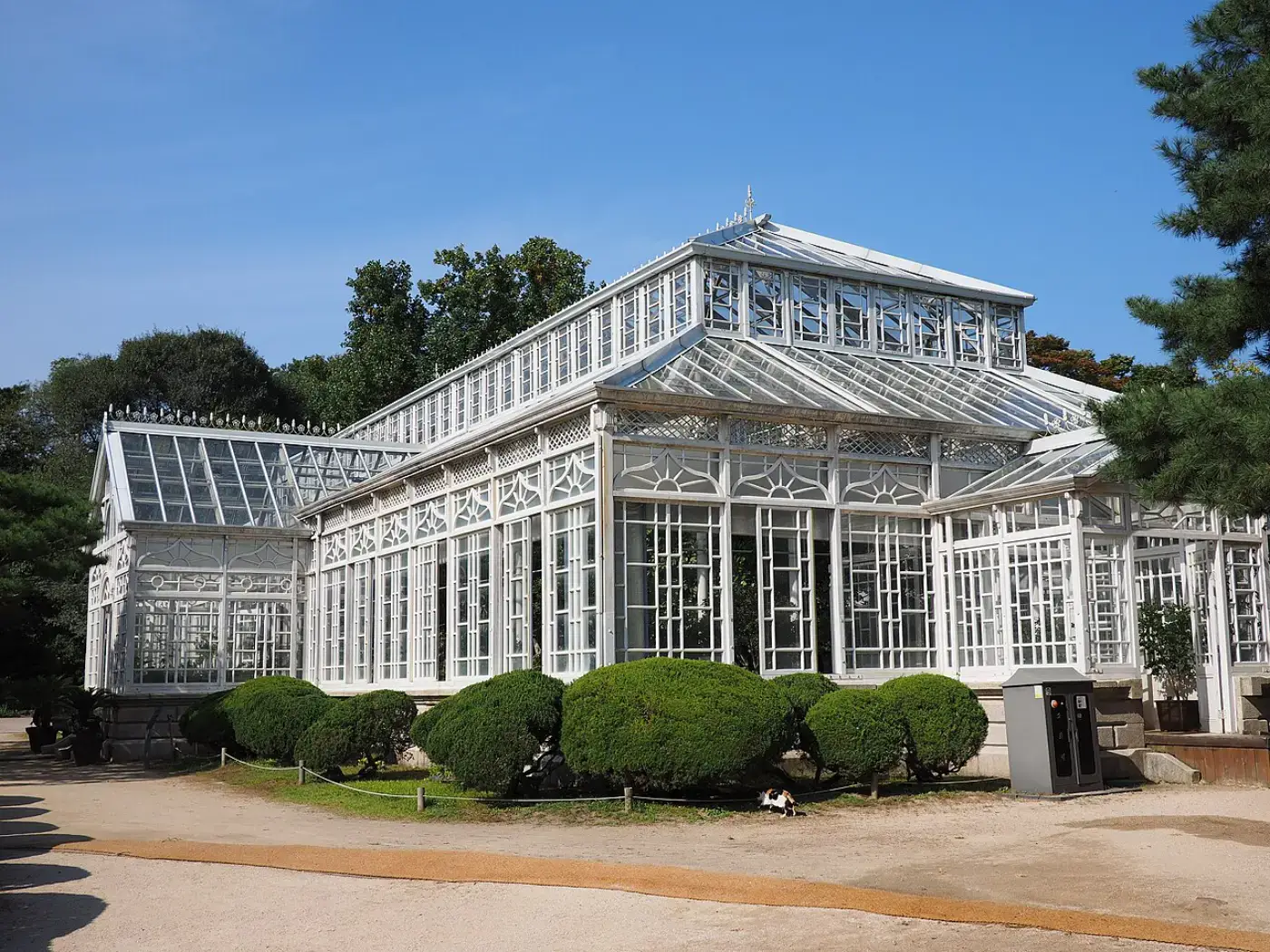
The Grand Greenhouse also dates from this period. The Korea Heritage Service describes it as Korea's first Western-style greenhouse, built in 1909. Its steel frame is combined with timber, and its exterior is clad in glass. It covers 582.3㎡ and stands 10.5m tall. According to The Korea Herald, Fukuba Hayato, head of the Shinjuku Imperial Garden, designed it, and a French company built it. The greenhouse is one Changgyeongwon-era facility that survives to this day.
1983 and after: the name restoration, the 1986 restoration work and today's visitor route
In 1983 Changgyeonggung regained its original name. That same year, according to the National Archives, the Office of Cultural Properties announced a restoration plan. The Royal Palaces and Tombs Center says the zoo was then relocated and the palace restored to its original form. The National Archives dates the completion of the restoration work to August 23, 1986. The Grand Greenhouse escaped demolition, and in 2004 it became Registered Cultural Heritage No. 83. The Korea Herald reported that it reopened in November 2017 after 15 months of renovation.
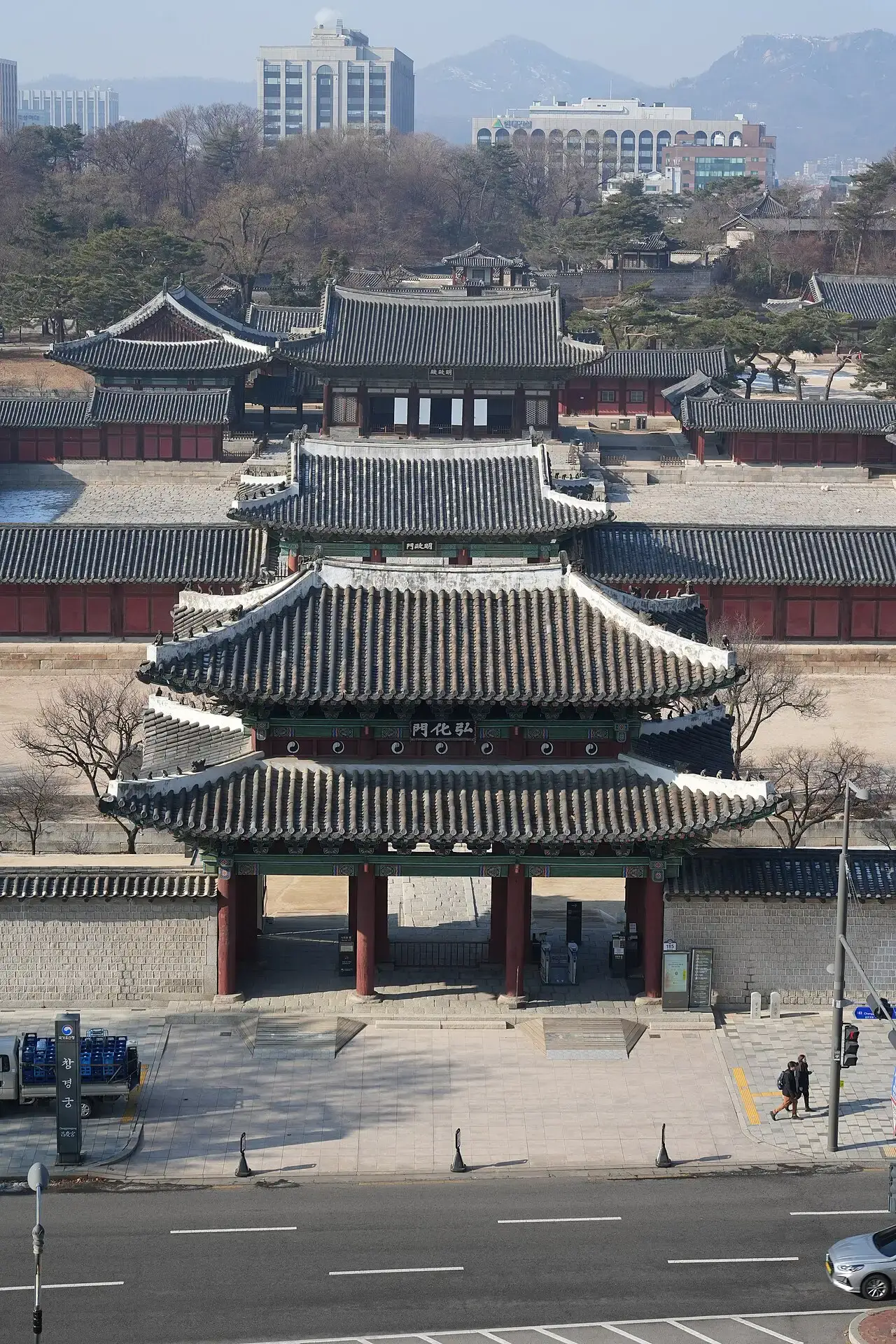
A visit begins at Honghwamun, the main gate. Beyond it, visitors cross Okcheongyo Bridge over the Ongnyucheon stream to reach Myeongjeongmun Gate and its corridors. According to the Royal Palaces and Tombs Center, Changgyeonggung's main gate and main hall face east, unlike those of other palaces, which face south. The Encyclopedia of Korean Culture identifies Myeongjeongjeon, Myeongjeongmun and Honghwamun as the oldest axis among surviving palace buildings. The Korea Times writes that Munjeongjeon faces south and was restored in 1986 together with Munjeongmun Gate.
This route takes visitors through both eras described above. Honghwamun and Myeongjeongmun are old buildings, while Munjeongjeon is a 1986 reconstruction. Even within a single palace, then, each building has its own history.
| Year | Event | Source |
|---|---|---|
| 1418 | King Sejong builds Suganggung for the retired King Taejong | Royal Palaces and Tombs Center, Korea Heritage Service |
| 1483 (1484 according to the National Archives) | King Seongjong expands Suganggung for three queen dowagers and names it Changgyeonggung | Royal Palaces and Tombs Center; National Archives of Korea |
| 1762 | King Yeongjo deposes the crown prince and reduces him to a commoner (13th day of the leap fifth month) | National Institute of Korean History, Annals of the Joseon Dynasty |
| 1911 | Palace demoted in name to Changgyeongwon | Royal Palaces and Tombs Center; Encyclopedia of Korean Culture |
| 1983 | Changgyeonggung name restored; Office of Cultural Properties announces a restoration plan | Royal Palaces and Tombs Center; National Archives of Korea |
| 1986 | Restoration work completed (August 23) | National Archives of Korea |
Summary
Sources disagree on some of Changgyeonggung's dates. For the founding, the Royal Palaces and Tombs Center gives 1483 and the National Archives 1484. For the zoo, the Encyclopedia of Korean Culture says from 1907, while the Korea JoongAng Daily says 1909. For the Grand Greenhouse, the Korea Heritage Service gives 1909 and The Korea Herald 1907. Rather than memorizing a single year, note which institution's record each date comes from.
Comparing the hall names in the Annals, such as Hwiryeongjeon, with the Munjeongjeon shown to visitors today highlights how historical records and modern visitor routes complement each other. On site, look at the courtyard in front of Munjeongjeon and then at the Grand Greenhouse. Seeing the two together conveys the distance between the two eras.