1. Clocks are set by parliaments, not by the sun
The Earth turns once in 24 hours, and solar time shifts by one hour every 15 degrees of longitude. That simple arithmetic is the starting point of the world’s time-zone system. As a 2023 Al Jazeera explainer puts it, the global time-zone system was “confirmed” by “the world’s colonial powers … during a conference in the US in 1884,” and modern timekeeping has its roots in the colonial era. Yet the boundaries on a time-zone map are almost never straight lines 15 degrees apart. They bend along borders, one country folds five zones into one, and some states deliberately offset their clocks by 30 or 15 minutes to look different from their neighbours.
This article reads time zones as products of politics rather than geography: countries that invoked a single time to speak of unity (China, India), a country that moved its clocks to match an ally (Spain), a country that deleted a day to match its trading partners (Samoa), the Korean peninsula, where 30 minutes shifted as a memory of colonization and as a signal of reconciliation, and the United States and Europe, which fixed summer time in law and then tried to abolish it, only to stop short. Every case rests on official legal texts and verifiable reporting.
2. China: five zones, one clock, two daily lives
China stretches across five time zones from east to west, but its official time is one. According to the Al Jazeera explainer, a single zone has practical and economic advantages, but “the impetus for standardisation was more about a signal the Chinese Communist Party wanted to send when it came to power in 1949.” In the words of the scholar quoted, “the Chinese state did not exercise full control over China before 1949, but the Communists sought to change that in order to consolidate and legitimise their power,” and controlling time became part of an official narrative about a united China.
The price is paid at the western edge. Urumqi, Xinjiang’s main city, “is geographically two hours behind Beijing,” and a Uyghur woman who grew up outside Kashgar remembers watching the summer sun set “at about midnight.” One Uyghur interviewed by Al Jazeera recalls that at university in Urumqi in the 1980s and 1990s, when class times were listed only in Beijing time, some Uyghur students “deliberately arrived two hours late,” because of “the belief that Xinjiang time should be used in Xinjiang.” Where the official clock and the sun are two hours apart, which clock you follow becomes a question of identity rather than of scheduling. India made a similar choice: the same explainer reports that on independence in 1947 India “abolished Mumbai time and Kolkata time and made Indian time the only official time,” and explains that Nepal came to have its own quarter-hour zone by taking the sacred Mount Gaurishankar, east of Kathmandu, as its reference.
3. Spain: why clocks moved in 1940 have not moved back
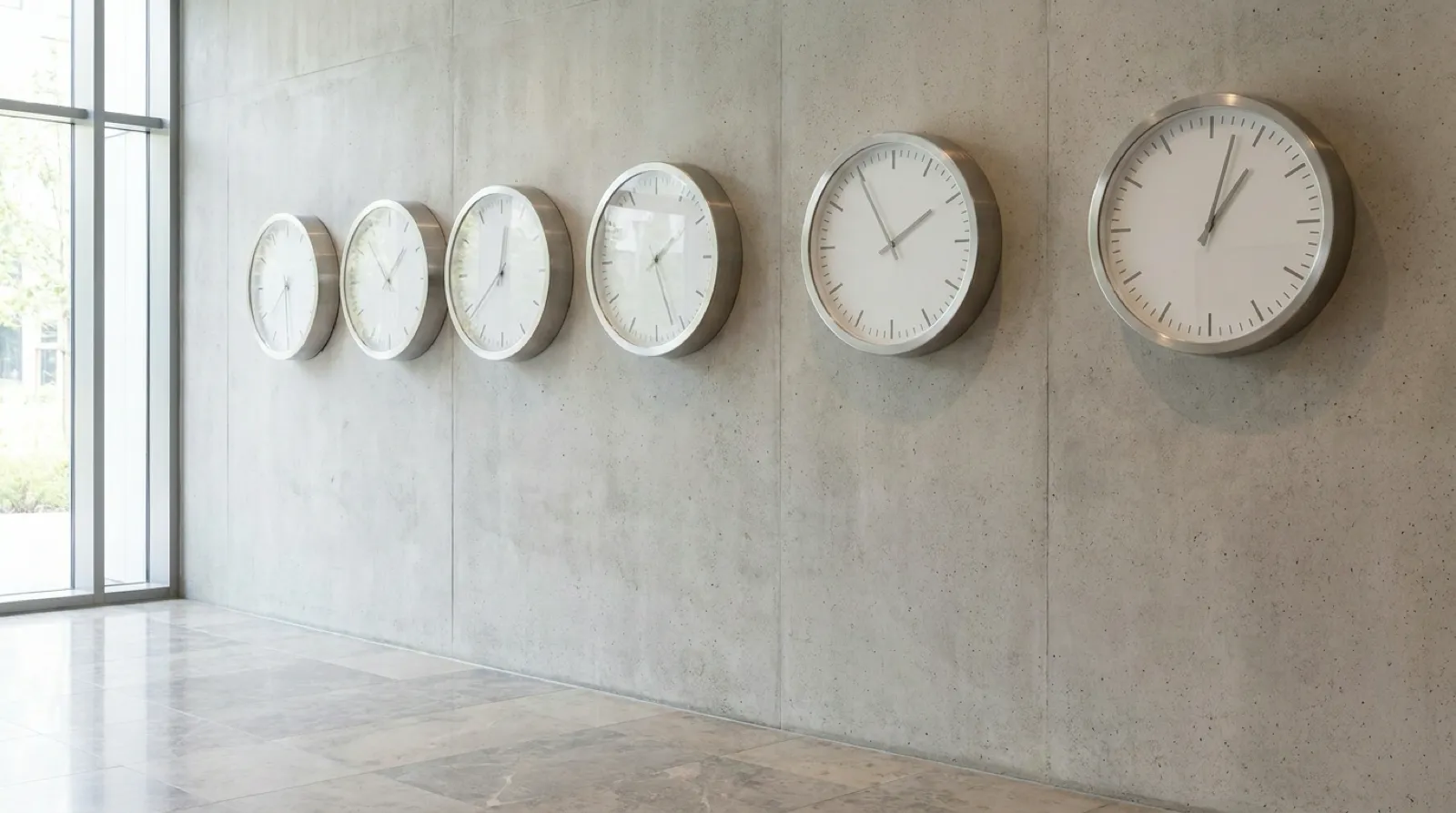
Geographically, Spain lies on the same longitudes as Britain, Portugal, and Morocco. Its clocks, however, agree with Poland and Hungary. A 2013 NPR report compresses the reason into one year: “It was 1940 and World War II was raging.” In the year Nazi Germany occupied Norway, Holland, Belgium, and France, Spain’s dictator Franco “stayed neutral, but switched Spain’s clocks ahead one hour, to be in line with Nazi Germany.” “Ever since, even though Spain is geographically in line with Britain, Portugal and Morocco — its clocks are on the same time zone as countries as far east as Poland and Hungary.”
More than seven decades later the Spanish government weighed changing them back. A business-school professor interviewed by NPR argued that Spain should return to Greenwich Mean Time, “the time zone it was on before Franco changed it in the early 1940s,” blaming late schedules and short sleep for lost productivity and strained family life. But the clocks still have not moved. Spain shows that a time-zone change can be made overnight by one dictator’s decision, while undoing it requires a democratic consensus that can take decades. Clocks are easier to move than to move back.
4. Samoa: the country with no 30 December 2011
The most dramatic form of time-zone change is crossing the International Date Line. On 30 December 2011 the BBC reported: “Samoa and Tokelau have skipped a day - and jumped westwards across the international dateline. … As the clock struck midnight at the end of 29 December, Samoa and Tokelau fast-forwarded to 31 December, missing out on 30 December entirely.” Samoa had announced the decision in May “in a bid to improve ties with major trade partners Australia and New Zealand,” and neighbouring Tokelau decided in October to follow.
The prime minister’s explanation shows that time zones are a matter of economic geography. “While it’s Friday here, it’s Saturday in New Zealand, and when we’re at church on Sunday, they’re already conducting business in Sydney and Brisbane.” After the change, Samoan businesses could reach New Zealand and Australia for “five working days of continuous contact.” The BBC adds that the change came “119 years after Samoa moved in the opposite direction”: in the nineteenth century the islands went east of the Date Line for trade with the United States, and in the twenty-first they came back west for trade with Oceania. The same islands gained and lost a day twice not because of where they lie but because of whom they trade with.
5. The Korean Peninsula: 30 minutes moved twice
Korea’s standard-time history overlaps with its history of sovereignty. According to a summary in the Kyunghyang Shinmun, Korea first adopted standard time on 1 April 1908, when “the standard meridian was 127°30′E, passing through the centre of the peninsula.” After annexation, “from 1 January 1912 the Government-General applied Japan’s central standard time (135°E) to all of Korea.” In 1954 the government moved back to 127°30′E “to clear away the vestiges of Japanese rule,” but not for long: “at midnight on 10 August 1961, ‘30 minutes’ vanished in an instant in Korea,” as “11:30 p.m. on the 9th became midnight on the 10th in the blink of an eye.” Since then Korea has kept 135°E time, nine hours ahead of Greenwich, with no time difference from Japan.
North Korea moved the same 30 minutes in the opposite direction, twice. The BBC reported in August 2015 that North Korea had introduced “Pyongyang Time, which puts the clocks back by 30 minutes on 15 August,” with the state news agency KCNA saying that “wicked Japanese imperialists” had “deprived Korea of even its standard time” during the occupation; the whole peninsula had been 8.5 hours ahead of Greenwich before being brought into line with Japanese time in 1912. The decision left the two Koreas’ clocks half an hour apart, and according to NPR on 30 April 2018, Chairman Kim Jong Un, looking at clocks that showed Seoul and Pyongyang times separately at the Panmunjom summit, said it was “a painful wrench” and then decided to turn the clocks back. The change took effect on 5 May 2018. On the peninsula, 30 minutes has served both as a memory of colonization and as a signal of reconciliation.
6. The United States: zones for the states, summer-time dates for Washington
The United States shows how time zones and summer time are handled in law. Section 260a of Title 15 of the United States Code advances the standard time of each zone by one hour “during the period commencing at 2 o’clock antemeridian on the second Sunday of March of each year and ending at 2 o’clock antemeridian on the first Sunday of November of each year.” The section was enacted by Public Law 89-387 of 13 April 1966, the Uniform Time Act, and its start and end dates were amended in 1986 (from the last to the first Sunday of April) and in 2005 (to the second Sunday of March and the first Sunday of November).
The law leaves an exit, however. The same section provides that “any State that lies entirely within one time zone may by law exempt itself from the provisions of this subsection providing for the advancement of time,” on condition that “the entire State (including all political subdivisions thereof)” observes standard time. The federal government unified when clocks change, but left whether they change to the states. Even inside one country, the clocks are set by two layers of politics, federal and state.

7. Europe: a vote to stop, and clocks that keep moving
The European Union once decided to abolish summer time. In a press release of 26 March 2019 the European Parliament announced that MEPs had “voted to end the practice of adjusting clocks by an hour in spring and autumn from 2021.” The vote was 410 in favour, 192 against, and 51 abstentions. MEPs backed the Commission’s proposal to end seasonal changes but postponed the date from 2019 to 2021; member states choosing to keep summer time would “make their final clock change on the last Sunday in March 2021,” and those preferring standard (winter) time “on the last Sunday in October 2021.” Which time to keep permanently was left to each member state.
Europe’s clocks still move twice a year. For Parliament’s vote to become law, the Council of member-state governments had to agree, and no coordination was reached on which countries would keep summer time and which winter time permanently. Parliament’s wish that member states coordinate to protect the single market ran into exactly that difficulty. Like Spain’s, Europe’s case shows that agreeing not to change the clocks is harder than deciding to change them.
8. What the six cases show together
First, time zones are declarations by the state. China’s single time in 1949 and India’s in 1947 folded several zones into one to speak of unity, while Korea’s changes in 1954 and 1961 were a state’s own choice of which time to belong to. The cost of unification appears at the periphery, where clock and sun drift apart, as in Xinjiang’s two hours.
Second, time zones are markers of relationships. Spain aligned its clocks with Germany in 1940, Samoa with Australia and New Zealand in 2011, North Korea with South Korea in 2018. Whose time you keep says whose side you are on and whom you trade with.
Third, clocks are easy to move and hard to move back. As Franco’s hour and the European Parliament’s 410 votes show, a time changed by one person’s decision can last for decades, while a time that many countries try to change together can stay put even after the vote. The crooked lines on the world time map are not errors of geography but strata of politics, recording when each country decided whose time to keep.