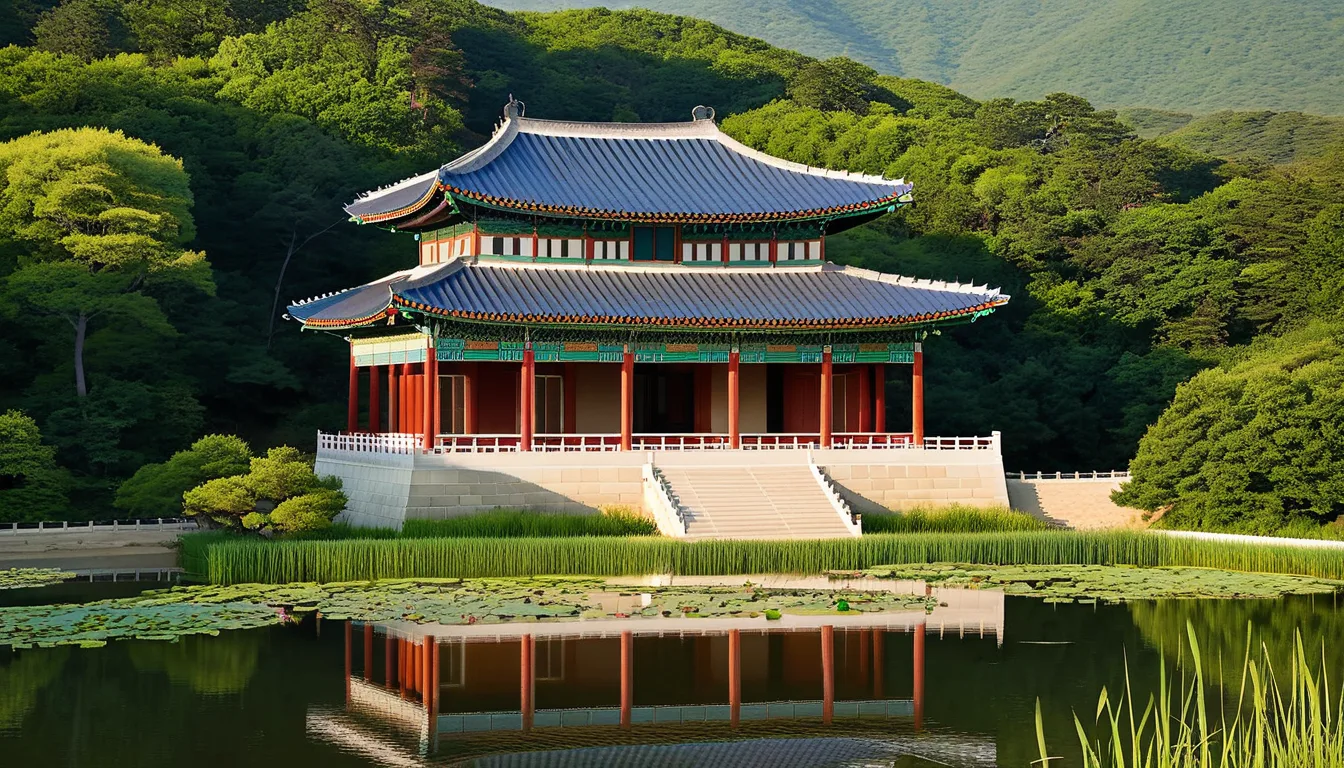
The short answer: silk woven on a loom from thread reeled off cocoons
Myeongju is silk woven on a loom from thread reeled off the cocoons of farmed silkworms. The process starts with growing mulberry trees. The word myeongju usually refers to degummed silk fabric, though there is also saengmyeongju, a raw silk fabric. This is Part 4 of a seven-part series.
Households across Korea wove myeongju, but the fabric was also tied to royal ritual. At the Joseon court, the queen tended silkworms herself in a rite called chinjam (親蠶). Today, myeongju weaving in Durisil, Seongju, is National Intangible Cultural Heritage. Seen this way, myeongju can be read as a fabric that brings together farming, handcraft and ritual.
The Encyclopedia of Korean Culture's 'Myeongju' entry: from sericulture to reeling thread from cocoons
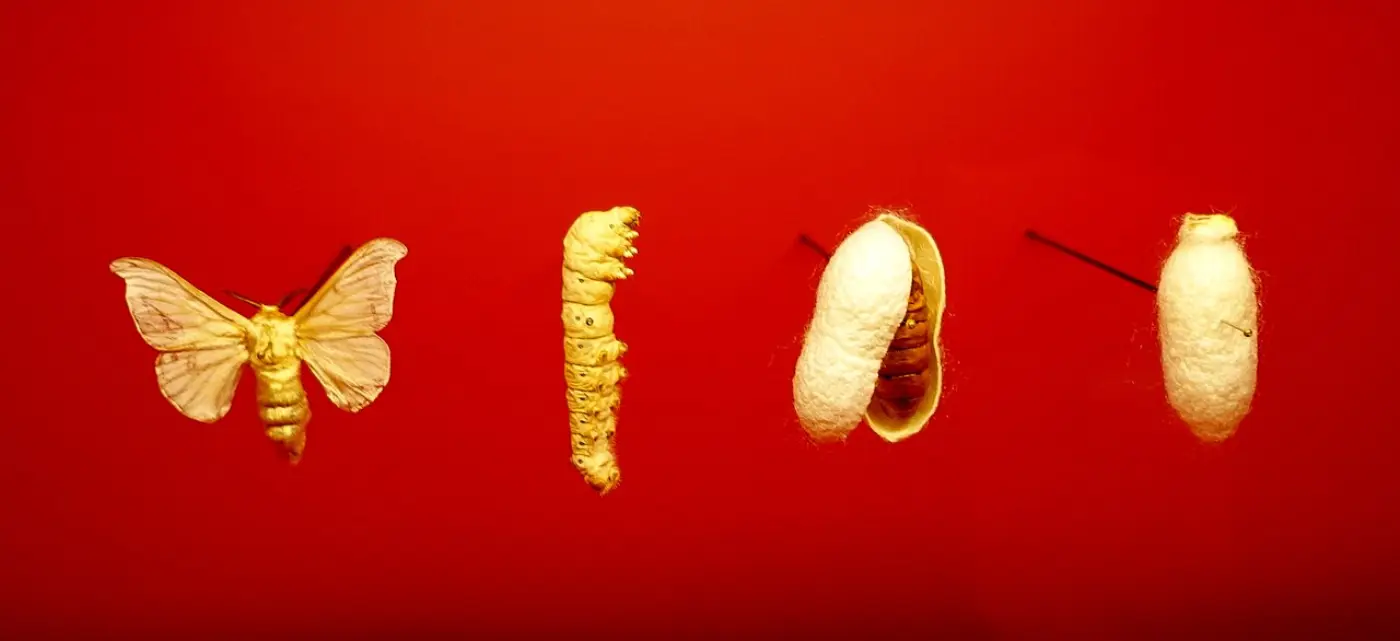
The Encyclopedia of Korean Culture is published by the Academy of Korean Studies. Its entry on myeongju says the fabric begins with jamsang (蠶桑), the work of growing mulberry trees and rearing silkworms. First, the silkworms are fed mulberry leaves. Then thread is taken from the cocoons they spin. The entry describes how the thread is made: "Myeongju thread is made into silk thread (jesa, 製絲) by placing silkworm cocoons in boiling water to loosen the ends of the filament, then reeling it with tools such as the jasae and wangchaengi."
Records from other countries make the differences in thread-making clearer. Start with the raw material. Korean myeongju uses cocoons whose filament ends have been loosened in boiling water. Yuki-tsumugi, a Japanese silk fabric, instead uses silk floss made from empty or misshapen cocoons that cannot be reeled. The thread is made differently, too: Yuki-tsumugi is spun by hand from that floss. Scope differs as well. UNESCO explains that Chinese silk craftsmanship covers mulberry cultivation and silkworm rearing, unreeling the cocoons, making thread, and designing patterns and weaving.
The comparison shows that the single word "silk" covers quite different ways of making thread. The same cocoon can become a different fabric depending on whether its thread is reeled or spun from floss. And as the Chinese records suggest, myeongju is best understood as one continuous process running from the mulberry tree to the loom.
Weaving on the loom: a 20-meter bolt and household weaving in the Samguksagi
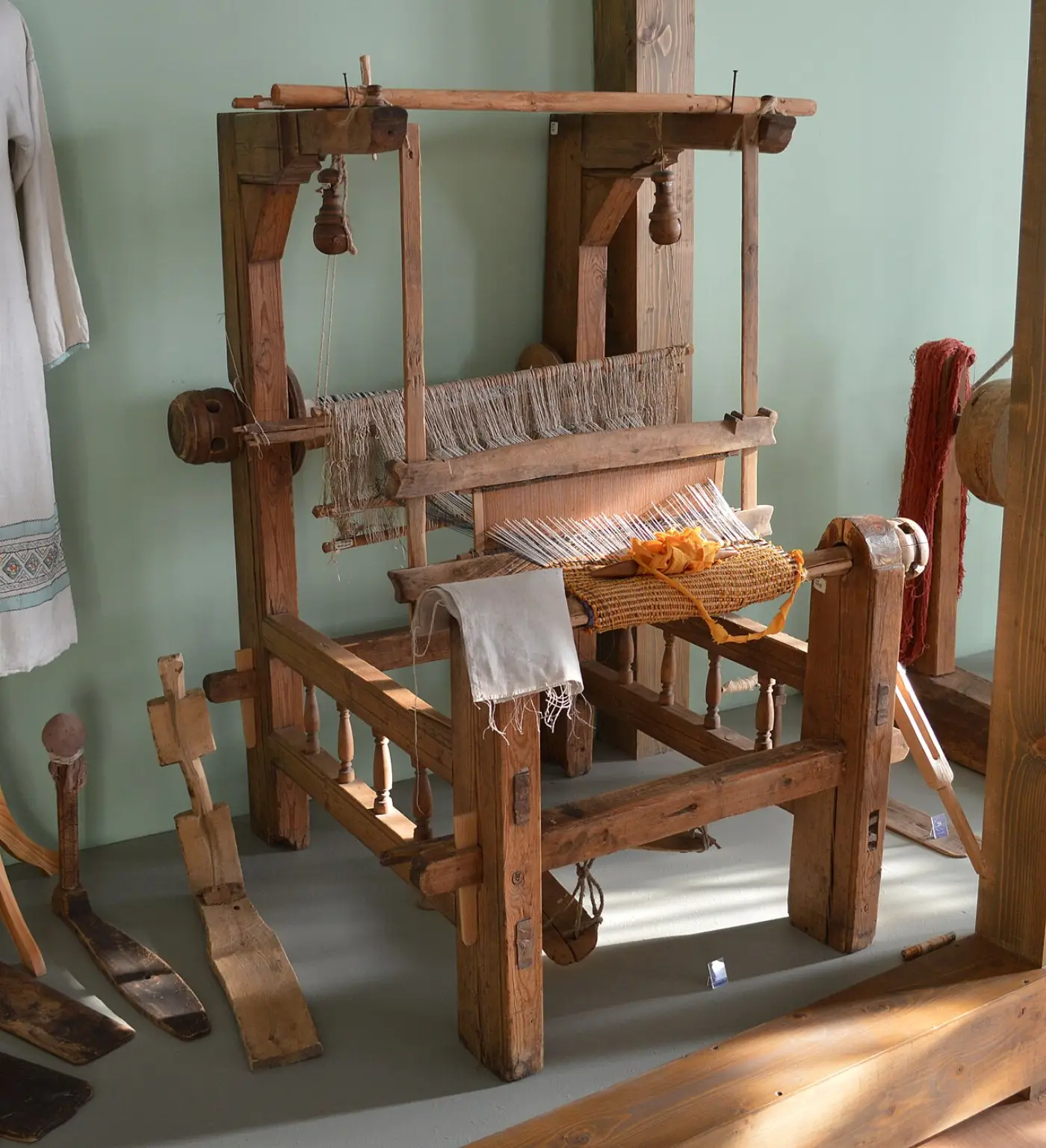
The Encyclopedia of Korean Culture lays out the preparation step by step. First, the warp is measured out from myeongju thread. Next, the warp is sized with starch in a step called bemaegi. The sized warp is wound onto the warp beam (dotumari) and mounted on the loom. Finally, the heddle threads (ing-a) are attached, and the end of the warp is tied to the cloth beam (malko). The weaver then fastens the backstrap (buti) around her waist. She opens the warp with her foot in the loom shoe (betteulsin). She passes the weft through with the shuttle and beats it in with the reed, and so weaves the myeongju.
According to the same entry, myeongju is about 35–40 cm wide, and one bolt is about 20 m long. Its quality is graded by seung count, and 15 seung marks the very finest grade. These figures show that myeongju had set widths, lengths and quality grades. A bolt of myeongju can therefore be read as both cloth and a countable good.
A Korea JoongAng Daily article notes that weaving appears in records such as the Samguksagi. In those accounts, married women wove in the seventh and eighth lunar months, and their mothers-in-law taught them how. In the same article, a researcher at the National Folk Museum of Korea described hemp and ramie as summer fabrics, and cotton and silk as expensive ones. Ramie is covered further in Part 2, on Hansan ramie weaving. The Encyclopedia of Korean Culture says that households all over the country once wove their own myeongju on traditional looms. The same entry cites Gyesan gijeong (薊山紀程), an envoy's travel record, which lists baekbyeongju and hongmyeongju among the textiles sent to China in 1803.
The 1476 rite at Chaesangdan and the 1767 Chinjam Uigwe: when the queen tended silkworms
The Encyclopedia of Korean Culture's entry on chinjam explains the rite's purpose: to show the people the importance of sericulture and to encourage it. The rite had two parts: the chinjamnye (親蠶禮), or royal sericulture rite, and the sugyeollye (收繭禮), or cocoon-receiving rite. Chinjam first appears in the records in 1411 (the 11th year of King Taejong). The first formal chinjamnye was held in 1476 (the 7th year of King Seongjong) at the Chaesangdan (採桑壇) altar in the palace's rear garden. In 1477, the rite was institutionalized through the Chinjam Eunghaeng Jeolmok (親蠶應行節目). According to the Seoul Metropolitan Government, Seonjamdan (先蠶壇) is an altar dedicated to Seoreungssi, the god of silkworms, and was built during Seongjong's reign. Unlike Seonnongdan, it had mulberry trees planted in front so their leaves could be fed to the silkworms.
The Chinjam Uigwe (親蠶儀軌), a record of the rite, was compiled by the Ministry of Rites in the third month of 1767 (the 43rd year of King Yeongjo). According to it, the queen picked five branches of mulberry leaves, the court women of the inner and outer ranks picked seven, and the wives of officials of the second and third ranks picked nine. Silkworm eggs came from Suncheon-bu (順天府), and the Seongonggam (繕工監) of the Ministry of Works supplied the sericulture tools. A section called Bangyeon sajeon describes how the cocoons from the rite were given to all the officials, who then gave thanks. Queen Jeongsun (貞純后), Yeongjo's second queen, held the cocoon-receiving ceremony on the 26th day of the fifth month at Deogyudang (德遊堂). On the 29th day of the fifth month, she received the officials' congratulations at Sungjeongjeon (崇政殿).
In 1924, Empress Yun (尹妃), consort of Emperor Sunjong, held a chinjam ceremony. On May 13 (solar calendar), the newly hatched silkworms were brushed onto leaves (sojam, 掃蠶) at the Suwon Sericulture Experiment Station. On June 17 (solar calendar), the cocoons were received at the Chinjamsil (親蠶室), west of Juhamnu (宙合樓) in Changdeokgung Palace. The number of branches picked varied by rank, so chinjam also put the court hierarchy on display. And the gift of cocoons to officials suggests that, within the rite, the raw material of myeongju became something to hand out.
The 1988 designation of Durisil myeongju weaving and the museums in Hamchang and Seongbuk
According to the Encyclopedia of Korean Culture, myeongju weaving in Durisil, Seongju, was designated an Important Intangible Cultural Property (now National Intangible Cultural Heritage) in 1988. Jo Ok-i (曺玉伊) was named its master. A photo caption in the same entry says the people of Durisil grew mulberry trees and wove myeongju to present to the royal court. The designation can be seen as a way to carry the household weaving skills described above forward as one village's technique.
The Hamchang Myeongju Museum holds 188 artifacts, including traditional looms, silk-reeling tools and irons. The Hamchang Myeongju Theme Park opened alongside it. It covers 111,390㎡ and has silk processing and production facilities and a mulberry walking trail. The park hosts the Sangju Slow Life Festival, a hanbok culture walk and the Nunnunanna Insect Festa, which features silkworms, butterflies and insects. In Seongbuk-gu, Seoul, the Seonjam Museum opened in April 2018 next to the Seongbuk Police Box. Its open storage area displays fabrics made from silkworm thread.
The original entries, 'Myeongju', 'Chinjam' and 'Chinjam Uigwe', are available in the online edition of the Academy of Korean Studies' Encyclopedia of Korean Culture. Kyujanggak holds a one-volume manuscript copy of the Chinjam Uigwe, 104 leaves long. A note at the end says it was rebound in 1919. Visit both the museums in the silk-producing region and the Seonjam Museum in Seoul, and you will see how myeongju spanned rural production and court ritual.
| Fabric or technique | Raw material | Characteristics and uses | Official record or basis |
|---|---|---|---|
| Myeongju (Korea) | Silk thread reeled with a jasae or wangchaengi from cocoons whose filament ends were loosened in boiling water | About 35–40 cm wide and about 20 m per bolt; 15 seung is the finest grade | Myeongju weaving in Durisil, Seongju, designated an Important Intangible Cultural Property (now National Intangible Cultural Heritage) in 1988 |
| Hemp (Korea) | Plant fiber | Summer fabric; many experts believe it was used earlier | Explanation by a National Folk Museum of Korea researcher in a Korea JoongAng Daily article |
| Ramie (Korea) | Plant fiber | Summer fabric; many experts believe it was used earlier | Explanation by a National Folk Museum of Korea researcher in a Korea JoongAng Daily article |
| Sericulture and silk craftsmanship of China | Thread unreeled from cocoons produced through mulberry cultivation and silkworm rearing | A craft covering everything from thread-making to pattern design and weaving | Inscribed on UNESCO's Representative List of the Intangible Cultural Heritage of Humanity in 2009 (4th session of the Committee) |
| Yuki-tsumugi (Japan) | Thread hand-spun from silk floss made from empty or misshapen cocoons | Light and warm, both crisp and soft; traditionally used for kimono | Inscribed on UNESCO's Representative List of the Intangible Cultural Heritage of Humanity in 2010 (5th session of the Committee) |
Conclusion
Taken together, these records place myeongju on a single line, running from drawing one strand of thread to the rituals of the state. Mulberry trees and cocoons, the names of loom parts, the length of a bolt and the number of branches the queen picked all point to the same fabric. Yet a village head quoted in the Korea JoongAng Daily article said that only 30 years earlier, people wore ramie, hemp and myeongju. Now, he added, these fabrics have nearly disappeared because of cheap foreign fabrics.
Some questions remain. How degummed myeongju and raw saengmyeongju differed in use deserves a closer look. On a visit, try to find the warp beam, reed and shuttle on a loom yourself. Among the original sources, the Bangyeon sajeon section and the preparation procedures in the Chinjam Uigwe are good places to start.