The short answer: a stone grotto and a temple inscribed together in 1995
Seokguram, a stone grotto, and Bulguksa, a temple, became UNESCO World Cultural Heritage on December 9, 1995. The Korea Heritage Service cites three qualities that make Seokguram valuable. They are the model for its main Buddha, its "round heaven, square earth" structure and its golden-ratio design. The Korean National Commission for UNESCO describes Bulguksa as ancient Buddhist architecture that combines stone and wood. This article is part 1 of a 17-part series.
The two sites share a single founding record. According to Samguk Yusa (Memorabilia of the Three Kingdoms), the chief minister Kim Dae-seong began building both at the same time. That is why this series opens by treating Seokguram and Bulguksa as a pair. Korea's other World Heritage sites will be covered in later installments.
The 1995 inscription: Seokguram, National Treasure No. 24, and Bulguksa, Historic and Scenic Site No. 1
According to the Korea Heritage Service, the inscription covers two sites. Seokguram is National Treasure No. 24, and Bulguksa is Historic and Scenic Site No. 1. The Korea Heritage Portal describes Seokguram as an artificial grotto. Its interior was built from some 360 fitted stones, and the outside was covered with earth. The National Institute of Korean History calls it a masonry (造積式) grotto, built by stacking stones.
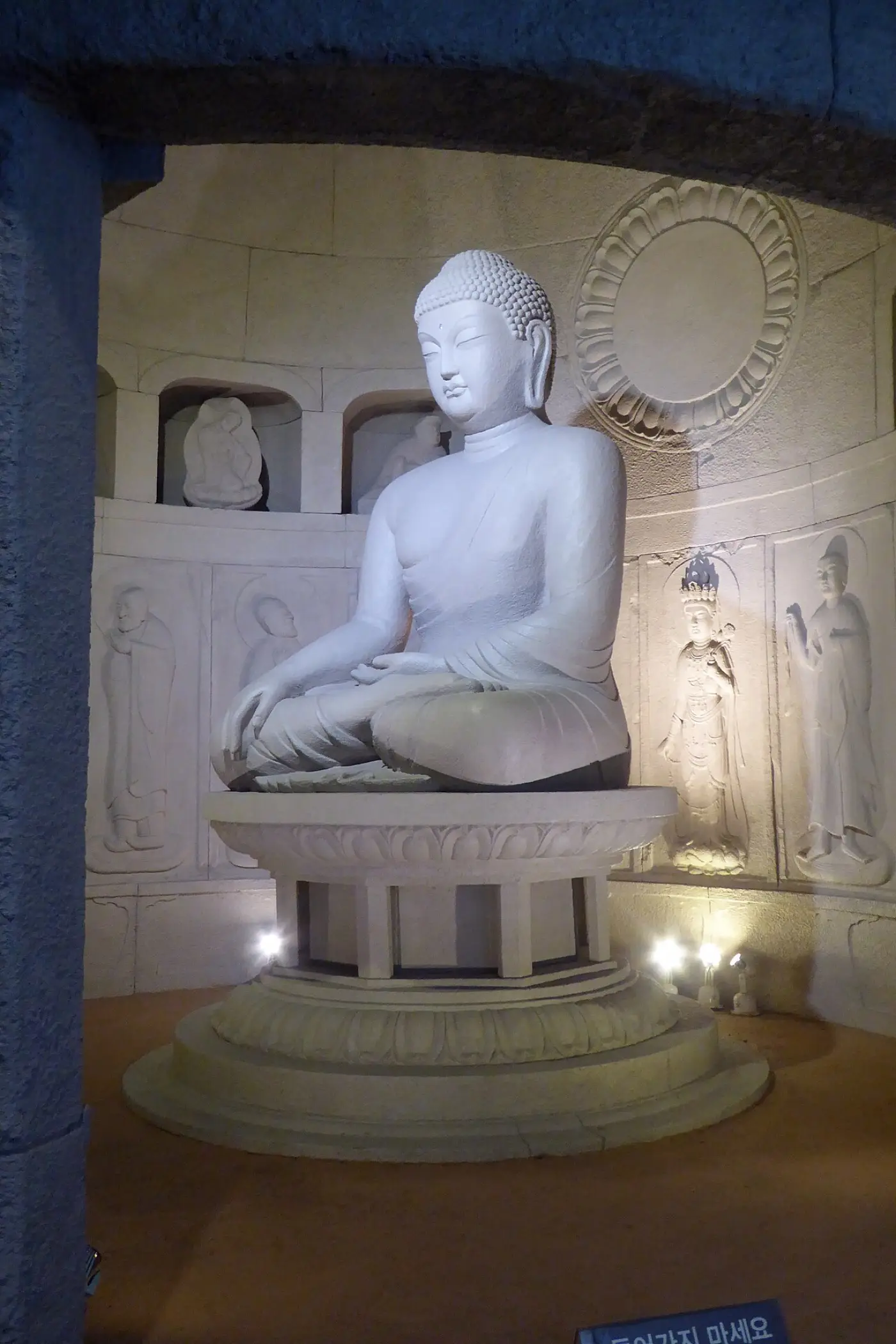
Seokguram's interior has three parts. First comes a rectangular antechamber, followed by a passage called the bido (扉道). At the far end is the circular main chamber, which houses the main Buddha. The Korean National Commission for UNESCO says 38 Buddhist figures surround the main Buddha. Korea JoongAng Daily, an English-language daily, writes that 39 figures are carved on the surrounding walls.
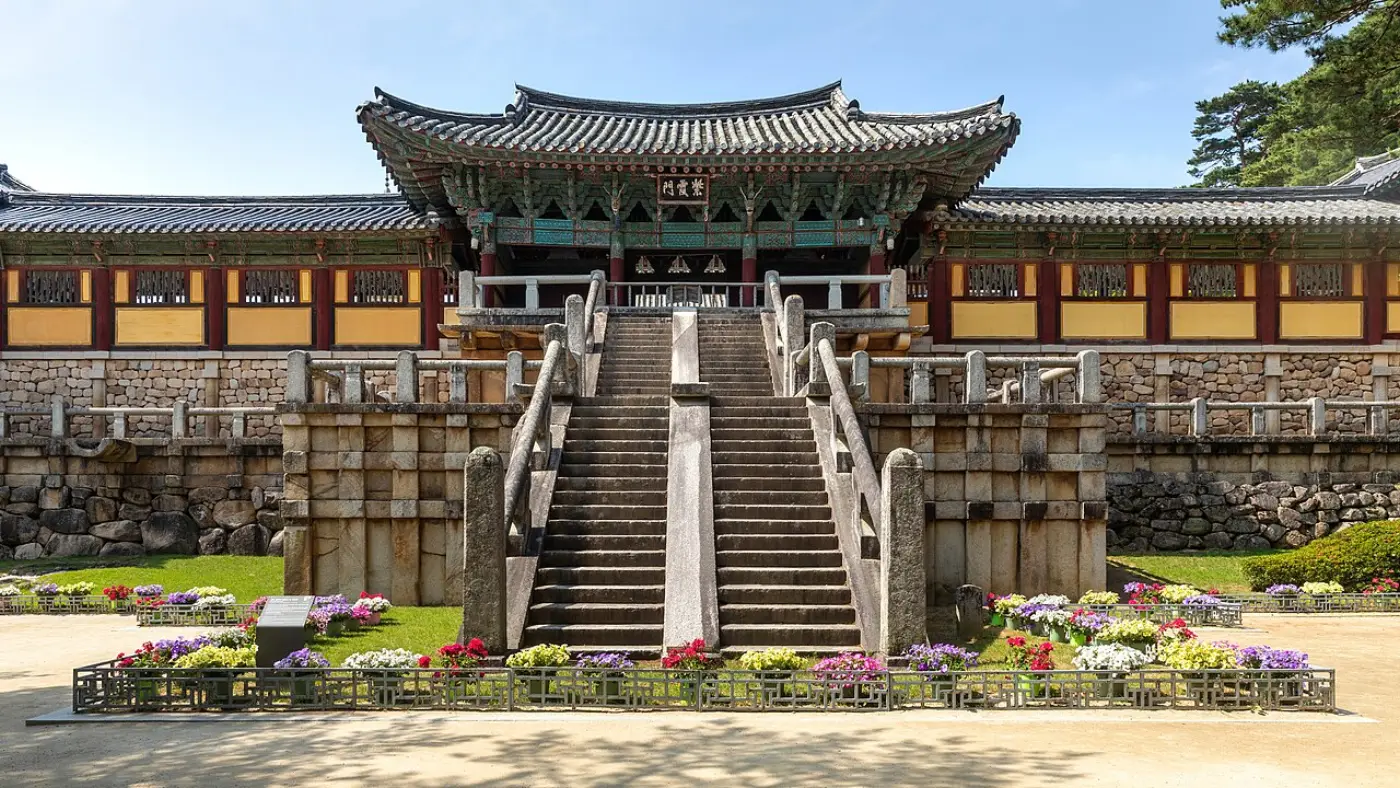
Because the two sources give different numbers, readers should check what each one is counting. The Korean National Commission for UNESCO describes Bulguksa as a place where stone structures and wooden buildings stand in harmony. Seokguram is an interior space enclosed in stone, while Bulguksa is above-ground architecture of stone and wood. A single inscription can thus be seen as bringing together two different ways of building.
The Korea Heritage Service's account: the golden Buddha of Great Tang Records on the Western Regions, round heaven and square earth, and 12 Tang feet
The Korea Heritage Portal identifies the main Buddha as Shakyamuni. The statue captures the moment of his enlightenment, after he has overcome the obstruction and temptation of demons. The Korea Heritage Service calls it the finest example of a seated Buddha in the earth-touching (hangma chokji) mudra. Its hand gesture and dimensions match those of the golden Buddha at the Mahabodhi Temple in Bodh Gaya, India. That statue is described in Great Tang Records on the Western Regions by Xuanzang (602–664).
The Korea Heritage Service's World Heritage guide describes the structure this way: "Seokguram's structure, with a square antechamber and a circular main chamber, recreates the East Asian idea of cheonwon jibang (天圓地方), or 'round heaven, square earth,' and ..." The English description on the same website addresses the design. Seokguram, it says, was designed according to the golden ratio. Its base unit is 12 Tang feet, or about 30 cm.
In short, this account divides Seokguram's value into three parts: the model for its Buddha, the philosophy built into its space and the proportions of its design. The National Institute of Korean History stresses that Seokguram is the only surviving artificial grotto from the Unified Silla period. Readers can find these descriptions in the World Heritage guide on the Korea Heritage Service website.
The 751 record in Samguk Yusa and the 1966 ink-written fragment from Seokgatap
According to the National Institute of Korean History, Kim Dae-seong was a jingol (true-bone) aristocrat. He served as jungsi (中侍), the chief minister, from 745 (the 4th year of King Gyeongdeok) to 750 (the 9th year of King Gyeongdeok). The Korea Heritage Service relays the founding record in Samguk Yusa. In 751, Kim began building Bulguksa and Seokbulsa (石佛寺) for his parents in this life and in a previous one. Seokbulsa is today's Seokguram. Kim died before the work was finished, and the state is said to have completed it in 774.
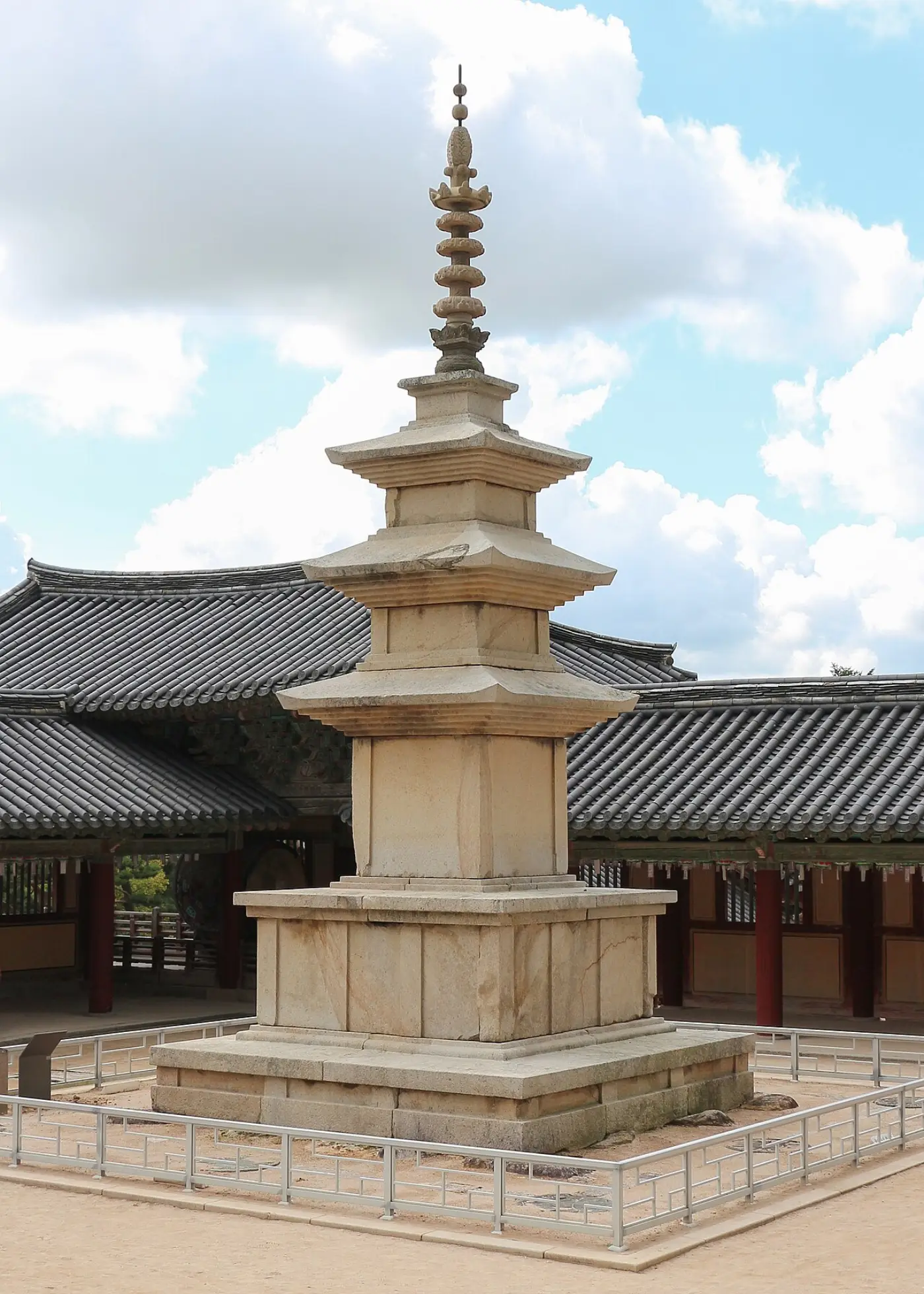
The National Institute of Korean History also recounts an anecdote from Samguk Yusa. A stone meant for the ceiling capstone suddenly broke into three pieces. Kim Dae-seong grieved and fell asleep. While he slept, a heavenly spirit came down, finished the capstone and left. When Seokgatap was dismantled in 1966, an ink-written paper fragment (墨書紙片) from the Goryeo period was found. It states that Seokgatap was erected in 742 (the 1st year of King Gyeongdeok) and completed in the reign of King Hyegong (765–780).
The Korea Heritage Portal relays another record about Dabotap and Seokgatap. After unification, craftsmen from Goguryeo and Baekje came to Silla and built the pagodas alongside Silla craftsmen. Samguk Yusa says construction began in 751, while the paper fragment says Seokgatap was erected in 742. Set side by side, the two records show a difference. Rather than settling on a single founding date, readers should keep each record's date distinct.
From Jeong Si-han's visit in 1688 to the 2014 comprehensive inspection
The National Archives of Korea cites records from the Joseon period. When Jeong Si-han visited in the fifth month of 1688, the stone figures in the front and rear chambers were intact. According to Bulguksa gogeum changgi (Ancient and Modern Records of Bulguksa), Seokguram was repaired in 1703 (the 29th year of King Sukjong). Stone steps were also built in front of the grotto that year. It was repaired again in 1758 (the 34th year of King Yeongjo). Seokguram also appears in Gyonam Myeongseungcheop, an album painted by Jeong Seon in 1733.
According to the National Archives of Korea, repairs began in 1913. They followed a visit to Seokguram by Terauchi, the first Governor-General of the Japanese colonial period. The archive dates the start of Seokguram's troubles to that moment. Cement repairs blocked the ventilation openings, and the gamnosu spring, which had drawn moisture downward, was lost. Humidity built up inside the grotto. Condensation formed on the statues, and the granite eroded.
Korea JoongAng Daily reports that a glass wall was installed in 1976 to prevent damage. Since 1966, the National Research Institute of Cultural Heritage has carried out regular inspections two or three times a year. A 2012 Cultural Heritage Administration report found 56 defects, 25 of them on the main Buddha. In 2013, the paper's own investigation found a 1-meter vertical crack in the main Buddha's pedestal. The 2014 comprehensive inspection observed cracks in the ceiling. Seokguram was classified as requiring close investigation or automated monitoring.
| Record | Year | Contents | Cited by |
|---|---|---|---|
| Samguk Yusa founding record | Begun 751, completed 774 | Kim Dae-seong began building Bulguksa and Seokbulsa for his parents; the state completed them | Korea Heritage Service |
| Ink-written fragment from Seokgatap (Goryeo period) | Erected 742, found 1966 | States that Seokgatap was completed in the reign of King Hyegong (765–780) | National Institute of Korean History |
| Jeong Si-han's visit | Fifth month of 1688 | The stone figures in the front and rear chambers were intact | National Archives of Korea |
| Jeong Seon's Gyonam Myeongseungcheop | 1733 | Depicts Seokguram in a painting | National Archives of Korea |
| Bulguksa gogeum changgi | 1703, 1758 | Seokguram was repaired, and stone steps were built in front of the grotto | National Archives of Korea |
| Cultural Heritage Administration report | 2012 | 25 of Seokguram's 56 defects were on the main Buddha | Korea JoongAng Daily |
Summing up
These records show that conserving Seokguram is ongoing work, not a one-time task. The stone figures were intact in 1688, Seokguram was repaired twice under Joseon, and it suffered damage after 1913. Since then, inspections have taken place two or three times a year. According to the National Institute of Korean History, the sculptures from 2 of the 10 niches above the main chamber are now missing. Questions also remain where the sources disagree, such as the founding date and the number of figures.
According to the National Archives of Korea, visitors can no longer enter the grotto and can view only the main Buddha, through glass. The National Institute of Korean History explains that Seokguram faces the East Sea. The main Buddha's azimuth nearly matches the angle of sunrise. Bulguksa has the Cheongungyo and Baegungyo bridges (National Treasure No. 23), which symbolize the 33 heavens. It also has the Yeonhwagyo and Chilbogyo bridges (National Treasure No. 22), which lead to the Western Paradise. Dabotap (National Treasure No. 20) and Seokgatap (National Treasure No. 21) stand in front of Daeungjeon Hall. Both derive from the "Apparition of the Jeweled Stupa" (Gyeonbotappum) chapter of the Lotus Sutra (法華經).