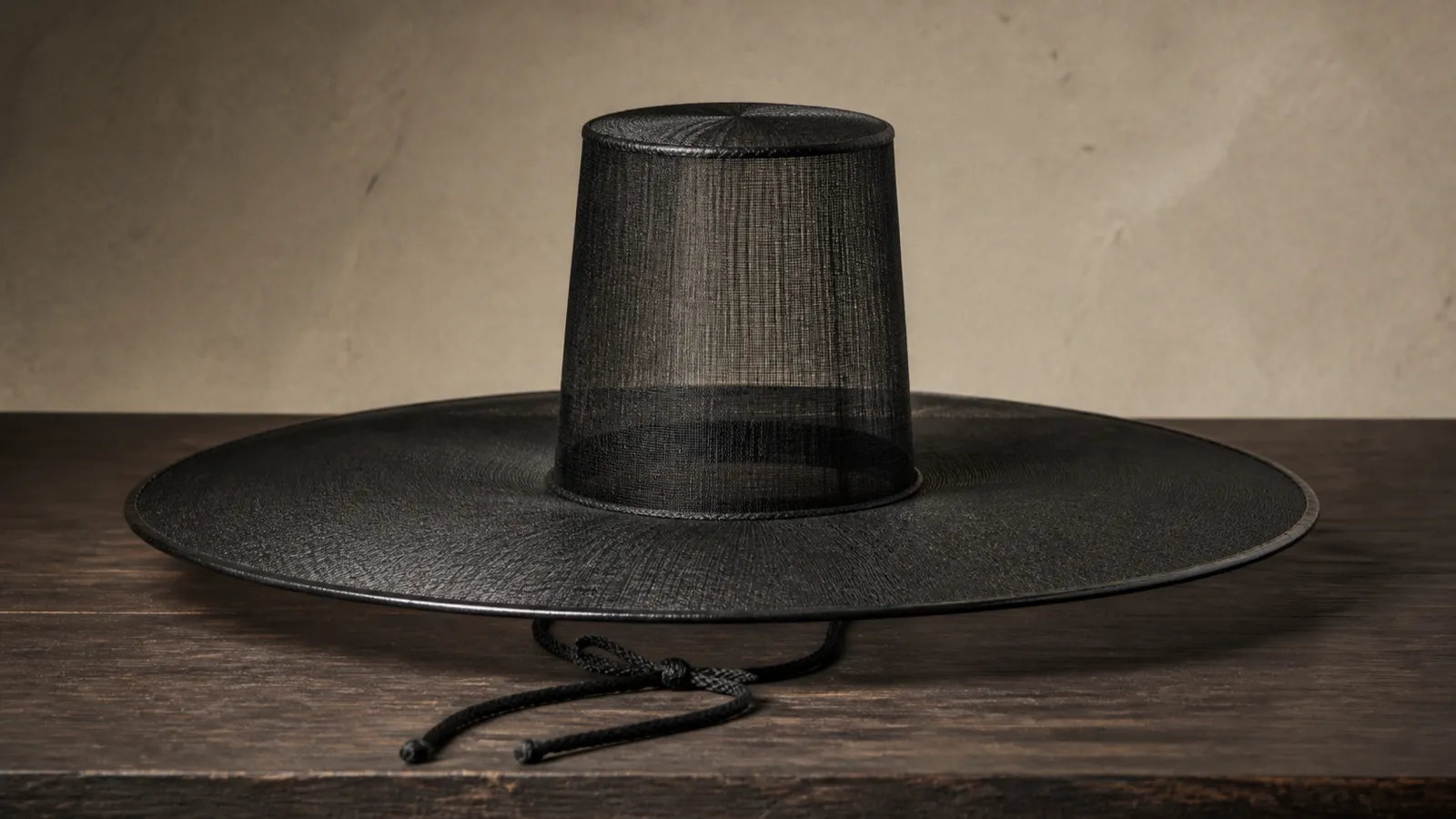
In global television, animation, and fashion showcases, the translucent black silhouette of the Korean gat, a traditional brimmed hat, has become an iconic visual emblem of Korean culture. Yet it is more than a stylish curiosity of Joseon scholars or an exotic fashion statement. Seeing it only that way misses more than five centuries of accumulated Confucian legal jurisprudence, rigorous social stratification, and highly specialized guild craftsmanship.
For a Joseon adult male, putting on a gat when stepping outside the gate was indispensable. It declared his social identity, filial decorum, and public responsibility. This was part of an institutional dress code known as uigwan (correct attire and headgear).
The hat was hand-woven from horsehair and bamboo strands split finer than human hair. It was then finished with deep natural lacquer. It shades the face without fully obscuring it, casting an aura of composed elegance and moral rectitude.
This lightweight, semi-transparent micro-architecture was forged where three forces met: royal legal codes, heated Annals debates on luxury, and an inter-regional trade network. That network spanned Jeju Island, Jeolla, Gyeongsang, and the royal capital. This study draws on primary legal statutes, dynastic annals, folk encyclopedias, and heritage registries. It offers an evidence-based institutional analysis of the Joseon gat.
1. A Social Institution Rather Than Simple Headwear
In its broadest etymological sense, gat is an indigenous Korean word for all forms of brimmed traditional headwear (ip, 笠). Primitive brimmed hats appear in ancient Goguryeo tomb murals, such as Gamsinchong and Anak Tomb No. 1.
The Samguk yusa, a 13th-century text, records a dream of King Wonseong of Silla. In it, he wore a plain white hat (sorip) instead of his royal cap. By the late Goryeo dynasty, the Goryeosa records a formal order. In 1367 (the 16th year of King Gongmin), all civil and military officials were ordered to wear black brimmed hats (heukrip).
However, the hat that defines the modern imagination is the heukrip perfected during the Joseon dynasty. This canonical black hat has a flat circular brim and an upright cylindrical crown. The Encyclopedia of Korean Seasonal Customs and Daily Life (National Folk Museum of Korea, article by Kang Soon-je) describes how it was made. Heukrip fabrication comprises three distinct stages: weaving the crown (daewu), weaving the brim (yangtae), and final assembly and lacquering in the hatmaker’s shop (gatbang).
In Joseon society, wearing a heukrip showed that a male had undergone the coming-of-age capping ceremony (gwanrye). It marked that he had reached full adulthood. It also embodied Confucian bodily discipline, which required proper grooming and modest comportment in public spaces.
The Encyclopedia of Korean Culture (item E0000945) documents who could wear it. During the later Joseon period, the heukrip gradually spread from scholar-officials (sadaebu) to commoners. However, members of the lowest social stratum (cheonin) were legally barred from wearing it. They were restricted instead to rough coarse hats (paeraengi).
Not until the reforms of 1895 were the lower classes formally permitted to wear the gat. This shows how headwear operated as a rigid visual marker of social hierarchy.
2. Hierarchies of Rank and Ornaments in the Gyeongguk daejeon
The Joseon state did not leave the adornment of hats to private whim. The Gyeongguk daejeon (Code of Law), the dynasty's foundational legal code, strictly codified hat ornaments. These rules appear in the ceremonial dress section (Uijang, 儀章) of the Rite Code (Yejeon).
The official text is archived in the National Institute of Korean History database. According to it, the top finials (jeongja, 頂子) affixed to the apex of the crown were precisely calibrated by official rank and post. So were the materials of the chin-straps:
- Officials of the Inspector General (Sahonbu), Censorate (Saganwon), Provincial Governors (Gwanchalsa), and Army/Navy Commanders (Jeoldosa): Required to mount carved jade finials (ok-jeongja, 玉頂子) upon their hats, projecting the solemn supervisory authority of their offices.
- Inspectors (Gamchal) of the Sahonbu: Mandated by statute to wear rock-crystal finials (sujeong-jeongja, 水精頂子).
- Grand Princes (Daegun) and First Rank Officials: Grand princes were permitted gold finials (geum-jeongja), while first-rank officials wore gold and jade ear-buttons (gwanja) and chin-straps with silver finials.
These statutory distinctions extended to sub-bureaucrats and regional functionaries. Local government clerks (hyangri) were required to wear square black bamboo hats (heukjuk bangrip, 黑竹方笠). Royal attendants and palace stewards (byeolgam) wore reddish-yellow straw hats (juhwang chorip, 朱黃草笠). A spectator in Hanyang or a provincial town needed only to glance at a man’s hat. Its color, weave, and gemstones instantly revealed his administrative office, bureaucratic rank, and social standing.
These provisions show that the hierarchy of the gat extended from officials' hat finials and hat strings all the way to the type of hat worn by local clerks (hyangni) and palace attendants (byeolgam). When ministers in 1498 cited the distinctions already set in the Daejeon as grounds for curbing extravagance, they can be read as pointing to these very provisions.
3. Annals Debates: Changing Fashions and Sumptuary Disputes
Despite statutory prohibitions, the gat was a dynamic medium of courtly fashion. Across five centuries, the height of the crown and the diameter of the brim swung through cyclical aesthetic trends. These shifts sparked recurrent controversy in royal council chambers over luxury and moral decay.
Primary records from the Annals of the Joseon Dynasty reveal the intensity of these deliberations:
- 1498 (Yeonsan 4th Year, June 15, Gyeongjin): In the Yeonsangun ilgi (Vol. 29), court ministers debating sumptuary guidelines noted that "the Code of Law already establishes distinct grades for hats," urging inspection against unauthorized horsehair hats (jongrip) and lavish chin-straps adorned with imported amber and coral. The record notes that royal approval was held in abeyance (留中, yujung), meaning the proposal was debated without immediate legislative enactment.
- 1556 (Myeongjong 11th Year, June 19, Byeongo): The Myeongjong sillok (Vol. 20) documents an impassioned memorial from the Inspectorate (Sahonbu). The censors lamented: "In former times, brims were so wide they resembled Buddhist monk hats, but recent fashions make the crown excessively tall and the brim bizarrely narrow." The memorial denounced that despite severe famine across the country, "a single fashionable gat now costs as much as an entire sack (seok) of rice," demanding strict suppression of wasteful luxury.
- 1834 (Sunjo 34th Year, April 29, Gapja): In the Sunjo sillok (Vol. 34), high official Sim Sang-gyu criticized the runaway enlargement of military hats (yungbok gat), protesting: "In earlier days, the brim barely covered the wearer's shoulders, but today it is so broad that it extends past half a seating mat." Hats had grown so enormous that wearers could scarcely maneuver inside sedan chairs or narrow rooms.
These primary entries prove that the dimensions of the gat were never frozen in a static mold. Rather, the hat existed in constant tension between royal sumptuary control and the sartorial aspirations of the Joseon aristocracy.
In 1556 the Office of the Inspector-General objected to brims that were too narrow, while in 1834 Sim Sang-gyu objected to brims that were too wide. This suggests the target of criticism was not a one-way trend toward ever-larger hats but whatever excess happened to be in fashion at the time.
4. Heukrip, Jurip, and Baekrip: Colors of Office and Mourning
The Joseon hat was not exclusively black. Depending on state ritual, military deployment, and bereavement, color shifted to signal ceremonial transitions.
The standard black heukrip served as everyday formal attire for civil officials and scholars. Its lustrous dark lacquer embodied Confucian restraint.
Military expeditions and formal martial parades called for a different hat. There, military officers and senior dignitaries wore the vermilion jurip (red brimmed hat) as part of their military uniform (yungbok). Jurip were frequently adorned with tiger whiskers (hosu) or peacock feathers. These ornaments projected martial vigor and commanding authority.
The most austere transformation came with the baekrip (white brimmed hat). It was made of unbleached hemp or covered with white paper. It was reserved for filial mourners during funeral rites. All subjects also wore it during periods of national mourning for a deceased monarch.
According to the Encyclopedia of Korean Culture ('Baekrip', E0022105), strict state statutes regulated its use. In 1454 (Danjong 2nd Year), white hats were barred within the royal palace during ordinary times. In 1466 (Sejo 12th Year), palace guards were prohibited from wearing them. In 1469 (Yejong 1st Year), everyday wear by commoners was banned. This reserved the white hat exclusively for official mourning.
Through the simple shift from black to white, an entire nation visually took part in dynastic mourning.
These restrictions can be read not as an attempt to abolish the Baekrip but as a way to preserve it as a marker of mourning. The fact that the 1895 notice still allowed those in mourning to keep their white attire likewise shows how closely white was tied to mourning rites.
5. Materials of the Semi-Transparent Architecture: Horsehair, Bamboo, Silk, and Lacquer
The captivating aesthetic of the Joseon gat lies in its semi-transparency. From a distance, the hat appears solidly black. On closer inspection, light filters through it. This optical nuance came from the physical properties of organic materials, masterfully harnessed by Joseon artisans.

According to the Encyclopedia of Korean Traditional Occupations and Technologies (National Folk Museum of Korea, article by Jang Kyung-hee), the verified materials of the heukrip include:
- Horsehair (馬鬃): Sourced from horse manes and tails, selected for uniform thickness and natural elasticity. Horsehair resists moisture and retains upright tensile rigidity, making it the ideal filament for weaving the cylindrical crown (chongmoja) while maintaining ventilation.
- Split Bamboo Strands (Sejuksa, 細竹絲): Cultivated from mature bamboo with long internodes, split with razor blades into filaments finer than human hair. Hundreds of these supple strands are woven radially and concentrically to form the flexible, springy brim (yangtae).
- Silk Fabric and Thread: Fine silk gauze is applied over the woven framework to smooth the exterior grain and unify the surfaces prior to lacquering.
- Natural Lacquer (Ottchil, 옻칠): Purified sap of the lacquer tree is brushed over the structure. Lacquer provides a luminous black finish while imparting exceptional moisture-proofing and insect-repelling durability, shielding delicate organic fibers against seasonal rot.
The heukrip is an ultra-lightweight composite structure made of natural horsehair, bamboo, silk, and tree lacquer. The marriage of horsehair elasticity, bamboo flexibility, and lacquer resilience represents a triumph of traditional micro-engineering.
We can see that each part of the hat had its own material: horsehair for the crown, bamboo for the brim. This offers a key to understanding why, as the next section shows, the regional division of labor was tied to where those materials were produced.
6. Chongmoja, Yangtae, and Ipja: Three Specialist Guilds and Regional Division of Labor
Creating a finished gat was never the solitary work of one artisan. Horsehair, bamboo, and finishing lacquer each demanded completely different skills. So production was organized around an elaborate inter-regional division of labor.
The National Heritage Portal confirms that traditional hatmaking falls into three distinct processes: chongmoja, yangtae, and ipja. It explicitly notes that "the three processes require different materials and manual techniques, and were customarily executed separately."
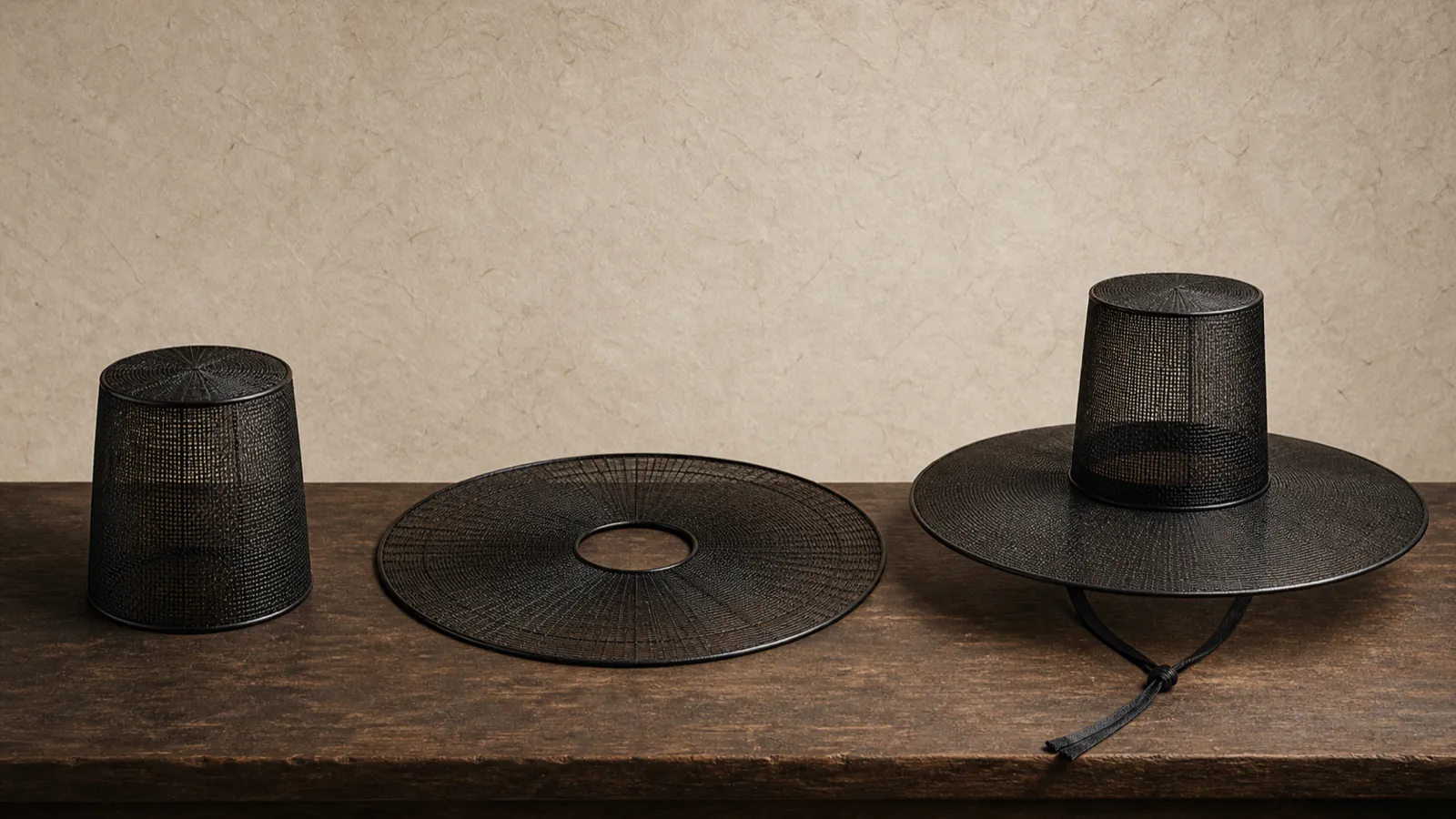
The Gyeongguk daejeon, the early Joseon legal code, also covered hatmakers in its Works Code (Gongjeon). It recorded 37 capital craftsmen (Gyeong-gongjang) attached to royal offices. They were divided into four categories: chorip-jang (6), yurip-jang (6), yangtae-jang (20), and moja-jang (5). This early state workshop system differed in names and organization from a later system. That later model was the specialized three-artisan tripartite division that matured during the later Joseon period.
As documented in the Encyclopedia of Korean Traditional Occupations and Technologies, the late Joseon craft network operated across distinct geographical regions:
- Chongmoja (Crown Weaving): Centered in Jeju Island—renowned for horse grazing—and northern Pyeongan Province. Domestic craftswomen wove horsehair around carved wooden molds into delicate cup-shaped crowns.
- Yangtae (Brim Weaving): Concentrated in bamboo-rich regions of Jeolla Province (such as Namwon and Damyang) and Jeju Island, where artisans split bamboo into hair-fine threads and wove circular brims over curved forms.
- Ipja (Assembly and Finishing): In urban workshops (gatbang) located in commercial hubs such as Tongyeong, Yecheon, and around Hanyang, master finishers assembled the crowns and brims, secured them with iron molds, covered them with silk, and applied multiple coats of protective lacquer.
An official report published by Korea.net on March 18, 2014 ("Gat, traditional headgear in Korea [7]") broke this complex procedure down. It counted 24 stages for the brim, 17 for the crown, and 10 for assembly and finishing. That totals roughly 50 to 51 meticulous hand operations. Each guild master needed over a decade of specialized apprenticeship. Each contributed his or her regionally acquired component to produce a single unified artifact.
Setting the capital artisan roster beside the later three-way division shows that the division of labor known today was not a fixed framework from the start of Joseon. The recognition of a separate holder for each of the three fields at the 1964 designation can also be read as following this later division.
7. The 1895 Topknot Decree, the 1897 Cancellation, and the Fate of the Gat
The centuries-long reign of the gat came to a dramatic turning point in the late 19th century under the modernization pressure of the Gabo Reforms.
The Annals of King Gojong (Vol. 33) record a turning point. On the 15th day of the 11th lunar month in 1895 (Gojong 32nd Year), the King issued the historic Topknot Decree (Danballyeong). It read: "We have sheared our hair to stand foremost before our ministers and people; let our subjects emulate our resolve to achieve equal footing with the nations of the world."
On the same day, Internal Ministry Notice No. 9 issued detailed regulatory provisions. Crucially, the notice allowed mourners to keep wearing white attire. It also declared that "the horsehair headband (manggeon) is abolished, and the adoption of foreign clothing is left to individual discretion."
A widespread historical misconception claims that the Topknot Decree explicitly banned the wearing of the gat. However, the original statutory text contains no prohibition against the hat itself. What it abolished was the manggeon, the tight horsehair headband used to secure male hair and anchor the hat.
With topknots and headbands removed, the traditional gat lost its physical foundation on the head. Moreover, on January 11, 1896 (solar calendar), an imperial edict singled out certain antiquated customs as requiring modernization. These were "wide sleeves, oversized hats (daegwan), topknots, and headbands."
King Gojong faced nationwide armed resistance and moral fury from Confucian scholars. He formally revoked the decree on August 12, 1897 (solar calendar). The Annals (Vol. 35) record his command: "Revoke all decrees and edicts promulgated on the 15th day of the 11th lunar month of the Eulmi year."
Yet although the decree was officially cancelled, Western haircuts, suits, and modern felt hats had been irreversibly adopted. They quickly pushed the gat to the margins. By the early 20th century, everyday hat workshops had vanished. The gat survived mainly as ceremonial attire for ancestral rituals and weddings.
The decline of the gat can be read not as the result of a direct ban but as an indirect effect of the disappearance of the topknot and the manggeon headband. Since 1895 was also the year the lowborn were officially allowed to wear the gat, we can see that the very year the gat opened to everyone was the year its foundations began to give way.
8. 1964 National Intangible Heritage Designation and Living Transmission
Traditional hatmaking was rescued from extinction through the formal establishment of South Korea's cultural heritage protection system. Official records from the National Heritage Portal confirm the details. The Korean government designated traditional hatmaking as National Intangible Cultural Heritage Gannil (Horsehair Hat Making) on December 28, 1964. The portal today still catalogues the element by its official title and the statutory designation date of December 28, 1964.
The National Heritage Portal's 'Transmission Information' register lists the first generation of accredited titleholders. They were appointed on December 28, 1964, and reflected the tripartite division of labor: Ko Jae-gu (chongmoja, Jeju), Jeon Deok-gi (ipja, Gyeongnam), and Mo Man-hwan (yangtae, Gyeongnam). Today, four living Titleholders (Boyuja) actively preserve this lineage:
- Ipja (Assembly and Lacquering): Master Jung Chun-mo (accredited 1991) and Master Park Chang-young (accredited 2000), supported by Education Specialist Jung Han-soo (accredited 2015).
- Yangtae (Bamboo Brim Weaving): Master Jang Soon-ja (accredited 2000, Jeju), preserving the delicate art of fine bamboo weaving.
- Chongmoja (Horsehair Crown Weaving): Master Kang Soon-ja (accredited 2009), sustaining the horsehair crown craft in Jeju.
One essential distinction concerns international heritage status: Gannil is a South Korean National Intangible Cultural Heritage; it is NOT inscribed on the UNESCO Representative List of the Intangible Cultural Heritage of Humanity. Other Korean elements include Pansori, the Royal Ancestral Ritual at Jongmyo Shrine, Ssireum wrestling, and Talchum mask dance. Unlike them, Gannil remains exclusively a nationally designated asset.
A Ministry of Culture, Sports and Tourism press release dated July 14, 2025, reports renewed popular fascination with the gat. Global media attention sparked this interest, through works such as the animated production K-Pop: Demon Hunters and the dance series World of Street Woman Fighter. The resurgence drew significant public interest to the National Folk Museum of Korea's exhibitions. These featured historical hats and ornate wooden storage cases (gatjip).
Once an austere emblem of Confucian rank, the Joseon gat endures today as an internationally recognized masterwork of living heritage and aesthetic sophistication.