At a glance
• "Ondol became a world standard" is only half right: an ISO working group led by a Korean researcher produced the design standard for embedded radiant heating (ISO 11855), but the standard covers radiant heating and cooling embedded in floors, walls and ceilings in general, not Korean ondol as such.
• Fixed energy-saving percentages for floor heating could not be confirmed: what official sources agree on is that lower water temperatures raise heat pump efficiency, and field measurements show that adequately sized radiators can run at similar temperatures.
• Health claims are often overstated: evidence that floor heating sharply reduces house dust mites is weak, and there is little evidence that reducing mite exposure improves asthma.
Every winter, stories circulate that people in Korean apartments walk around in T-shirts and that ondol has become a world standard. They are not entirely wrong, but the records tell a more complicated story. This article checks the history of ondol, what actually happened with its international standardization, how Korean law defines apartment floors today, and how floor heating and heat pumps are assessed in Europe, using official records and research.
1. How old is ondol?
On 30 April 2018, the Korea Heritage Service designated "ondol culture" as a National Intangible Cultural Heritage. It was designated as a community element, with no individual holder or organization recognized. In other words, the heritage is not just a technique but the whole culture of building ondol, firing it and living on top of it.
Its origins call for careful wording. The Heritage Service notes that primitive ondol remains thought to date from around the 3rd to 1st centuries BCE have been found across the Korean Peninsula, and estimates that ondol culture has been handed down for more than about 2,000 years. The Encyclopedia of Korean Culture's entry on gudeul states first that it is not certain when such systems began to be installed. It mentions that some point to gudeul traces in Bronze Age pit houses in Unggi, North Hamgyong Province, and dates the L-shaped partial gudeul found at the Seodun-dong pit-house site in Suwon to the Early Iron Age, after 300 BCE. The frequently repeated figure of "5000 BCE" does not appear in these official records.
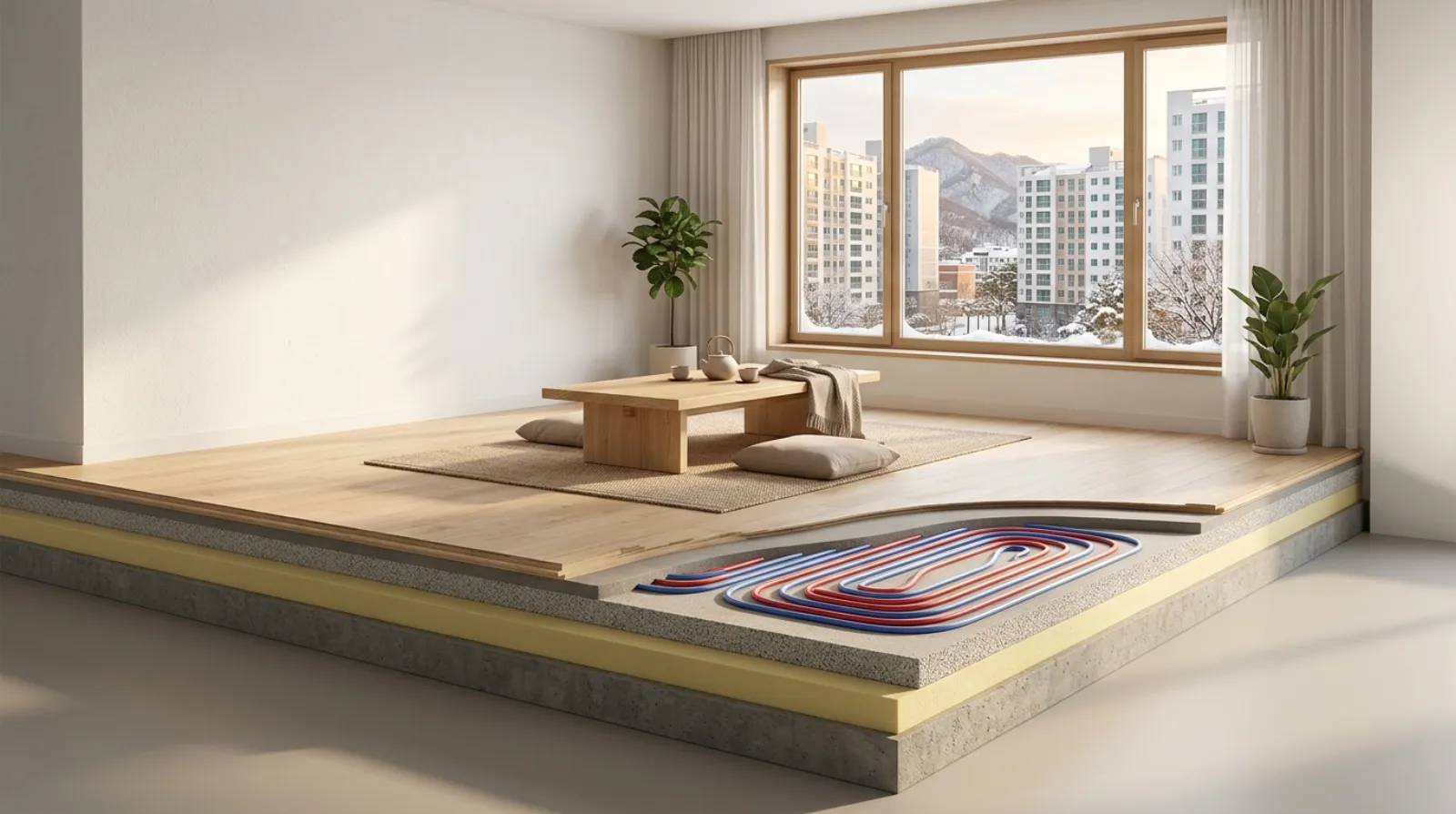
The principle is simple. According to the encyclopedia's entry on ondol, traditional ondol was a direct heating system: a fire lit in the agungi (firebox) sent hot gases through the gorae (flues under the floor), warming the floor, so that cooking and heating could be done at the same time. The full-floor ondol, with flues under the entire room covered by gudeuljang stone slabs, was completed in the late Goryeo period.
Its spread brought problems too. The same entry explains that when ondol installation surged across regions and social classes in the 17th century, firewood supply caused economic and environmental problems. In the modern era, heat sources changed from coal briquettes to gas, oil and electricity, hot-water pipes or electric panels replaced the flues, and the firebox disappeared. The hot-water floor heating in today's apartments continues that line of development.
2. Why Europe became a continent of radiators
Europe also once heated rooms from below. Encyclopaedia Britannica describes the Roman hypocaust as used not only in the warm and hot rooms of baths but almost universally in private houses in the northern provinces. The system disappeared with the decline of the Roman Empire, however, and central heating was not reintroduced until some 1,500 years later.
When central heating returned to Europe, it came through emitters rather than floors. Britannica explains that coal-fired boilers delivered hot steam to rooms by means of standing radiators. Korea developed heating that warms the floor, while Europe developed heating that warms room air through emitters placed in the room, and today's differences in heating equipment start from these different building histories.
3. What really happened with "ondol becoming a world standard"
The Science Times article headlined "Korean-style ondol to become a world standard" is not recent news: it dates from March 2008. According to the article, the Agency for Technology and Standards under the then Ministry of Knowledge Economy announced that seven new international standard proposals on ondol submitted by Korea had won majority approval in a vote of member countries of an ISO technical committee and had been adopted as international standard drafts. They covered comfort criteria for people using ondol, heating capacity according to floor thickness and area, design criteria, energy performance, and maintenance guidelines for installation and operation. The article also says four standards related to ondol pipes had been established as international standards the previous year.
The key point is that this was the adoption of draft proposals, not the publication of standards. A December 2008 article in Today Energy gives more detail: working group WG8 was created at the ISO/TC205 (Building environment design) meeting in October 2006 with Professor Kim Kwang-woo of Seoul National University as its chair; seven new work item proposals were submitted in December 2007 and, after being accepted in March 2008, were numbered ISO WD 11855-1 to 7.
The result is the ISO 11855 series. The REHVA Journal describes ISO 11855 as the first international standard on radiant heating and cooling systems, published in 2012, and lists co-author Kim Kwang-woo as Convener of ISO/TC205/WG8. The second edition of ISO 11855-1 was published in August 2021, replacing the 2012 first edition, and was prepared in collaboration with CEN/TC 228 of the European Committee for Standardization. The series covers definitions, symbols and comfort criteria (Part 1), design heating and cooling capacity (Part 2), design and dimensioning (Part 3), thermo active building systems or TABS (Part 4), installation (Part 5), control (Part 6), and input parameters for energy calculation (Part 7).
The standard itself, however, does not use the words "ondol" or "Korea". It covers radiant heating and cooling systems embedded in floors, walls and ceilings in general, and Europe already has EN 1264 for water-based surface-embedded heating and cooling systems. The accurate statement is therefore that a working group led by a Korean researcher produced the international design standard for embedded radiant heating and cooling. The 2008 Science Times article also claimed that ondol was installed in more than 50% of new homes in Europe, but gave no source for that figure.
4. How Korean law defines apartment floors today
Modern ondol has a structure set by regulation. Article 12 of the Rules on Building Equipment Standards requires ondol installed in buildings to meet the criteria of Annex 1-7, so that heat energy is managed efficiently and fire risk is prevented. Under Annex 1-7, hot-water ondol consists of a base layer, insulation layer, fill layer, pipe layer (including heating pipes) and finish layer, while traditional gudeul ondol consists of a firebox, ondol vent, air intake, flues, chimney and chimney neck. The layer thicknesses often quoted online do not appear in the current annex, so they should not be cited as legal requirements.
Apartment floors must also meet noise rules. Article 14-2 of the Regulations on Housing Construction Standards requires concrete slabs in multi-unit housing to be at least 210 millimetres thick (150 millimetres for rigid-frame structures that carry loads through beams and columns), with lightweight and heavyweight floor impact sound each at or below 49 decibels. Korean apartment floors are thick not only because of heating but because of noise and structural rules as well.
By heating type, individual heating with a boiler in each home is the most common in Korea. In January 2023, the Kyunghyang Shinmun, citing the Ministry of Trade, Industry and Energy, reported that 52% of households use individual heating, the largest share. Electrification is also visible: according to a September 2026 Chosunbiz report, Kyungdong Navien produces air-source boilers and air-source water heaters at its Pyeongtaek plant, and its newly launched product is a commercial water heater combining a heat pump with an electric heater. It should be read as distinct from a heat pump for floor heating.
5. Floor heating and heat pumps: water temperature is what matters
The idea that floor heating suits heat pumps comes down to temperature. The International Energy Agency (IEA) explains that heat emitters designed for fossil fuel boilers typically operate at 60–80°C, while heat pumps are more efficient at output temperatures below 55–60°C. Because floor heating releases heat across a large area, it can warm a room with lower water temperatures and so meets this condition more easily.
A report by the Carbon Trust published by the UK Department of Energy and Climate Change (DECC) in 2016 gives an example: a heat pump using the ground as its source and supplying underfloor heating at 35°C will have a higher efficiency than one using ambient air and supplying radiators at 55°C. The same report estimates that 90–95% of existing UK buildings have radiator systems running at 70°C and above. The example changes both the heat source and the emitter, however, so it does not isolate the effect of floor heating.
Field measurements by Germany's Fraunhofer Institute for Solar Energy Systems (ISE) give a more balanced picture. From July 2018 to June 2019, 29 air-source heat pumps in existing homes reached seasonal performance factors (SPF, the heat obtained per unit of electricity) of 2.5 to 3.8, averaging 3.1. The researchers reported that the only clear correlation with performance was the heating circuit temperature, not the age of the building. In an article in the REHVA Journal, the same team reported that seven systems equipped exclusively with surface heating ran at average heating circuit temperatures of 31–33°C, while 84% of radiator-led systems ran at 34–43°C, and noted that even panel radiators can be operated in the temperature range of surface heating.
A follow-up project completed in 2025 measured 77 heat pumps in existing homes over four years and found seasonal performance factors from 2.6 to 5.4, averaging 3.4 for air-source and 4.3 for ground-source units. Fraunhofer ISE also reported that adequately sized radiators can be operated at similarly low temperatures as underfloor heating. The UK Energy Saving Trust's installer guidance likewise says heat pumps are most efficient delivering lower-temperature water (up to 45°C) but that neither underfloor heating nor oversized radiators are essential. Germany's consumer advice centre (Verbraucherzentrale) considers a building suitable for a heat pump if the heating flow temperature stays below 55°C as much of the year as possible.
In short, fixed figures such as "floor heating saves 15–35% energy compared with radiators" could not be found in the official sources checked for this article. What can be confirmed is the principle that lower water temperatures raise heat pump efficiency, and that floor heating is an easy way to create that condition.
6. How far can the health claims be trusted?
Floor heating marketing often promises that dust mites fall by 80–90% or that it helps asthma. The research is far more cautious. A 2003 house comparison study in Experimental and Applied Acarology found that floors with sub-floor heating had, on average, fewer mites, but the difference was small, and some houses with sub-floor heating had high mite numbers, indicating that this type of heating is compatible with a thriving mite population.
A 2012 review by Yonsei University researchers notes that lower house dust mite levels in Korean homes are thought to reflect cultural differences such as ondol as well as climate, but this is a hypothesis, and the same review states that house dust mites are found in more than 90% of Korean houses. A Cochrane systematic review of 54 trials concluded that chemical and physical methods aimed at reducing exposure to house dust mite allergens cannot be recommended for treating asthma. The review is old and has limits as a basis for current decisions, but no evidence was found to support the claim that floor heating cures asthma.
7. Europe's transition: heat pump rules and district heating
Floor heating is attracting renewed attention in Europe because of heating decarbonization policy. According to the German federal government, under the amended Building Energy Act (GEG), since 1 January 2024 only heating based on at least 65% renewable energy may be installed in new buildings within new development areas. For existing buildings and other plots, the 65% rule is tied to municipal heat planning: large cities must set their plans by mid-2026 and all municipalities by mid-2028 at the latest, after which the rule becomes binding for all new heating systems.
The change on the ground is clear. According to data released by Germany's Federal Statistical Office (Destatis) on 10 June 2026, 73.6% of the roughly 58,900 residential buildings completed in 2025 use heat pumps as their main heating, more than double the 31.4% of 2015, and 83.0% of residential buildings approved in 2025 are planned to heat mainly with heat pumps. The statistics record only the energy source, however, not whether homes use floor heating or radiators.
At city scale, district heating is the other pillar. According to Euroheat & Power's DHC Market Outlook 2024, 19,037 district heating networks in Europe supply heat to over 77.3 million citizens, district heat supply amounts to 608 TWh, and renewable and waste heat make up 42.6% of the sector's fuel mix. District heating covers approximately 45% (Finland) to 66% (Denmark) of residential and commercial heat demand, and Sweden's district heating relies on sustainable bioenergy for 68% of its supply. An Aalborg University study cited in the report estimates that expanding district heating from 13% to 20% of EU heat demand by 2030 would save 24 billion cubic metres of gas demand, a scenario projection rather than an achieved saving. The EU Smart Cities Marketplace collection of low-temperature district heating case studies opens with Albertslund in Denmark, where about 2,200 social housing dwellings from the 1960s were renovated between 2011 and 2015.
8. Conclusion: not "ondol wins" but a convergence on low-temperature heating
Followed through the records, the ondol story is more interesting than the exaggerations. Ondol is a way of life on the Korean Peninsula with a history of more than 2,000 years, and Korean researchers did play a central role in creating the international design standard for embedded radiant heating and cooling. At the same time, the standard is not only about ondol, and the efficiency advantage of floor heating appears through the condition of low water temperatures rather than as a guaranteed saving rate.
The spread of heat pumps in Germany and the shift of European district heating toward lower temperatures show heating moving toward delivering heat broadly at lower temperatures. Within that trend, floor heating is one good option, and adequately sized radiators are another. When you see news or videos about ondol, check first whether the figures come from an official body or product marketing, and whether the story distinguishes between a draft being adopted and a standard being published.
Sources and references
- 국가유산청 — 국가무형유산 온돌문화 (국가유산 기본 정보) (accessed 2026-09-14)
- 국가유산청 — 온돌문화 해설 (accessed 2026-09-14)
- 한국민족문화대백과사전 (한국학중앙연구원) — 온돌(溫突) (accessed 2026-09-14)
- 한국민족문화대백과사전 (한국학중앙연구원) — 구들 (accessed 2026-09-14)
- 사이언스타임즈 — '한국식 온돌' 세계표준 된다 (2008-03-14) (accessed 2026-09-14)
- 투데이에너지 — 온돌 국제표준화 경과 (2008-12-24) (accessed 2026-09-14)
- International Organization for Standardization (ISO) — ISO 11855-1:2021 Building environment design — Embedded radiant heating and cooling systems — Part 1 (accessed 2026-09-14)
- iTeh Standards (ISO preview) — ISO 11855-1:2021 sample (foreword and part list) (accessed 2026-09-14)
- REHVA Journal — ISO 11855: The international standard on the design, dimensioning, installation and control of embedded radiant heating and cooling systems (accessed 2026-09-14)
- BSI Knowledge — BS EN 1264-2:2021 Water based surface embedded heating and cooling systems (accessed 2026-09-14)
- 국가법령정보센터 — 건축물의 설비기준 등에 관한 규칙 (제12조, 별표 1의7) (accessed 2026-09-14)
- 국가법령정보센터 — 주택건설기준 등에 관한 규정 (제14조의2) (accessed 2026-09-14)
- 경향신문 — 개별난방·지역난방 관련 보도 (2023-01-25) (accessed 2026-09-14)
- Chosunbiz — Kyungdong Navien launches hybrid heat pump water heater in South Korea (2026-09-14) (accessed 2026-09-14)
- Encyclopaedia Britannica — Heating (process or system) (accessed 2026-09-14)
- Encyclopaedia Britannica — Hypocaust (accessed 2026-09-14)
- International Energy Agency (IEA) — Are renewable heating options cost-competitive with fossil fuels in the residential sector? (accessed 2026-09-14)
- UK Government (GOV.UK) — Domestic High Temperature Heat Pumps (Carbon Trust for DECC, 2016) (accessed 2026-09-14)
- Fraunhofer ISE — Wärmepumpen funktionieren auch in Bestandsgebäuden zuverlässig (2020) (accessed 2026-09-14)
- Fraunhofer ISE — Effizienzanalyse von Wärmepumpen im Bestand (Chillventa 2020) (accessed 2026-09-14)
- REHVA Journal — Heat pumps in existing buildings: field test results (Fraunhofer ISE authors) (accessed 2026-09-14)
- Fraunhofer ISE — Research project completed: heat pumps provide climate-friendly heating in existing buildings (2025) (accessed 2026-09-14)
- Energy Saving Trust — Heat pump myths (installer toolkit) (accessed 2026-09-14)
- Verbraucherzentrale — Wärmepumpe im Eigenheim: Welche Voraussetzungen muss mein Haus erfüllen? (accessed 2026-09-14)
- PubMed — House dust mites and sub-floor heating (Exp Appl Acarol, 2003) (accessed 2026-09-14)
- PubMed — House dust mite allergy in Korea (Allergy Asthma Immunol Res, 2012) (accessed 2026-09-14)
- PubMed — House dust mite control measures for asthma (Cochrane review) (accessed 2026-09-14)
- Die Bundesregierung — Neues Gebäudeenergiegesetz (accessed 2026-09-14)
- Statistisches Bundesamt (Destatis) — Pressemitteilung Nr. N038: Wärmepumpen in neuen Wohngebäuden (2026-06-10) (accessed 2026-09-14)
- Euroheat & Power — DHC Market Outlook 2024 (accessed 2026-09-14)
- EU Smart Cities Marketplace — Case studies of Low Temperature District Heating systems (accessed 2026-09-14)