The Short Answer and What This Article Covers
Najeonchilgi (螺鈿漆器) is lacquered ware decorated with seashell ground thin and cut to shape. The Encyclopedia of Korean Culture's entry on najeon defines it as "a decorative technique of lacquer craft in which thinly ground seashell is cut into various forms and inlaid into the surface of an object." The National Intangible Heritage description of najeonjang calls it the skill of grinding abalone and other shells, cutting them into patterns, and attaching them with lacquer to furniture and objects built of wood. Set side by side, both descriptions locate the core of the craft in the union of shell and lacquer.
Shell alone does not make najeonchilgi, and neither does lacquer. The shell creates the pattern; the lacquer binds that pattern to the ground and covers it. In Korea, abalone shell from the South Sea was traditionally used.
This article runs from shell materials and the production process to jureumjil and kkeuneumjil, the Goryeo and Joseon records, Tongyeong and Wonju, and comparisons with Chinese and Japanese najeon.
Green Turban Shell and Abalone Shell in the Encyclopedia of Korean Culture
Mother-of-pearl does not come from just any shell. The National Intangible Heritage description of najeonjang states: "The materials for mother-of-pearl are mainly abalone, conch and pearl oyster, and those taken from the south coast and the waters around Jeju Island are beautiful and of fine quality." Two criteria govern the choice: species and place of origin. The English Wikipedia entry "Najeonchilgi" likewise notes that Korean artisans generally use processed abalone shell, and the Encyclopedia of Korean Culture's entry on najeonjang says Korea traditionally used South Sea abalone shell for its iridescent color.
Abalone was not the shell of choice from the beginning. The Encyclopedia of Korean Culture's entry on najeon puts it this way: "In the early period after its introduction, white yagwangpae (夜光貝, green turban shell) was mainly used, but in later ages, and especially in Korea, abalone shell with its complex blue-green coloring came to be used widely." Use shifted from white shell to blue-green shell — from a material of simple color to one of complex color. Why that shift happened cannot be determined from this record alone.
Lacquer has its own production regions. The Encyclopedia of Korean Folk Culture's entry on najeonchilgi names Taecheon in North Pyongan Province, Wonju in Gangwon Province, Hamyang in South Gyeongsang Province, and Sinheung in South Hamgyong Province. Wonju, the same entry adds, is the representative lacquer-producing area today and yields excellent lacquer, though output is small and large quantities are imported. The National Intangible Heritage description of najeonjang also notes that Wonju in Gangwon Special Self-Governing Province is widely known as a source of fine lacquer.
Supply problems appear on the shell side as well. The English Wikipedia entry "Najeonchilgi" explains that as demand grew and the supply of abalone shell shrank, conch and pearl oyster shells were imported from places such as Australia, Taiwan and the Philippines. The same entry notes that modern mass production, along with new materials such as cashew lacquer used in place of true lacquer, has raised problems of durability and authenticity. Supply and substitution appear here together.
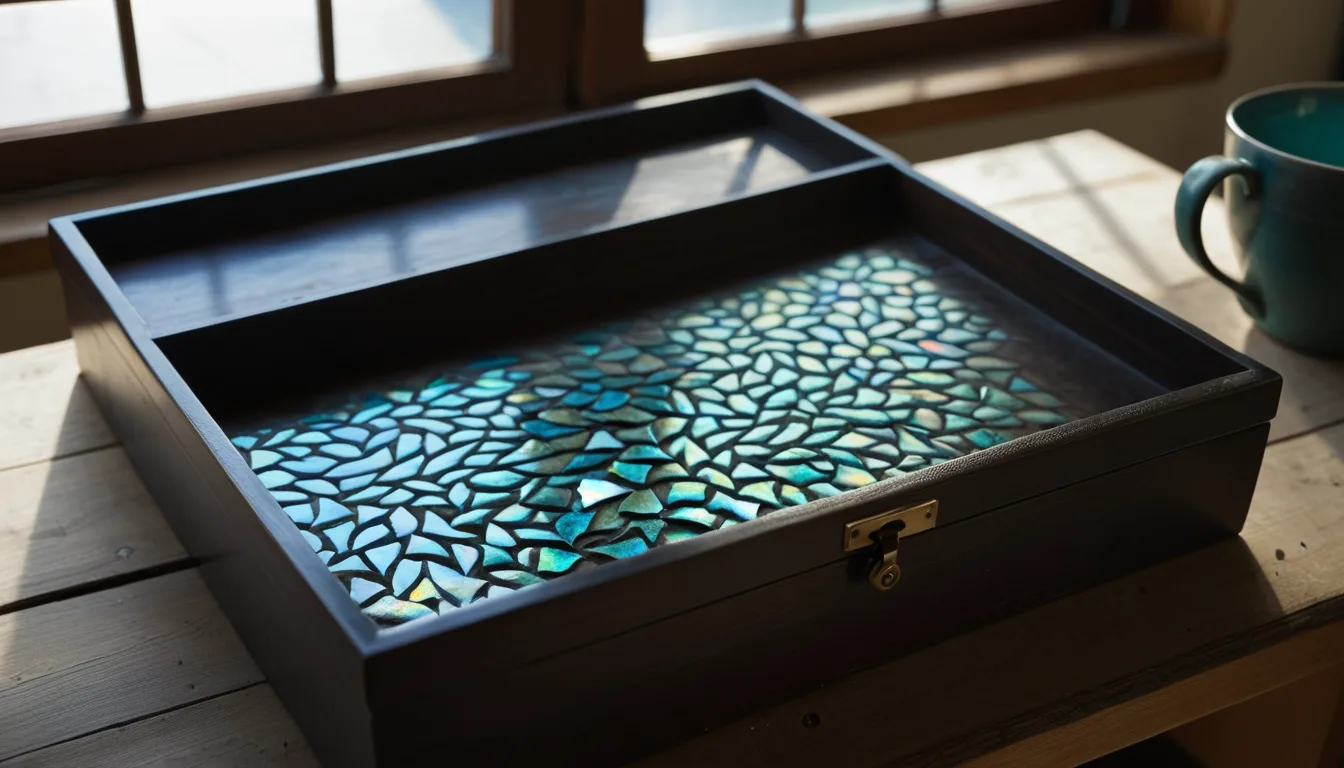
Cloth Wrapping and Lacquer Drying Conditions in the Encyclopedia of Korean Folk Culture
Production begins with the baekgol, the bare wooden body. The National Intangible Heritage description of najeonjang explains that the basic wooden frame is assembled, its surface sanded or its gaps filled until even, and the mother-of-pearl then attached; polishing, lacquering and buffing follow to finish the piece. The English Wikipedia entry "Najeonchilgi" lists wood, thickly layered paper, metal and porcelain as materials for the base, and puts the process at more than thirty stages.
The work done on the bare body has a stated reason. The Encyclopedia of Korean Folk Culture's entry on najeonchilgi writes: "The reason for cloth wrapping is to prevent the wooden baekgol from warping after the najeonchilgi is completed." Before anything decorative goes on, deformation of the base is forestalled. Groundwork comes before ornament.
Lacquer is demanding about conditions. The same entry states: "Lacquer dries only at a high humidity of 70–80% and a high temperature of 20–30℃, so it must be dried inside a lacquer cabinet (漆欌), and each cycle of applying one coat and drying it takes more than a day of drying time." Drying, not coating, governs the schedule. Completing a single piece of najeonchilgi, the entry adds, is reckoned to take more than a hundred passes of the hand. The number of stages and the drying time together stretch the production period out.
The name itself carries the process. The Encyclopedia of Korean Culture's entry on najeon states: "Because mother-of-pearl is generally attached over a lacquered ground, lacquer is applied again, and the surface is then polished so that the pattern emerges, it is customary to attach the word for lacquer to najeon and write najeonchilgi." The mother-of-pearl is covered once it has been attached, then revealed again by polishing. The pattern does not sit on top of the lacquer; it surfaces from within it. That is why chilgi follows najeon.
The Division of Labor Among Baekgoljang, Chiljang and Najeonjang
No single person handled every stage. The Encyclopedia of Korean Culture's entry on najeonjang states: "Traditionally, najeon lacquerware was produced through a division of labor among the baekgoljang (白骨匠), the chiljang (漆匠) and the najeonjang." The person who built the frame, the person who applied the lacquer and the person who set the mother-of-pearl were separate specialists.
The najeonjang's share lay in handling the shell. The same entry says the najeonjang cuts and trims the mother-of-pearl to the pattern and attaches it to the lacquered ground with isinglass or animal glue. The adhesives named are worth noting: isinglass and animal glue. Once the pattern is in place, thin raw lacquer (生漆) is brushed over the surface and dried, firmly fixing the mother-of-pearl to the lacquered ground. Attaching and fixing are set down as separate operations.
The finish returns to lacquer and polishing. The same entry says that once the inlay is complete, lacquer is applied repeatedly until the pattern and the lacquer surface (漆面) are level, after which the piece is polished and buffed to a shine. Bringing mother-of-pearl and lacquer surface to the same height is the goal of finishing, and it is why the surface feels like a single continuous plane.
Jureumjil (주름질), Kkeuneumjil, and Jureumjil (줄음질)
What separates the techniques is whether the mother-of-pearl works as a plane or as a line. The Encyclopedia of Korean Culture's entry on najeon states: "Jureumjil is originally the skill of cutting mother-of-pearl with a file and trimming it to the very shape of the object before attaching it, while kkeuneumjil refers to making thread-like strips of mother-of-pearl with a geodu and breaking them off as they are attached, so as to draw the pattern in line (線描)." One approach cuts and applies the whole form; the other breaks fine strips to draw lines. The same material takes two routes to entirely different images.
The tools differ too. The Encyclopedia of Korean Folk Culture's entry on najeonchilgi writes: "Jureumjil is the method of coating mother-of-pearl cut to the pattern with animal glue (阿膠), placing it on the lacquered ground and pressing it down with a heated iron, while kkeuneumjil is the technique of laying fine sangsa strips of mother-of-pearl on a glue-coated lacquered ground and snapping them off bit by bit with a knife as they are set to the pattern." A heated iron on one side, a knife on the other: the difference in process shows up in the tool held in the hand.
What gets depicted is recorded as well. The National Intangible Heritage description of najeonjang says that in the jureumjil technique the mother-of-pearl is rubbed thin and worked into designs such as chrysanthemums, bamboo and turtles. The English Wikipedia entry "Najeonchilgi" divides the ways of cutting mother-of-pearl into jureumjil and kkeuneumjil. The Encyclopedia of Korean Culture spells the term jureumjil (주름질), while the Encyclopedia of Korean Folk Culture and the National Intangible Heritage description use jureumjil (줄음질); both can be taken to point to the same operation, cutting mother-of-pearl to the pattern and attaching it to the lacquered ground.
Shell thickness has its own classification. The Japanese Wikipedia entry "螺鈿" notes that no clear standard divides thick shell from thin shell, and gives as an example the classification of thick shell as 1.5mm to 3.0mm and thin shell as 0.3mm to 1.0mm. The same entry mentions another practice: taking the thickness of a hundred stacked shell pieces as the unit. Thickness works less as a fixed numerical specification than as one way of sorting.
Goryeo Najeon in Dongguk Munheon Bigo and Seonhwa bongsa Goryeo dogyeong
The documentary record begins with a gift. The Encyclopedia of Korean Culture's entry on najeon names the Dongguk Munheon Bigo record that King Munjong sent najeonchilgi as a gift to the Liao royal house in the 11th century as the first documentary mention of najeon in the Goryeo period. The same entry says the contemporary estimation of Goryeo najeon appears clearly in the Goryeo dogyeong, written by the Song envoy Seo Geung (徐兢), who came to Goryeo in 1123. A diplomatic gift and an outsider's account survive together.
The appraisal itself is brief. The Encyclopedia of Korean Culture's entry on najeonjang reports that Seo Geung's Seonhwa bongsa Goryeo dogyeong (宣和奉使高麗圖經), written in 1124, records that "the work of mother-of-pearl inlay is fine and detailed, and may be called precious" (而螺鈿之工 細密可貴). What matters is that the praise rests on fineness alone: not the rarity of the material or the scale of the work, but the precision of the hand served as the measure. The same entry says this record offers a glimpse of the level of najeon technique in the Goryeo period.
Little has survived. The Encyclopedia of Korean Culture's entry on najeon counts roughly 15 Goryeo najeon lacquerware pieces in Korea and abroad combined, most of them scattered in foreign countries, Japan above all. The Encyclopedia of Korean Folk Culture's entry on najeonchilgi puts the figure at some 20 pieces in the entire world. Because the two counts differ, no single exact number can be settled on. The Encyclopedia of Korean Folk Culture states that only three pieces remain in Korea, all held by the National Museum of Korea: a mother-of-pearl sutra box, a mother-of-pearl covered bowl with chrysanthemum-and-vine design, and a mother-of-pearl and tortoiseshell Buddhist whisk with chrysanthemum-scroll design.
Broader statements cover the dynasty as a whole. The English Wikipedia entry "Najeonchilgi" records that Goryeo (918–1392) is counted the golden age of the craft and explains that it was influenced by Buddhism. The Encyclopedia of Korean Culture lists among the surviving works the sutra boxes, rosary boxes, incense cases and whisks used in Buddhist practice, along with nesting boxes, oil bottles and small boxes known as cosmetic implements. The uses spanned religion and daily life alike.
Joseon's Capital-Artisan Najeonjang and the Tongjeyeong at Tongyeong
In Joseon, najeon artisans worked inside government offices. The Encyclopedia of Korean Culture's entry on najeonjang says that in the Joseon period najeonjang were assigned as capital artisans — two to the Board of Works (工曹) and one to the Royal Wardrobe (尙衣院) — to produce the najeon lacquerware the court required. The figure of three is striking. One side of production, it may be read, was tailored to court demand.
The patterns changed over time. The National Intangible Heritage description of najeonjang says that in the Goryeo period and early Joseon the dominant motifs were plants such as peony, chrysanthemum and lotus, while mid-Joseon favored birds-and-flowers, paired cranes, grapes and the Four Gracious Plants. The repertoire widened from plants alone to compositions that mixed in birds and animals. What caused the change cannot be determined from this description alone.
Regional production is recorded too. The Encyclopedia of Korean Culture's entry on najeonjang says that najeon lacquerware for tribute to the court was also made in Tongyeong (統營) in South Gyeongsang Province, where the Tongjeyeong (統制營) naval headquarters was established after the Imjin War. The same encyclopedia's entry on najeon adds that an industrial training institute (工業傳修所) opened early in Tongyeong, a town that produced abundant abalone with beautiful color and little curvature in the shell, teaching the practical skills of najeon lacquer craft, and that countless small private workshops of cottage industry flourished there. The National Intangible Heritage description of najeonjang likewise names Tongyeong in South Gyeongsang Province as the region most famous for najeonchilgi today. Material, training and workshops overlapped in one place.
There is a record on the institutional side as well. The Encyclopedia of Korean Culture's entry on najeon says that to protect and foster najeon lacquer craft, the skills centered on jureumjil were designated Important Intangible Cultural Property Najeonjang in 1966, a designation that is now a National Intangible Heritage. That sentence makes clear which of the two techniques stood at the center of the designation.
Shōsōin Treasures, Yuan Thin-Shell Inlay and Goryeo Thin-Shell Inlay Compared
Thinness is set down as the hallmark of Goryeo mother-of-pearl. The Encyclopedia of Korean Culture's entry on najeon writes that the mother-of-pearl of this period was abalone shell ground as thin as a sheet of paper, with no examples of green turban shell or conch used thickly. The Japanese Wikipedia entry "螺鈿" likewise notes that Goryeo najeon, characterized by thin-shell inlay, appears in the Goryeo period, and that although the origin or transmission of the technique is unclear, the surviving examples suggest it may predate Chinese najeon of the Yuan period. The route of origin is left unsettled.
Accounts of China and Japan vary by period. The Japanese Wikipedia entry "螺鈿" says the technique developed greatly in the Tang period, and that although few examples have been found, the Shōsōin (正倉院) treasures in Japan show thick-shell inlay methods and a variety of mounting techniques. The same entry explains that najeon entered Japan from Tang China in the Nara period. It adds that the technique was scarcely carried on in the Song period and declined, and that records survive of Japanese and Goryeo najeon being esteemed even in China. The center of the technique, one may read, did not stay in one place.
The account of early Joseon runs the other way. The same entry says a new inlay method using thin shell appeared in the Yuan period, after which thin-shell inlay became the mainstream in China. It finds no trace of Goryeo najeon being carried on, and describes early Joseon najeon as using somewhat thicker shell, dominated by peony-scroll motifs with distinctive curves. The notable point is the shift from thin to thick.
Laid out item by item, the differences come out as follows. First, shell thickness: Goryeo on the paper-thin side, the Shōsōin treasures and early Joseon najeon on the thick side. Second, Japan: najeon arrived from Tang China in the Nara period. Third, China: the technique developed in the Tang period, declined in the Song period, and thin-shell inlay became mainstream in the Yuan period. The Encyclopedia of Korean Folk Culture's entry on najeonchilgi says that najeonchilgi developed across several East Asian regions where the lacquer tree grows naturally — China, Japan, Vietnam, Myanmar — and rates Korean najeonchilgi the finest of them; that judgment is best read as the assessment of that entry.
| Category | On shell and technique | On period |
|---|---|---|
| Goryeo najeon | Abalone shell ground as thin as a sheet of paper, with no examples of thick use | Characterized by thin-shell inlay; surviving examples suggest it may predate Chinese najeon of the Yuan period |
| Early Joseon najeon | Somewhat thicker shell, dominated by peony-scroll motifs with distinctive curves | Recorded as showing no trace of carrying on Goryeo najeon |
| China | A new inlay method using thin shell appeared in the Yuan period, after which thin-shell inlay became mainstream | The technique developed greatly in the Tang period, then was scarcely carried on in the Song period and declined |
| Japan | The Shōsōin treasures show thick-shell inlay methods and a variety of mounting techniques | Najeon arrived from Tang China in the Nara period |
| Thickness classification | One example classifies thick shell as 1.5–3.0mm and thin shell as 0.3–1.0mm | No clear standard is said to divide thick shell from thin shell |
Related reading: Why Were Norigae Hung Three to a Set? · How the Joseon Gat Became an Institution: Legal Codes, the Annals, and the Three Artisans of Gannil
Summing Up
The key to understanding najeonchilgi lies not in the shell but in the order of shell and lacquer. The name rests on this sequence: mother-of-pearl is attached, lacquer is applied over it, and polishing then reveals the pattern. The materials are mainly abalone, conch and pearl oyster shell, and in Korea abalone shell from the South Sea was traditionally used. The techniques divide between cutting to the shape of a motif and breaking fine strips to draw lines. Goryeo najeon is described as using thin shell and early Joseon najeon somewhat thicker shell, so thickness alone cannot define a single tradition.
The original passages can be checked directly. The entries on najeon and najeonjang in the Encyclopedia of Korean Culture, the entry on najeonchilgi in the Encyclopedia of Korean Folk Culture, and the National Intangible Heritage document introducing najeonjang are the sources of the sentences quoted here. The Japanese Wikipedia entry "螺鈿" and the English Wikipedia entry "Najeonchilgi" can be read alongside them for comparison. Where the figures disagree — as with the roughly 15 and the some 20 surviving pieces of Goryeo najeonchilgi — the discrepancy is best left standing.