1. The week at a glance: chip earnings, a Korean Series berth and a flu rebound
This week's roundup, covering October 26 to November 1, features three stories. Samsung Electronics and SK hynix posted record third-quarter results. The Samsung Lions reached the Korean Series for the first time in two years. And influenza-like illness cases rose again after three weeks of decline. The chip earnings came out on October 28–29, the flu figures on October 30 and the baseball result on November 1. Because the three stories come from unrelated fields, readers who follow them separately tend to remember only the numbers. This article therefore gives each story two sections. The first covers what happened, with dates, organizations and figures. The second covers what changes, how people reacted and where to check for yourself.
The chip story: Samsung Electronics reported third-quarter operating profit of 107.4 trillion won on October 29, and SK hynix reported 83.3 trillion won on October 28. The baseball story: the Samsung Lions beat the KIA Tigers 6-1 in Game 5 of the playoffs on November 1. They will meet regular-season champion KT Wiz in the Korean Series. The flu story: the KDCA's October 30 weekly bulletin showed influenza-like illness cases in week 43 rising from the previous week to 19.2 per 1,000 outpatients. The final section sets the three stories side by side and points out what to watch for.
2. Q3 chip earnings: Samsung Electronics' operating profit hits 107.4 trillion won, SK hynix's 83.3 trillion won (Oct 28–29)
On October 29, 2026, Samsung Electronics reported consolidated third-quarter revenue of 195.3 trillion won and operating profit of 107.4 trillion won. The company said it set new records for both revenue and operating profit for the fourth consecutive quarter. It also said it was the first global tech company to exceed 100 trillion won in quarterly operating profit. According to TheElec, third-quarter revenue and operating profit rose 127% and 783% year on year, respectively. The operating margin was 55%.
SK hynix disclosed its third-quarter results a day earlier, on October 28. MBC reported that operating profit was 83.3 trillion won, up 632% year on year. That extended a run of record highs to six consecutive quarters, dating back to the second quarter of last year. Revenue rose 327% to 104.6 trillion won. According to MBC, this was the first time SK hynix's quarterly revenue had exceeded 100 trillion won.
Put side by side, the two announcements show that "all-time high" can cover different stretches: Samsung Electronics claimed four consecutive record quarters, SK hynix six. The phrase "topping 100 trillion won" also meant different things. For Samsung Electronics it referred to operating profit; for SK hynix, to revenue. This can be seen as a sign that even when headlines look alike, readers should check which figure a record actually refers to.
3. Impact and reaction: Samsung's DS division posts 106.5 trillion won in operating profit as HBM4 sales more than triple (Oct 29)
Semiconductors drove the results. According to Samsung Electronics, its DS (semiconductor) division posted third-quarter revenue of 147.1 trillion won and operating profit of 106.5 trillion won. The company said its memory business achieved record quarterly results by sharply increasing HBM4 sales in line with rising AI demand and by meeting demand for server SSDs. TheElec reported that during the October 29 conference call (earnings briefing), the company said third-quarter HBM4 sales had more than tripled from the previous quarter. At SK hynix, MBC reported, DRAM results grew as shipments of HBM4, dubbed "sixth-generation memory," ramped up and sales of server DDR5 increased. By contrast, Samsung Electronics said its DX division, which launches new models such as the Galaxy Z Fold8, grew revenue year on year but continued to face a tough business environment, including rising component costs. Of the 107.4 trillion won in total operating profit, 106.5 trillion won came from the DS division, which shows that this record was mostly a semiconductor record.
The results also drew reactions. MBC (October 28) reported that SK hynix's operating profit far exceeded the market forecast of 76 trillion won. In the same report, the head of an investor protection association commented on SK hynix's dividend policy: "I think it was a truly surprising dividend policy, just like an earnings surprise." Comparing forecasts with actual figures helps separate two different claims. A "record" and an "unexpected" result are judged against different benchmarks.
Samsung Electronics' release included other figures too. Third-quarter R&D spending was 14.4 trillion won. The cash dividend was 4,601 won per share for both common and preferred shares, totaling 30 trillion won. TheElec reported that third-quarter net profit rose 5% from the previous quarter to 75.1 trillion won. Capital expenditure was 29 trillion won, up 12.2 trillion won from the previous quarter and 19.8 trillion won from a year earlier. Newsis reported that semiconductor exports in October 2026 reached 56.4 billion dollars, topping 50 billion dollars for a second straight month. To read the original, start with the segment figures in the earnings release on Samsung Newsroom.
4. Samsung Lions reach the Korean Series: a 6-1 win over KIA in Game 5 of the playoffs on November 1
On November 1, 2026, the Samsung Lions beat the KIA Tigers 6-1 in Game 5 of the playoffs at Samsung Lions Park in Daegu. The playoffs are a best-of-five series, so the first team to win three games advances. Samsung lost Game 1, won Games 2 and 3, dropped Game 4 and then won the deciding Game 5. With the win, Samsung returned to the Korean Series (best of seven) for the first time in two years.
One pitcher and one hitter stood out in the box score. Ilgan Sports reported that starting pitcher Ariel Jurado allowed just one run on five hits over seven innings. Leadoff hitter Kim Ji-chan went 3-for-4 with three RBIs and a stolen base. Newsis reported that Kim was named Game 5 MVP. The two teams traded wins all the way through, so the Korean Series berth came down to a single game: Game 5.

5. Impact and reaction: the Korean Series opens November 3 against regular-season champion KT
Samsung's Korean Series opponent is regular-season champion KT Wiz. Wikipedia's 2026 KBO League season article shows KT finishing first at 90-49-5 (a .647 winning percentage) and Samsung second at 83-58-3 (.589). The same article lists the Korean Series as running from November 3 to November 11 at Suwon KT Wiz Park and Daegu Samsung Lions Park. Ilgan Sports noted that Samsung's most recent Korean Series title came in 2014. Because the regular season's top two teams are meeting on the final stage, the standings and the postseason results can be read together.
Attendance records also made news. Newsis reported that Game 5 between KIA and Samsung drew a full house. That extended a streak of sellouts to 46 consecutive postseason games. The Wikipedia article puts total 2026 regular-season attendance at 12,770,551. According to Newsis, media day for the KT–Samsung Korean Series is set for November 2. If you plan to attend, first check which games are being played at each ballpark, Suwon or Daegu.
6. Influenza-like illness: week 43 cases rise again to 19.2 per 1,000 outpatients (KDCA, Oct 30)
A flu (influenza) epidemic advisory for this season was already issued in September. The KDCA tracks epidemics by season, a unit running from September to August of the following year. Segye Ilbo reported that the KDCA issued an influenza epidemic advisory for the 2026–2027 season effective midnight on September 11, 2026. At the time, the rate of influenza-like illness in week 36 (August 30–September 5) was 25.3 per 1,000 outpatients. That was above this season's epidemic threshold of 12.9. The KDCA defines an influenza-like illness case as a person with a fever of 38°C or higher along with a cough or sore throat.
The numbers moved again in late October. Newsis reported on the KDCA's October 30 infectious disease sentinel surveillance weekly bulletin. Influenza-like illness cases in week 43 (October 18–24) stood at 19.2 per 1,000 outpatients. The rate had fallen for three straight weeks: from 33 in week 39 to 23.6 in week 40, 21.6 in week 41 and 17.7 in week 42. In week 43 it rose from the previous week. The week 43 figure remains above the epidemic threshold of 12.9. If you look only at the decline, it is easy to assume the epidemic is winding down. Tracing the weekly numbers shows exactly when the direction changed again.
Hospitalization figures moved somewhat differently. According to the KDCA, influenza hospitalizations at hospital-level facilities in week 43 totaled 380. That was down slightly from the previous week but about four times the figure for the same period last year (98). As of the September 11 report, people aged 65 and older made up 60.0% of hospitalized patients. Outpatient influenza-like illness cases rose while hospitalizations dipped slightly. That divergence shows how hard it is to judge the situation from a single indicator.
7. Impact and reaction: increases among school-age children and people 65 and older as the KDCA urges vaccination (Oct 30)
The week 43 increase varied by age group. Newsis reported that the rate rose from 47.8 to 49 among 7- to 12-year-olds and from 30.3 to 30.6 among 13- to 18-year-olds, a clear increase among school-age groups. Among people 65 and older, it rose from 5.9 to 7.3. These figures and the hospitalization share for people 65 and older come from different dates. Read together, though, they suggest that the groups with the highest influenza-like illness rates may not be the groups that account for most hospitalizations.
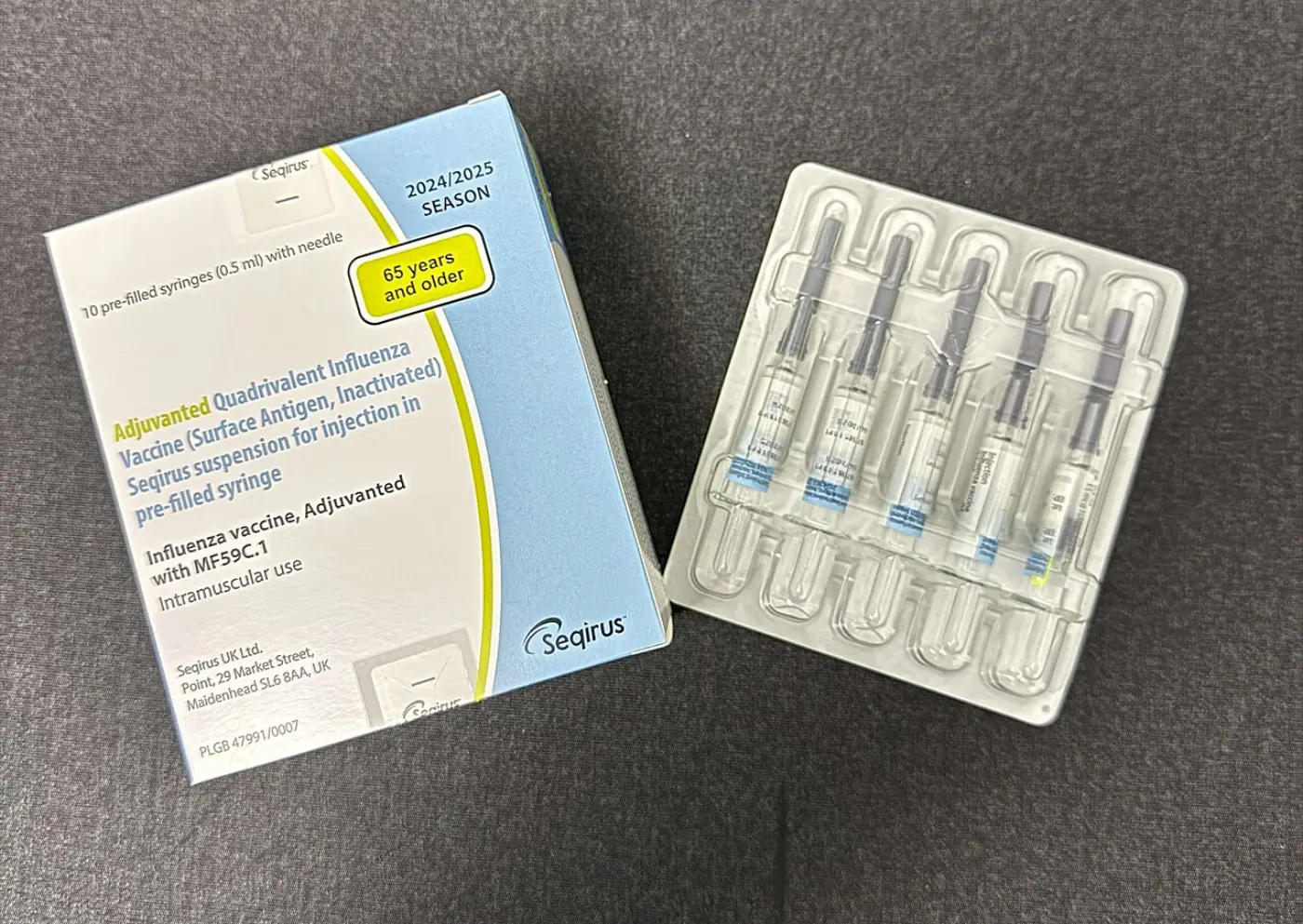
On October 30, the KDCA advised that "children, older adults and others should get the influenza vaccine, and if symptoms such as high fever develop, early diagnosis and treatment are needed." Earlier, on September 11, the KDCA commissioner urged, "I hope people get vaccinated on schedule according to their group, including older adults aged 65 and over, pregnant women and children." The KDCA rolled out its national influenza vaccination program in stages starting September 21. As of an October 27 report, influenza vaccinations are available until April 30, 2027, and COVID-19 vaccinations until June 30, 2027.
A few points help when reading the numbers. According to the KDCA, influenza-like illness surveillance is conducted at 300 clinic-level facilities nationwide (pediatrics, internal medicine, family medicine and otolaryngology). In other words, it does not count every patient; it tracks trends through cases reported by designated clinics. The epidemic threshold is set before each season after consultation with an expert advisory panel. During an epidemic advisory period, national health insurance covers antiviral drugs for high-risk groups prescribed on suspected symptoms alone, without separate testing. These groups include children, pregnant women or mothers within two weeks of giving birth, people 65 and older, immunocompromised people and those with underlying conditions. So an epidemic advisory is not just a warning; it also changes how patients are treated.
| Issue | Date | What happened | Official source |
|---|---|---|---|
| Samsung Electronics and SK hynix Q3 earnings | Oct 28 (SK hynix), Oct 29 (Samsung Electronics) | Q3 operating profit of 83.3 trillion won and 107.4 trillion won, respectively, extending runs of consecutive records | Samsung Newsroom earnings release, MBC report |
| Samsung Lions reach the Korean Series | Nov 1 | Beat KIA 6-1 in Game 5 of the playoffs; Korean Series against KT Wiz from Nov 3 | Ilgan Sports and Newsis game reports |
| Influenza-like illness rises again | Released Oct 30 (week 43, Oct 18–24) | Influenza-like illness cases up from the previous week to 19.2 per 1,000 outpatients; 380 hospitalizations | KDCA infectious disease sentinel surveillance weekly bulletin (reported by Newsis) |
8. Wrap-up: the three stories, revisited through numbers and sources
First, the chip story is a reminder to check what a "record" covers. As noted above, Samsung Electronics crossed the 100-trillion-won quarterly mark for the first time in operating profit, while SK hynix did so in revenue. Both companies put HBM4 at the center of their earnings explanations. Yet some divisions within the same company reported difficulties, such as Samsung Electronics' DX division. The headline totals do not reveal that.
Second, the baseball story lets you look at a single game and a full season together. Samsung closed out a back-and-forth playoff series with a 6-1 win in Game 5 and will face regular-season champion KT from November 3. In the regular season, KT posted a .647 winning percentage and Samsung .589. Reports of 46 consecutive postseason sellouts add another set of numbers, attendance, separate from the results on the field.
Third, the flu story shows why trends and thresholds should be read together. The week 43 figure of 19.2 per 1,000 outpatients is an increase after three weeks of decline, and it remains above the epidemic threshold of 12.9. Cases rose among both school-age children and people 65 and older. Hospitalizations were about four times those of the same period last year. The KDCA urged children, older adults and others to get vaccinated. It also advised anyone with symptoms such as high fever to seek early diagnosis and treatment.
Related reading: Lockouts and strikes: who carries out each, and how do they differ? · Korea's 'bad' fine dust forecast: what ㎍/㎥ level it means and what to do