The short answer
The Shanhaijing (山海經, Classic of Mountains and Seas) entries on Jingwei, Kuafu, Nüwa and Xiwangmu are short. Most are a single sentence or a few phrases. Even within the Shanhaijing, Kuafu's details change from one chapter to the next. For Xiwangmu, the Queen Mother of the West, dictionary commentary describes how her image changed in stages in later texts. The entry on Xiwangmu in Kotobank (コトバンク) explains that a being with animal markings became an immortal maiden holding the elixir of immortality in the Huainanzi (淮南子). This is the second part of a three-part series.
This article covers the original texts on the four Shanhaijing figures and Xiwangmu's later changes. Wikisource (維基文庫) presents the Shanhaijing chapter by chapter, so readers can check the original text directly. Every classical Chinese quotation here comes from those pages.
Jingwei in the Beishan jing: a transformation folded into one sentence
The Beishan jing (北山經, Classic of the Northern Mountains) features a bird called Jingwei (精衛). The text first describes its appearance: "有鳥焉,其狀如烏,文首、白喙、赤足,名曰精衛,其鳴自詨。" In paraphrase: there is a bird shaped like a crow. It has a patterned head, a white beak and red feet. It is called Jingwei, and its cry calls out its own name.
Jingwei's backstory fits into a single sentence: "是炎帝之少女,名曰女娃,女娃游于東海,溺而不返,故為精衛,常銜西山之木石,以堙于東海。" In other words, the bird is the youngest daughter of Yan Di (炎帝), and her name is Nüwa (女娃). Nüwa was playing in the Eastern Sea when she drowned. She never came back, and so she became Jingwei. Jingwei constantly carries twigs and stones in her beak from the Western Hills (西山) to fill in the Eastern Sea.
The entry treats appearance and backstory separately. The description lists colours and body parts one after another. The backstory packs death, transformation and unending action into a single sentence. The structure can be seen as three events strung together by just a few commas.
This helps pin down where the Jingwei story starts. The Shanhaijing entry describes no feelings and contains no dialogue. Yet one character, 常 ("constantly"), tells us the action never stops. The tension of this short record can be read as resting on that one character.

Kuafu in the Haiwai beijing: the staff that became a forest
The Haiwai beijing (海外北經, Classic of Regions Beyond the Seas: North) features Kuafu (夸父), the figure who chased the sun. His whole story takes up only a few phrases: "夸父與日逐走,入日。渴,欲得飲,飲於河、渭,河、渭不足,北飲大澤。未至,道渴而死。棄其杖,化為鄧林。"
In paraphrase: Kuafu raced after the sun. When he grew thirsty, he drank from the Yellow River (黃河) and the Wei River (渭水). When the two rivers were not enough, he went north to drink from the Great Marsh (大澤). He never reached it and died of thirst on the way. The staff he threw aside became a forest called Denglin (鄧林).
The same chapter also describes the people of the Kuafu state (夸父國): "其為人大,右手操青蛇,左手操黃蛇。鄧林在其東,二樹木。" They are large people. Each holds a blue-green snake in the right hand and a yellow snake in the left. Denglin lies to their east.
In this chapter, the Kuafu story ends with the Denglin forest. The chapter then locates the forest again, using the Kuafu state as a reference point. The story's ending is thus tied to geography. This suggests that the Kuafu story also explains how one particular forest came to be. Here we can see myth and description of place recorded as a single whole.
Kuafu in the Dahuang beijing: an added lineage and two deaths
The Dahuang beijing (大荒北經, Classic of the Great Wilderness: North) tells of Kuafu again. In this chapter he lives on Mount Chengdu Zaitian (成都載天山): "有人珥兩黄蛇,把兩黄蛇,名曰夸父。后土生信,信生夸父。" Kuafu wears two yellow snakes as earrings and holds two more in his hands. Houtu (后土) begot Xin (信), and Xin begot Kuafu.
This chapter's version of the sun chase passes judgment on him: "夸父不量力,欲追日景,逮之于禺谷。將飲河而不足也,將走大澤,未至,死于此。" Without measuring his own strength, Kuafu chased the sun's shadow. He caught up with the sun at Yu Valley (禺谷). He tried to drink the Yellow River, but it was not enough. He set out for the Great Marsh and died before he reached it.
The same chapter also preserves a different tradition: "應龍已殺蚩尤,又殺夸父,乃去南方處之,故南方多雨。" In this version, Yinglong (應龍) had already killed Chiyou (蚩尤) and went on to kill Kuafu as well. Yinglong then settled in the south. That, the text says, is why the south gets so much rain.
Set beside the Haiwai beijing, the differences are clear. The Dahuang beijing adds Kuafu's lineage, the judgment 不量力 ("not measuring his strength") and the place name Yu Valley. Within one chapter, it also holds two deaths: one from exhaustion and one at Yinglong's hands. This suggests that the Shanhaijing did not record a single fixed version of the Kuafu story. The key point is that short records already expand and branch within a single book.

Nüwa in the Dahuang xijing: ten gods born from her intestines
The Dahuang xijing (大荒西經, Classic of the Great Wilderness: West) mentions Nüwa (女媧) in just one sentence: "有神十人,名曰女媧之腸,化為神,處栗廣之野,横道而處。" There are ten gods called "the Intestines of Nüwa." They are Nüwa's intestines transformed into gods. They live on the plain of Liguang (栗廣), lying across the road and blocking the way.
The subject of this sentence is the ten gods, not Nüwa. Nüwa appears only as a name that explains where the gods came from. The sentence says nothing about her own actions or appearance. The entry therefore reads less as a story about Nüwa than as an account of the ten gods' origin.
The names also need care. As noted above, Jingwei's original name is Nüwa (女娃), while the Nüwa in this section is written 女媧. The two names sound alike in Korean, but their characters differ. Knowing this keeps you from mixing up the two records.
Even so, this entry has something in common with the Jingwei and Kuafu records. A person becomes the bird Jingwei, Kuafu's staff becomes a forest, and Nüwa's intestines become gods. The text marks all three transformations with the short words 為 or 化為. These records share one habit: they state the result of a transformation rather than describing it at length.
Xiwangmu in the Dahuang xijing and the Hainei beijing
The Dahuang xijing locates the Mound of Kunlun (崑崙) as follows: "西海之南,流沙之濱,赤水之後,黒水之前,有大山,名曰崑崙之丘。" South of the Western Sea, on the shore of the Flowing Sands (流沙), there is a great mountain. It lies behind the Red River (赤水) and in front of the Black River (黑水). It is called the Mound of Kunlun.
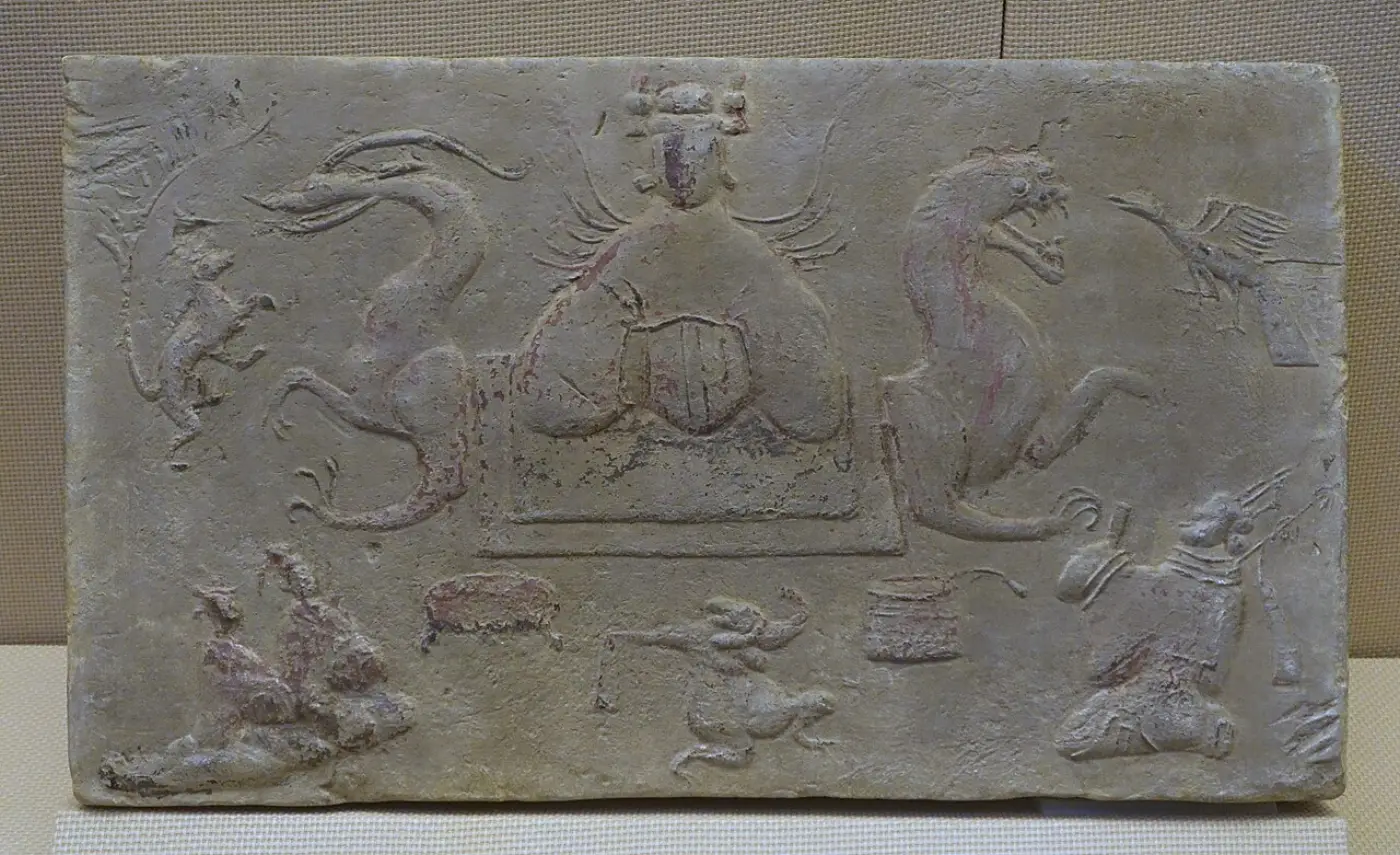
The same chapter describes Xiwangmu (西王母), the Queen Mother of the West, like this: "有人,戴勝,虎齒,有豹尾,穴處,名曰西王母。此山萬物盡有。" There is a being who wears a sheng (勝) headdress and has tiger's teeth and a leopard's tail. This being lives in a cave and is called Xiwangmu. The mountain holds every kind of thing.
A commentary note on the Wikisource page for the Hainei beijing (海內北經, Classic of Regions Within the Seas: North) quotes another Xiwangmu entry: "西王母梯几而戴勝,其南有三青鳥,為西王母取食。在昆侖虛北。" Here Xiwangmu leans on an armrest and wears a sheng. To her south are three blue birds (三青鳥), which fetch food for her. The place lies north of the Kunlun Mound (昆侖虛).
The feature both records share is the sheng. The Dahuang xijing stresses animal-like features: tiger's teeth, a leopard's tail and life in a cave. The entry quoted in the Hainei beijing commentary shows her leaning on an armrest and attended by birds. Read side by side, they suggest that even the Shanhaijing did not record Xiwangmu in only one form. It is also worth noting that both records mention her together with the place name Kunlun.

The Huainanzi and the Liezi: Kotobank on how Xiwangmu changed
Kotobank's entry on Xiwangmu traces her origins back to the Yin period (殷代). It explains that the "Ximu" (西母) of the oracle bone inscriptions is thought to be Xiwangmu. Citing the Shanhaijing's Xishan jing (西山經, Classic of the Western Mountains), the entry also describes her appearance: a human face, tiger's teeth, a leopard's tail and dishevelled hair.
According to the entry, later texts gradually idealized Xiwangmu. In the Lanming xun (覽冥訓) chapter of the Huainanzi, she appears as an immortal maiden who holds the elixir of immortality. The "King Mu of Zhou" (周穆王) chapter of the Liezi (列子) and the Mu Tianzi zhuan (穆天子傳) feature King Mu of Zhou (周). He is said to have set out on an expedition to the west and roamed with Xiwangmu at the Jade Pool (瑤池). The entry adds that the Hanshu (漢書) records an explosive spread of Xiwangmu worship at the end of the Western Han.
In this account, the changes can be read as running in three directions. The first is appearance: a being with animal markings becomes an immortal maiden in the Huainanzi. The second is relationships: in the Liezi and the Mu Tianzi zhuan, Xiwangmu meets a king, King Mu of Zhou. The third is worship: the Hanshu records her spreading widely as an object of worship.
The tiger's teeth and leopard's tail of the Dahuang xijing also appear in the Xishan jing passage that Kotobank cites. The same features thus span two chapters of the Shanhaijing. So the "beautification" arguably stands out more clearly against her overall image across the Shanhaijing than against a sentence from a single chapter.
Xiwangmu in the Shanhaijing and in later texts: a point-by-point comparison
Kotobank also sums up the change in a single sentence. Over time, it says, beliefs about immortals shaped Xiwangmu, and she became a beauty with fine eyes. Her home also became fixed at Mount Kunlun, the sacred mountain of the west. With this summary as a guide, we can compare the Shanhaijing records with her later image point by point.
First, appearance. The Dahuang xijing describes tiger's teeth and a leopard's tail, and Kotobank explains that she later became a beauty. Second, home. The Dahuang xijing says she lives in a cave. The entry in the Hainei beijing commentary places her north of the Kunlun Mound. Later, Mount Kunlun became her fixed home. Third, what she carries. Both Shanhaijing records mention the sheng, while the Xiwangmu of the Huainanzi's Lanming xun holds the elixir of immortality. Fourth, who is with her. In the Shanhaijing, three blue birds bring her food. In the Liezi, King Mu of Zhou roams with her.
Laid out this way, Kunlun turns out not to be a later addition. It can be read as a place already linked with Xiwangmu in the Shanhaijing that later became fixed as her home. Her appearance, by contrast, changed in almost the opposite direction. Seeing this difference helps avoid two oversimplifications. One treats the later Xiwangmu as a completely different being. The other treats her as the same figure carried over unchanged.
A comparison with Kuafu reveals one more difference. Kuafu's details vary from chapter to chapter within the Shanhaijing. Xiwangmu, by contrast, is described as changing in character in texts outside it. Taken together, the two cases suggest that short records grow longer in two ways: inside the book and outside it.
| Text and chapter | Figures | Passages used in this article | How it differs from other records |
|---|---|---|---|
| Shanhaijing, Beishan jing | Jingwei, Yan Di, Nüwa (女娃) | Jingwei's appearance and how she came to fill the Eastern Sea | Tells in one sentence how a person became a bird |
| Shanhaijing, Haiwai beijing | Kuafu, the people of the Kuafu state | Kuafu dies chasing the sun, and his staff becomes Denglin | Ties the ending to the location of the Denglin forest |
| Shanhaijing, Dahuang beijing | Kuafu, Houtu, Xin, Yinglong, Chiyou | Kuafu's lineage, the chase to Yu Valley, the Yinglong tradition | Gives two accounts of Kuafu's death |
| Shanhaijing, Dahuang xijing | Nüwa (女媧), Xiwangmu | The ten gods born from Nüwa's intestines; Xiwangmu wearing a sheng | Describes Xiwangmu as a cave-dweller with tiger's teeth and a leopard's tail |
| Xiwangmu entry quoted in the commentary on the Shanhaijing's Hainei beijing | Xiwangmu, the three blue birds | Xiwangmu leaning on an armrest and wearing a sheng | Three blue birds bring Xiwangmu food |
| Huainanzi, Lanming xun, and Liezi, "King Mu of Zhou" (Kotobank commentary) | Xiwangmu, King Mu of Zhou | The immortal maiden with the elixir of immortality; roaming at the Jade Pool | She appears as an immortal maiden in the Huainanzi and roams with King Mu of Zhou in the Liezi |
Summing up
The Shanhaijing records of all four figures keep only the essentials, such as transformations or locations. Brevity also leaves many gaps. The text does not dwell on what drives Jingwei to fill the sea or why Kuafu chases the sun. Xiwangmu's case suggests that later texts could fill such gaps with an elixir, an encounter and a cult.
Some questions remain. How do the two deaths of Kuafu in the Dahuang beijing relate to each other? How does the Xiwangmu of the Xishan jing, as Kotobank cites it, differ in detail from the Xiwangmu of the Dahuang xijing? And how should readers tell apart similar-sounding names such as 女娃 and 女媧? These questions can be explored by rereading the original text chapter by chapter.