The short answer: about 63% of Korea's land is forest
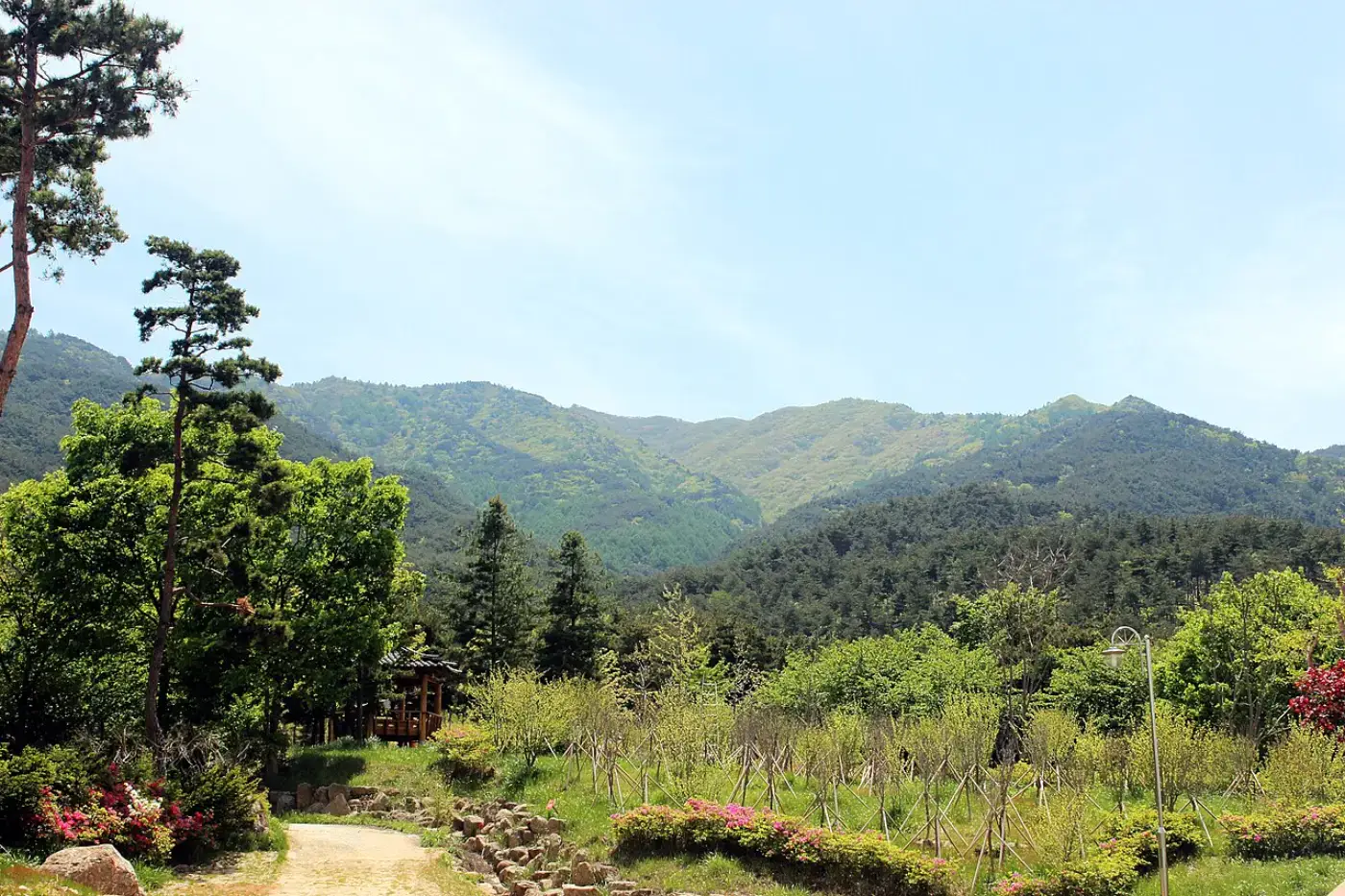
About 63% of Korea's land is forest, the fourth-highest share among the countries of the Organisation for Economic Co-operation and Development (OECD). At the end of 2020, Korea had 6.29 million ha of forest, equal to 62.6% of its land. The three countries ahead of it are Finland (73.7%), Sweden (68.7%) and Japan (68.4%).
e-Narajipyo, Korea's national indicator system, puts the forest share at the end of 2020 at 62.7%. It uses a national land area of 10,041 thousand ha as the denominator. It cites the Ministry of Land, Infrastructure and Transport's Cadastral Statistics Yearbook (2021) as the source of this figure. "About 63%" can be seen as an answer that covers both figures.
Korea can also be compared with the world as a whole. The Food and Agriculture Organization of the United Nations (FAO) estimates global forest area in 2025 at 4.14 billion ha, or 32% of total land area. Korea's forest share is close to double that. Keep in mind, though, that the two numbers come from different reference years and different agencies.
Basic Forest Statistics 2015 and 2020: less forest area, more growing stock
The Basic Forest Statistics measure forest area and growing stock every five years. The 2020 figures come from the 7th National Forest Inventory, carried out from 2016 to 2020. The previous edition, the Korea Forest Service's 2015 Basic Forest Statistics, put forest area in 2015 at 6,335,000 ha, or 63.2% of the country's land.
Forest area in 2020 was 48,000 ha smaller than in 2015. According to Newsis, the decline came from forest land being converted to roads, building sites, factory sites and other uses. e-Narajipyo says forests shrank by an average of about 7,296 ha a year over the five years from 2015. That is roughly 25 times the size of Yeouido each year, by its reckoning.
Newsis defines growing stock as "the measure of how dense a forest is (the timber volume of its trees)." In 2020, growing stock stood at 165 m³ per ha. That was up 13% from 146 m³ five years earlier and up 30% on ten years earlier. Total growing stock reached 1,038.37 million m³. This was 18.4 times the level of 1946, the year Arbor Day was established. It was also 13.9 times the level of 1973, the first year of the national reforestation and erosion-control campaign. Taken together, the two trends show that the forest share measures only how much land forests cover, not how dense they are.
OECD forest rankings and Japanese government data: Korea and Japan compared
Korea also ranked 4th in the OECD in the 2015 Basic Forest Statistics. The countries ahead of it then were Finland (73.1%), Japan (68.5%) and Sweden (68.4%). In the 2020 figures, the order was Finland, Sweden and Japan, with Korea in 4th place. e-Narajipyo gives the same order and figures. Korea held 4th place both times, while Japan and Sweden swapped 2nd and 3rd.
Japanese government data paint a similar picture. A public-information page from Japan's Ministry of Agriculture, Forestry and Fisheries (農林水産省) states: "日本は、国土の7割近くを森林が占めています。" In English: "Forests cover nearly 70% of Japan's land."
Here is how the two countries compare, item by item. On forest share, Korea stands at 62.6% and Japan at 68.4%, according to the comparison figures in the 2020 Basic Forest Statistics. On OECD ranking, Korea was 4th in both 2015 and 2020. Japan was 2nd in 2015 and 3rd in 2020. In other words, the two countries sit side by side in the rankings, yet their forest shares differ by about 6 percentage points.
Forest share by region in e-Narajipyo: Gangwon at 81.2%, Seoul at 25.3%
e-Narajipyo also breaks forest shares down by province and metropolitan city. Gangwon Province has the highest at 81.2%, and North Gyeongsang Province stands at 70.1%. Seoul has the lowest at about 25.3%. The highest share is more than three times the lowest. The national figure of about 63% can be said to hide these regional differences within an average.
Measured by area, the two provinces stand out even more. In 2015, Gangwon had 1.37 million ha of forest and North Gyeongsang 1.34 million ha, together 43% of Korea's total forest area. In 2020, Gangwon had 1.35 million ha and North Gyeongsang 1.33 million ha, together 42.8%. In both years, the two provinces held more than 40% of the country's forests.
Korea's forests in 2020 can also be divided by ownership. National forests covered 1.66 million ha (26.3%) and public forests 480,000 ha (7.7%). Private forests made up the largest share at 4.15 million ha (66.0%). Nearly two-thirds of Korea's forests, in other words, are privately owned. How much forest there is and who owns it are separate questions.
The FAO's Global Forest Resources Assessment 2025: forests on 32% of the world's land and how they are distributed
The FAO's Global Forest Resources Assessment (FRA) 2025 covers 236 countries and territories. The FAO describes it as the only global assessment based on official national data, with a transparent methodology and broad scope. The full FRA 2025 report is available in the FAO Open Knowledge repository. Korea's figures appear on the forest area page of e-Narajipyo.
FRA 2025 shows that forests are unevenly distributed. Of the 10 countries and territories with the highest forest shares, seven have shares of 90% or more. At the other end, seven have no forest at all and 49 have less than 10%. Five countries hold 54% of the world's forests: Russia, Brazil, Canada, the United States and China. By region, Europe accounts for 25%, South America 20%, North and Central America 19%, Africa 16%, Asia 15% and Oceania 4%. So while Korea's 62.6% ranks 4th in the OECD, it can be read as occupying a different position from the world's top tier.
The FAO also tracks how the world's forests are changing. Deforestation fell from 17.6 million ha a year in 1990–2000 to 10.9 million ha a year in 2015–2025. Annual net forest loss fell from 10.7 million ha in the 1990s to 4.12 million ha in 2015–2025. About 489 million ha were lost to deforestation between 1990 and 2025, but the pace has slowed. Asia recorded the largest annual net gain of any region in 2015–2025, at 1.62 million ha. That figure is a total for the whole region. It covers a different period and scope from Korea's 2015–2020 decline discussed earlier, so this difference needs to be kept in mind when the two are set side by side.
| Country | Forest share, 2020 Basic Forest Statistics | Forest share, 2015 Basic Forest Statistics | OECD rank (2015 → 2020) |
|---|---|---|---|
| Finland | 73.7% | 73.1% | 1st → 1st |
| Sweden | 68.7% | 68.4% | 3rd → 2nd |
| Japan | 68.4% | 68.5% | 2nd → 3rd |
| Korea | 62.6% (e-Narajipyo: 62.7%) | 63.2% | 4th → 4th |
Summing up
Korea's forest share is the result of a survey taken at a single point in time. The Basic Forest Statistics come out every five years, so "about 63%" should always come with a reference year. The figures point to three things. First, forest area and forest density moved in opposite directions. Second, the national average hides the large gap between Gangwon and Seoul. Third, the OECD ranking and the global distribution place the same figure in different positions.
Some questions remain open. How the shrinking area and rising growing stock will show up in the next National Forest Inventory must wait for new statistics. In the meantime, readers can open the regional table in e-Narajipyo alongside the country tables in the FRA 2025 report. Reading them side by side gives a more concrete sense of how far the description of Korea as a "mountainous, wooded country" holds true.