The short answer: an upgrade program to cut power losses and boost supply capacity
Korea's household voltage became 220V because of a state-led voltage-upgrade program. A 2005 Kyunghyang Shinmun (京鄕新聞) article describes its purpose as expanding power supply capacity and reducing power losses, and reports that the project to raise 110V to 220V was completed after 32 years.
The same article also outlines how voltages are distributed around the world. By its count, 141 countries, including Korea, use only 220V; China, the UK, France and Germany are among them. Another 51 countries, including Japan, the US and Canada, use 110V alongside 220V, and eight countries, including Senegal, use only 110V.
Set side by side, these numbers place Korea among the majority of countries that use only 220V. The classification, however, dates from the 2005 article, so the figures are best read as a snapshot of the world at the moment Korea's upgrade was completed.
A 1963 policy decision and 3,000 households in Gangwon in 1973
A 1990 Seoul Shinmun article dates the start of the upgrade program to 1963. According to the article, academics, KEPCO (Korea Electric Power Corporation) and home-appliance makers met under government leadership and decided on the project, which the article calls a national policy project. It also describes conditions in 1965, when the rural electrification program began: annual electricity consumption per person was 86kWh.
KEPCO's webzine briefly describes the decision and the first supply. KEPCO says it settled on 220V after a comprehensive analysis of global trends and future demand. It then selected several areas, including Yangjae-dong in Seoul, where some 5,000 households were the first to receive 220V. After that, the program expanded in earnest to other regions, and KEPCO names 3,000 households in Gangwon Province in 1973 as its starting point.
This record separates the year of the decision from the year construction began: 1963 was when the policy was set, and 1973 was when full-scale work started. It is easy to picture the upgrade as a single switchover, but the sources show several stages: a decision, a pilot supply and region-by-region expansion.
KEPCO's explanation of the principle and the 1990 Seoul Shinmun figures
KEPCO's webzine explains the principle in a single sentence: "Power loss on distribution lines decreases in inverse proportion to the square of the supply voltage." The same article gives a concrete figure: raising 110V to 220V cuts power loss on distribution lines by about 75%.
The 1990 Seoul Shinmun article gives slightly different figures. In it, KEPCO uses the example of raising the voltage from 100V to 220V: wire of the same thickness can carry 2.2 times as much power, and the electricity lost can be cut by 80%. Because the two sources start from different voltages, 100V and 110V, their figures are better read as calculations from different starting points than as errors.
The same principle was applied to transmission. A subject description in the National Archives of Korea outlines how the voltage hierarchy of the transmission system changed, from 154kV-66kV-22kV-6.6kV(3.3kV) to 765kV-345kV-154kV-22.9kV. The National Archives says this shift to higher and simpler voltage levels helped improve reliability and reduce transmission losses. The household upgrade and the higher transmission voltages can be seen as the same principle applied at different levels of the grid.
From a 67% conversion rate in 1989 to completion in October 2005
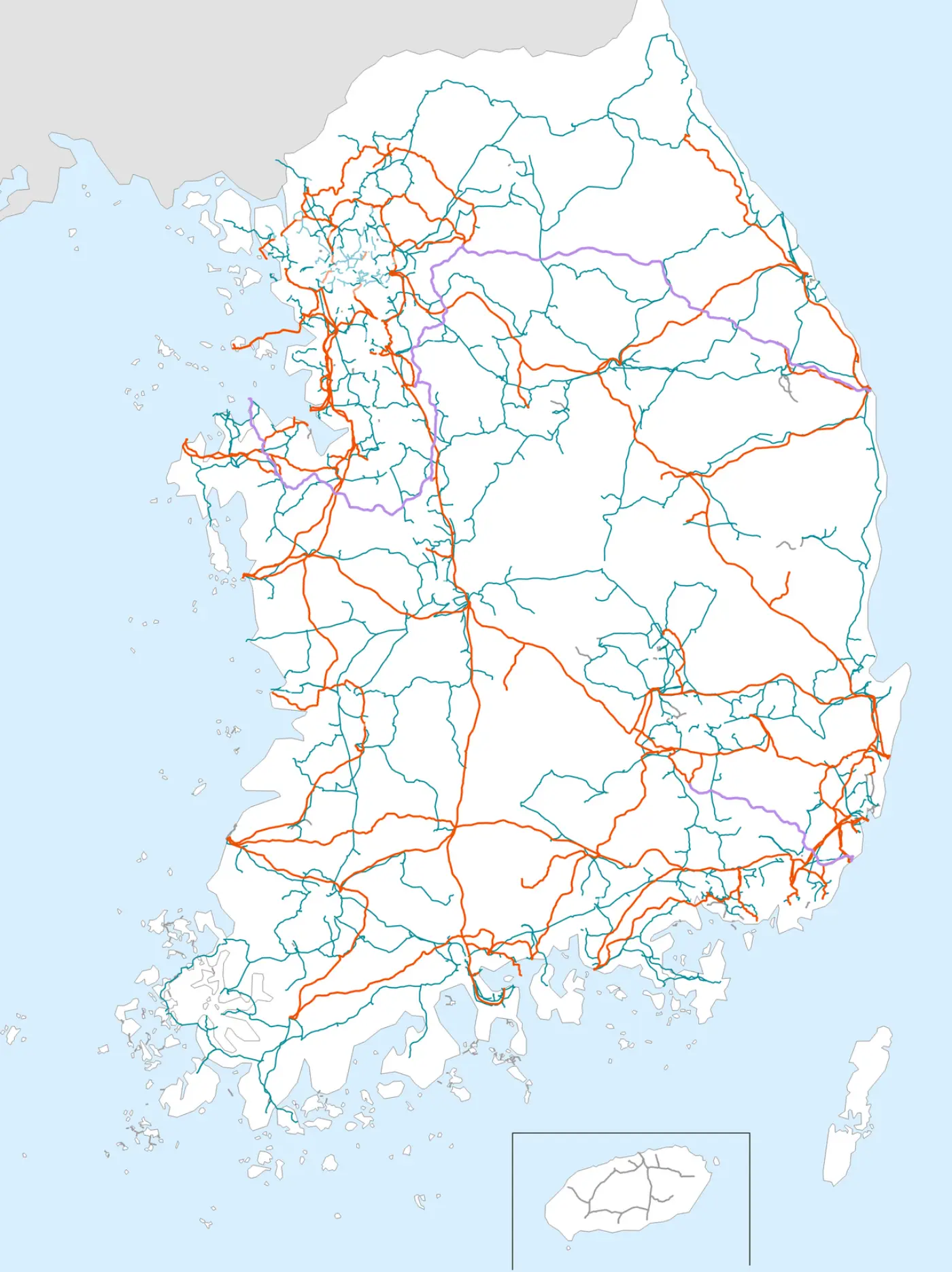
The 1990 Seoul Shinmun article also offers an interim progress report. By the end of 1989, 5,603,000 of the country's 8,392,000 households had been converted, a conversion rate of 67%. The article notes that big cities lagged behind rural areas. Home appliances had spread earlier in the cities, so replacing them with 220V models was a heavier burden, and work therefore began in farming and fishing villages.
The National Archives and KEPCO describe the transition period slightly differently. The National Archives says that from 1980, direct conversion to 220/380V was pursued alongside a 110/220V dual-voltage (single-phase three-wire) system. KEPCO describes 1977 to 1987 as the transition period of 110V/220V dual-voltage work. Both put the finish in 2005: the National Archives says the work was completed except in a few exempt areas, and KEPCO says it finished upgrading households to 220V and industry to 380V in October 2005.
The results were documented too. According to the 2005 Kyunghyang Shinmun article, the investment totaled 1.4 trillion won, or 3.4 trillion won in end-2004 value. KEPCO told the paper that the upgrade doubled power capacity without adding facilities, cut power losses by 75% and brought the transmission and distribution loss rate to around 4.5%. The annual reduction in losses, 4 billion kWh, was equivalent to the output of one 450,000kW power plant. The National Archives says that unifying the voltage hierarchy lowered the transmission and distribution loss rate to 4.43%. The two agencies state the rate slightly differently, but their figures can be seen as pointing to the same range.
Edison's 1882 patent in the US and AEG's 50Hz in Germany
The American side of the story comes from material published by the IEEE History Center. Edison designed high-resistance lamp filaments, which he considered desirable for reducing distribution losses, and in 1882 he applied for a patent on a three-wire system that transmitted at 220V and used 110V lamps. On the US standard of 120V, the material's assessment is brief: "120 seems to have been chosen somewhat arbitrarily."
Frequency followed a different path from voltage. According to the same IEEE material, AEG, which used 50Hz, held a virtual monopoly in Germany, and its standard spread across continental Europe. IEEE's page on the Sakuma Frequency Converter Station covers Japan: in 1895 the Tokyo Electric Light Company brought in AEG's 50Hz generators. Today Japan's grid is split between 50Hz in the east and 60Hz in the west, and IEEE describes Japan as the only industrialized country that uses two commercial frequencies within its borders.
Here is how the four countries compare. In the Kyunghyang Shinmun classification, Korea uses only 220V; it made the policy decision in 1963 and carried out the full-scale upgrade from 1973 to 2005. The US is classed as using both 110V and 220V, and Edison's 1882 three-wire patent is on record there. Japan is also classed as using both, and its grid is split between 50Hz in the east and 60Hz in the west. Germany uses only 220V, and AEG's 50Hz spread across continental Europe. The comparison shows that voltage and frequency are separate standards. The fact that concern about reducing losses was built into system design from Edison's day can also be read alongside the purpose of Korea's upgrade.
| Country | Voltage classification (Kyunghyang Shinmun, 2005) | Key historical records | Source |
|---|---|---|---|
| Korea | 220V only (one of 141 countries) | Policy decision in 1963, full-scale upgrade from 1973, completed in October 2005 | Seoul Shinmun, KEPCO, National Archives of Korea |
| United States | Both 110V and 220V (one of 51 countries) | In 1882, Edison applied for a patent on a three-wire system with 220V transmission and 110V lamps | IEEE History Center |
| Japan | Both 110V and 220V (one of 51 countries) | AEG 50Hz generators introduced in 1895; grid split between 50Hz in the east and 60Hz in the west | IEEE History Center |
| Germany | 220V only (one of 141 countries) | AEG, which used 50Hz, held a virtual monopoly, and its standard spread across continental Europe | IEEE History Center |
Conclusion
Taken together, the sources show that 220V was not the product of a single decision but a standard established through decades of work. The principle fits in one sentence, but putting it into practice meant replacing appliances household by household, which explains why big cities lagged behind. Loss-rate figures also vary slightly by agency, at around 4.5% and 4.43%. The U.S. Energy Information Administration (EIA) estimates average annual US transmission and distribution losses at about 5% for 2018–2022, but because the period and the estimating agency differ, that figure is hard to compare directly with Korea's.
Some questions remain open. KEPCO dates the dual-voltage transition from 1977, while the National Archives dates it from 1980, and settling the difference requires reading both agencies' original texts. These are available in the subject descriptions on the National Archives website and in the webzine on KEPCO's website. The history of the US and Japan can be found on ETHW (Engineering and Technology History Wiki), run by the IEEE History Center.