The short answer: how alder-wood Hahoe masks change expression
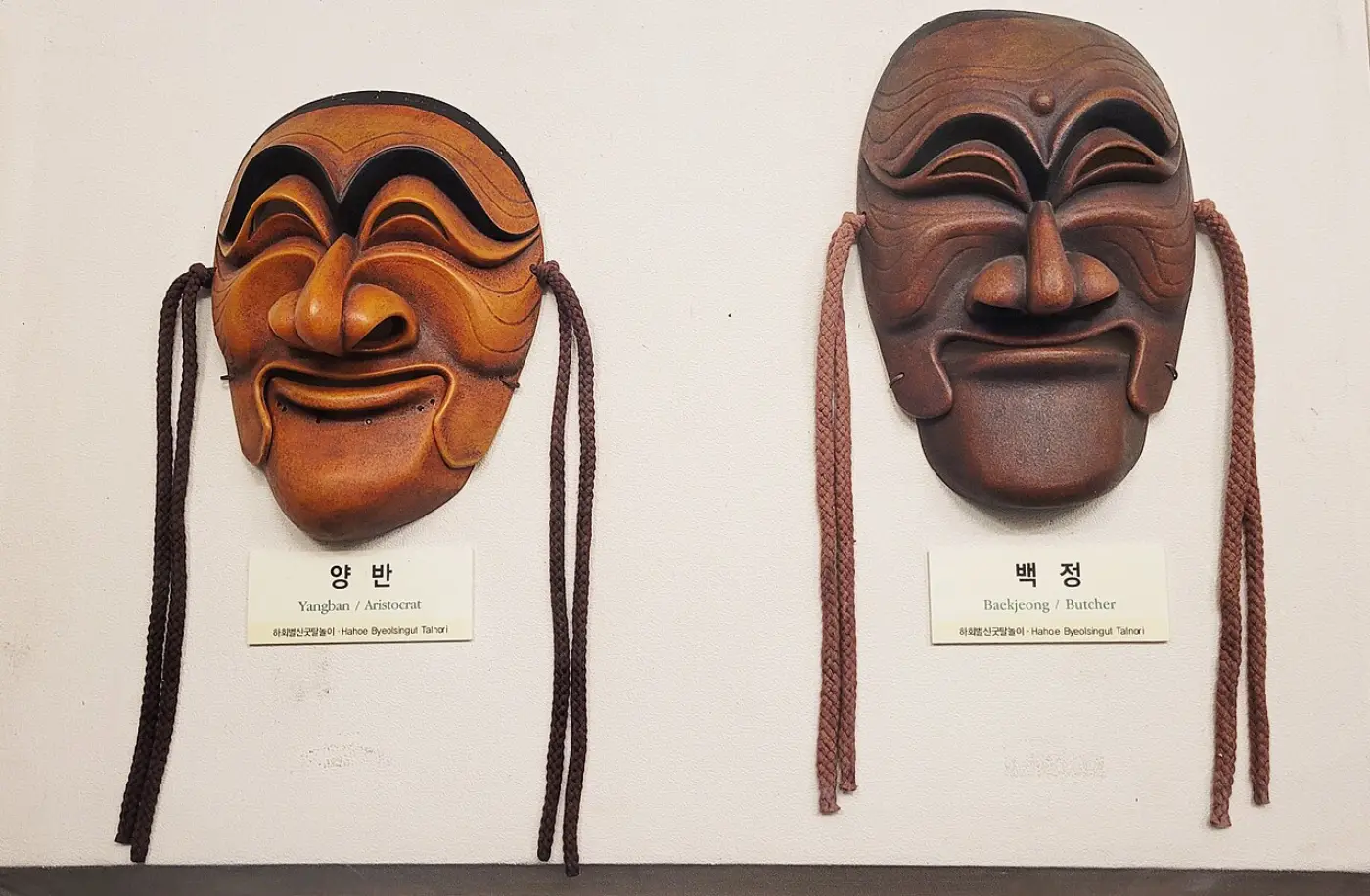
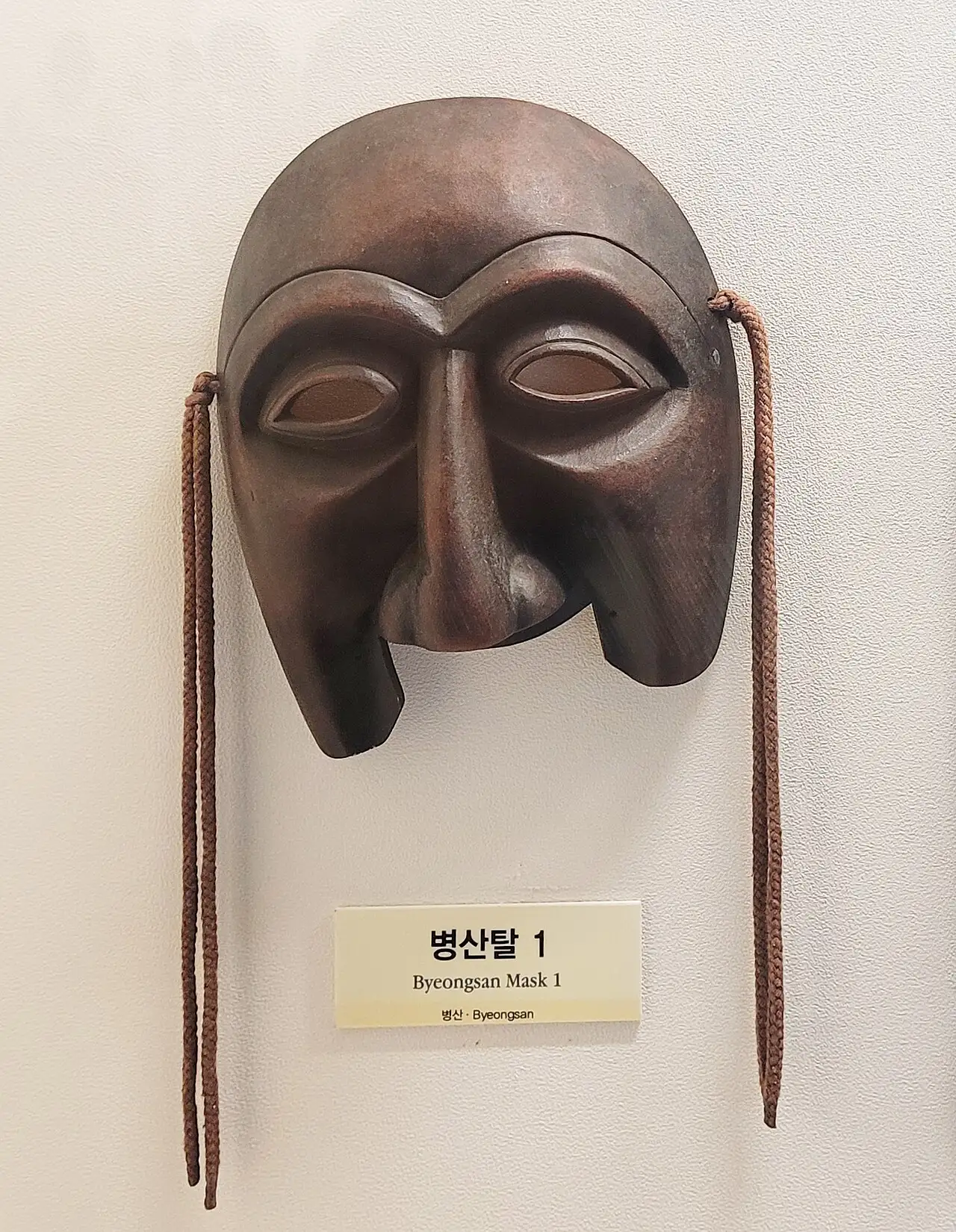
The Andong Hahoe and Byeongsan masks are Goryeo-era wooden masks carved from alder wood and finished with two to three coats of lacquer. Unlike most traditional Korean masks, which were made of paper or gourd and burned after a performance, these were carved from wood and have survived to the present. Five male masks—Yangban (aristocrat), Seonbi (scholar), Jung (monk), Baekjeong (butcher), and Imae (foolish servant)—use the jeorak (切顎, cut-jaw) technique, in which a separately carved lower jaw is tied to the upper mask with cord. When the performer lowers the head, the face takes on a dark expression; when the head tilts backward, the mask breaks into a bright laugh. The forward-and-backward tilt of the performer's body works together with the cord-hung lower jaw to create an animated face.
Today, 13 masks across 12 types hold National Treasure status: 11 Hahoe masks of 10 types from Hahoe Village and 2 Byeongsan masks from neighboring Byeongsan Village. Performers wore these wooden masks across the acts of Hahoe Byeolsingut Tallori, a ritual mask dance held once every 10 years or whenever prompted by a divine oracle (sintak, 神託, divine revelation). Rather than burning the masks after the ritual, villagers placed them in a woven straw sack and enshrined them in the attic of the village communal hall (dongsa, 洞舍, communal village house). Legends attributing their creation to Master Heo (Heo Doryeong) and Master An (An Doryeong) accompany the masks, while comparisons with Japanese Noh masks (nomen, 能面) situate them within the wider history of East Asian mask-making. Entries in the Encyclopedia of Korean Culture, the Encyclopedia of Korean Folk Culture, and Korea Heritage Service records document both their construction and their transmission in detail.
Readers can consult these primary descriptions directly through the Academy of Korean Studies' Encyclopedia of Korean Culture, the National Folk Museum of Korea's Encyclopedia of Korean Folk Culture, and the Korea Heritage Service's National Heritage Portal. Alongside details on the alder-wood material and the jeorak jaw mechanism, these sources present differing estimates that place the masks' creation in either the mid-Goryeo or late Goryeo period. They also trace how the ritual was halted in 1928, during the Japanese colonial period, before being designated a National Intangible Heritage in 1980. Following the materials, carving techniques, village rituals, legends, and Korean-Japanese mask comparisons step by step brings the historical value of these Goryeo wooden masks into clear focus.
Alder wood and the jeorak detached-jaw technique in the Encyclopedia of Korean Culture
Most traditional masks in Korea were crafted from paper or gourd and burned as soon as the year's mask dance ended. As the Korea Heritage Service explains, "Korean masks were mostly made of gourd or paper, so few have been preserved for long, and it was customary to burn them after that year's mask dance ended." By contrast, the Hahoe and Byeongsan masks of Andong are rare examples carved from wood rather than paper or gourd. The Encyclopedia of Korean Culture notes that "whereas the materials of masks in Korea are mostly paper or gourd, the Hahoe and Byeongsan masks are rare wooden masks; the timber used is carved from alder wood, with two or three coats of lacquer applied on top to produce refined coloring." The Encyclopedia of Korean Folk Culture likewise states that "the Hahoe masks are the oldest (最古) wooden masks in Korea, made using alder wood as their material," explaining that they are the oldest surviving wooden masks.
Among these lacquered alder-wood masks, several male characters feature a separately moving lower jaw. The Encyclopedia of Korean Culture explains that "the Jung, Yangban, Imae, Seonbi, and Baekjeong masks have separately attached jaws that can move, allowing changes in expression, and display an intermediate expression that adds the effect of a dark look when the face is lowered and a bright look when tilted back." The Encyclopedia of Korean Folk Culture defines this method as jeorak (切顎, cutting away the lower jaw and tying it to the upper jaw with cord): "In the case of some male masks of Hahoe (Yangban, Seonbi, Jung, Baekjeong, and Imae), in a manner rarely seen in other regions, they were produced with the jeorak technique—separating the lower jaw and connecting it to the upper jaw with cord so that tilting the head back or lowering it causes a change in expression—a technique that was discontinued in masks of later eras." The Korea Heritage Service adds that "the jaw is carved separately, and the lower jaw is hung with cord so that it moves as if speaking during the performance, giving a lifelike quality."
The Korea Heritage Service further remarks that "among the Hahoe masks, the Yangban and Baekjeong in particular stand out for their excellence in three-dimensionality and carving skill." The English Wikipedia entry on Hahoetal similarly highlights that the jaw of the Yangban mask is a separate piece from the upper face, noting that by leaning forward or backward, the actor can make the mask appear to smile or frown as needed. Together, these accounts show that the changing facial expressions of the Hahoe masks arise from the interaction of the detached lower jaw, the cord suspension, and the angle of the actor's head. That the jeorak technique was discontinued and did not carry over into later Korean masks underscores the distinctive sculptural craftsmanship of the Hahoe masks.
The 11 Hahoe masks and 2 Byeongsan masks and their transfer to the Andong Folk Museum
The Korea Heritage Service describes the Hahoe and Byeongsan masks as "masks handed down in Hahoe Village and its neighboring Byeongsan Village in Andong-gun, Gyeongsangbuk-do, representing the oldest surviving mask-dance masks." The National Treasure designation brings together masks from both Hahoe Village and neighboring Byeongsan Village rather than a single settlement. According to the Encyclopedia of Korean Culture, "as for the Hahoe masks, 11 pieces of 10 types—Juji (2 pieces), Gaksi, Jung, Yangban, Seonbi, Choraengi, Imae, Bune, Baekjeong, and Halmi—have been handed down." Because there are two Juji masks, the 10 character types total 11 physical masks. The same encyclopedia adds that "as for the Byeongsan masks, 2 masks (traditionally called the Daegam mask and the Yangban mask) survive today," bringing the combined total from the two villages to 13 masks across 12 types.
Kept for decades at the National Museum of Korea in Seoul, these 13 wooden masks eventually returned to their home region of Andong. The Encyclopedia of Korean Culture records that "the 11 Andong Hahoe masks and 2 Byeongsan masks, which had been stored at the National Museum of Korea after being designated a National Treasure in 1964, were transferred to the Andong Folk Museum on December 27, 2017." Meanwhile, oral accounts have sometimes claimed that three additional masks once existed alongside the surviving set. On this point, the Encyclopedia of Korean Folk Culture draws a clear line: "There is a claim that a Japanese individual took three masks—Chonggak, Byeolchae, and Tteokdari—to Japan, but this has not been verified."
Official encyclopedias and Korea Heritage Service records thus strictly define the surviving corpus as 13 masks of 12 types. Recognizing that the National Treasure commonly referred to simply as the Hahoe masks actually comprises 11 Hahoe masks and 2 Byeongsan masks keeps the heritage of the two villages distinct. It is equally important that the reference literature classifies the alleged removal of the Chonggak, Byeolchae, and Tteokdari masks to Japan as an unsubstantiated claim. Readers should therefore separate the documented record of the 13 surviving masks now housed in the Andong Folk Museum from unverified popular lore.
Dating the Goryeo masks: Encyclopedia of Korean Culture and Korea Heritage Service estimates
Major reference institutions differ slightly on when the Hahoe and Byeongsan masks were first carved. The Encyclopedia of Korean Culture places their production earlier, around the middle of the Goryeo period, stating that "it seems reasonable to estimate the production date of the Hahoe and Byeongsan masks as prior to late Goryeo, generally around the mid-Goryeo period (11th–12th centuries)." In this view, the alder-wood masks took shape between the 11th and 12th centuries, well before the close of the dynasty.
By contrast, the Korea Heritage Service bases its dating estimate on historical records of the clans that inhabited the village. Its official description notes that "because records state that the Ryu clan lived there in the early Joseon period, the masks are generally estimated to have been made around the late Goryeo period." Using documentary evidence of the Ryu clan's residence in Hahoe Village during early Joseon as a benchmark, this view places the creation of the masks in the preceding late Goryeo era. Both institutions nevertheless agree on the broader framework that these are Korea's oldest surviving mask-dance masks, crafted during the Goryeo dynasty.
Comparing the mid-Goryeo estimate in the Encyclopedia of Korean Culture with the late Goryeo estimate from the Korea Heritage Service reveals the different criteria behind each dating. One situates the masks in the 11th to 12th centuries within the broader evolution of mask traditions, while the other works backward from village clan records to point to late Goryeo. This divergence indirectly reflects the absence of an exact dated inscription on the Hahoe masks themselves. Rather than fixing their origin to a single year, it is more accurate to understand their creation across a historical span stretching from mid-Goryeo to late Goryeo.
The sixth act of Hahoe Byeolsingut Tallori and storage rituals in the village shrine attic
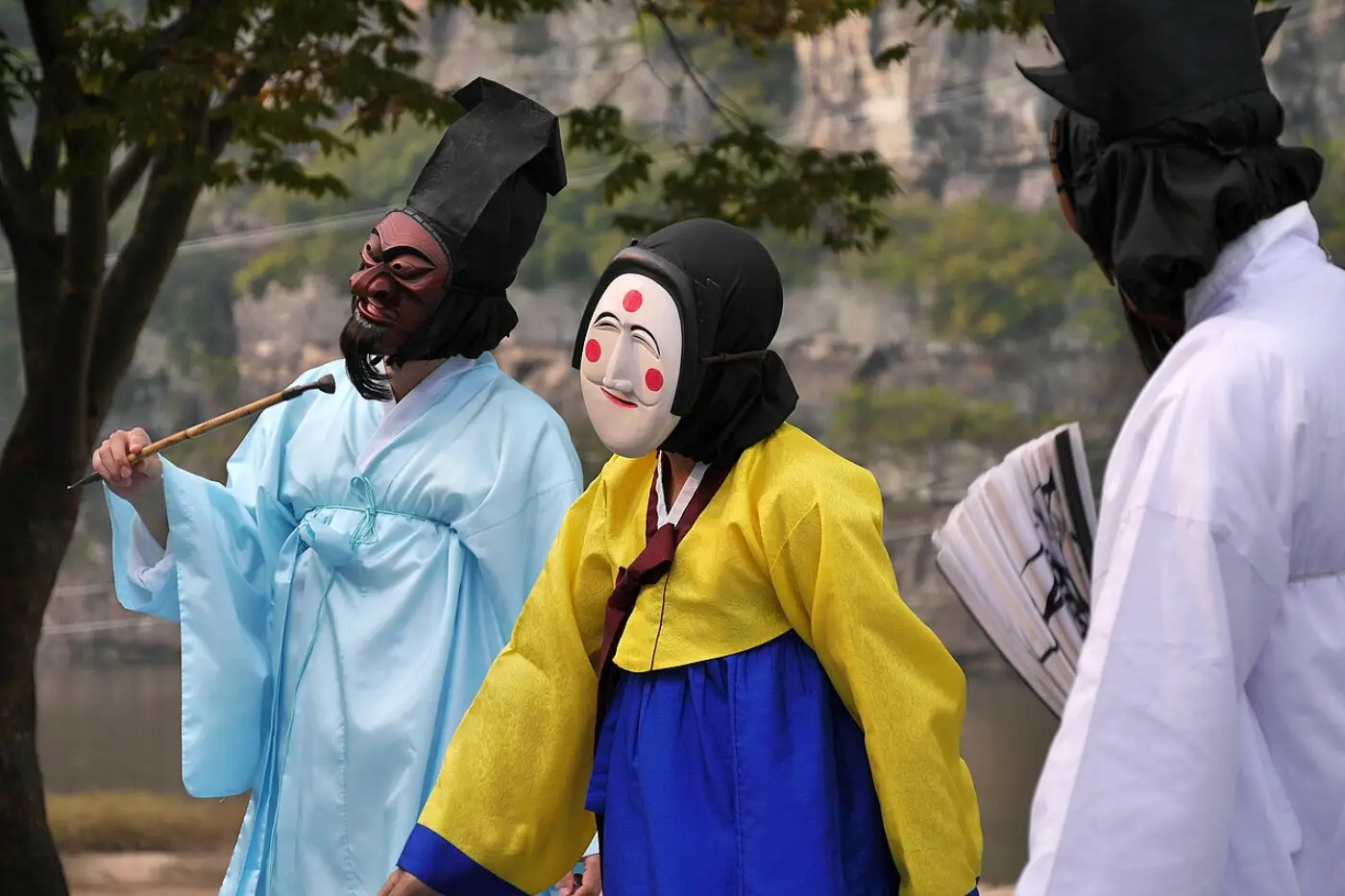
In Andong's Hahoe Village, the Hahoe masks served as the faces of individual characters during the mask dance of the Byeolsingut, a communal village shamanic ritual. The Encyclopedia of Korean Culture entry on Hahoe Byeolsingut Tallori notes that "this performance is held as part of the Byeolsingut, which is observed once every 10 years or on an ad hoc basis following a divine oracle (sintak, 神託)." Rather than an annual seasonal pastime, it was a special rite staged only on a 10-year cycle or upon receiving a divine revelation. Regarding the second act of the performance, the encyclopedia states that "the second act is the 'Juji play,' where juji means lion; as an exorcism act, it carries the meaning of a ritual dance (uisikmu, 儀式舞) for warding off evil spirits (byeoksa, 辟邪)." Here, byeoksa (辟邪) refers to driving away misfortune and malicious forces, showing that the two Juji masks, which mean lions, were used in a ritual dance.
The Yangban and Seonbi masks, whose lower jaws move via the jeorak mechanism, appear in the sixth act paired with other character masks. The Encyclopedia of Korean Culture states that "the sixth act is the 'Yangban and Seonbi' act, in which the Yangban enters bringing his servant Choraengi, and the Seonbi enters bringing his concubine Bune." Among all the masks, the Gaksi mask—representing the village tutelary deity (Seonangsin)—was governed by the strictest taboos: "In particular, because the Gaksi mask is believed to stand in for the Seonangsin, it cannot be seen except during the Byeolsingut, and when it must unavoidably be taken out and viewed, the ritual master (sanju) must first perform a sacrificial rite (gosa)." The Encyclopedia of Korean Folk Culture adds that "ordinarily, after a mask dance is performed, masks are burned as an act of purification and sending off the deities (songsin, 送神), but the Hahoe masks were placed in a woven straw sack and stored in the attic of the village communal hall (dongsa, 洞舍), and when a mask dance was to be held, a sacrificial rite was performed before taking them out."
Whereas other regions burned their masks after a performance as a songsin (送神) rite to send the welcomed deities back, Hahoe Village preserved its masks inside the attic of the dongsa. Treating the Gaksi mask as the Seonangsin itself and requiring the sanju to offer a sacrificial rite before bringing it out underscores the sacred status of the masks. These records demonstrate that the Hahoe masks were treated not merely as theatrical props, but as sacred vessels of village worship. That ritual storage practice in the dongsa attic, combined with durable alder wood and lacquer, can be seen as what allowed the wooden masks to survive intact.
The Master Heo legend and the jawless Imae mask in the Encyclopedia of Korean Folk Culture
Folk traditions explaining how the Hahoe masks were first carved preserve two different names for their creator. The Encyclopedia of Korean Folk Culture states that "among the legends concerning the creation of the Hahoe masks, there is a story that Master Heo (Heo Doryeong) made them and a legend that Master An (An Doryeong) made them." Although Master Heo is far better known to the general public, written folklore sources record the Master An tradition alongside it. Of the two, the Master Heo narrative describes in detail the ritual taboos required during carving and their tragic end.
According to the Encyclopedia of Korean Folk Culture, the ritual rests on "the legend that when Master Heo strung up a sacred taboo rope (geumjul) and performed ritual ablutions (mogyokjaegye) to carve the masks, a 17-year-old maiden who longed for him secretly peeked inside, causing Master Heo to suffer divine punishment, vomit blood, and die on the spot, while the maiden died and came to be enshrined as the village tutelary deity (Seonangsin)." Hanging a taboo rope and purifying the body show that carving the masks was regarded as a sacred rite in its own right. The English Wikipedia entry on Hahoetal includes a story that Master Heo died while carving Imae, the final mask, leaving it unfinished without a lower jaw. This is a folk tale, and it could not be confirmed in the Korean encyclopedia sources cited above.
Connecting this folk narrative with the structural descriptions in the Encyclopedia of Korean Culture and the Encyclopedia of Korean Folk Culture reveals a striking link. Both encyclopedias classify the Imae mask alongside the Yangban, Seonbi, Jung, and Baekjeong masks as part of the male group designed with the jeorak detached-jaw technique. The legend explains why the Imae mask—which belongs to that detached-jaw group—lacks a lower jaw by attributing the missing chin to Master Heo's sudden death. Meanwhile, the detail that the maiden died and became the Seonangsin ties the origin legend directly to the Byeolsingut worship in which the Gaksi mask embodies the village deity.
Historical position in East Asian mask-making compared with Japanese Noh masks and Okinamen kiriago
Beyond Korean mask history, scholars value the Hahoe and Byeongsan masks as artifacts that illuminate the broader evolution of masks across East Asia. The Encyclopedia of Korean Culture notes that "the period when continentally derived Nogaku (能樂, Noh theater) reached completion in Japan was the mid-14th century, which corresponds to the reign of King Gongmin in late Goryeo in Korea." It goes on to state that "these masks show the transition from gigaku masks to bugaku masks, as well as an intermediate position moving toward Japanese Noh masks (nomen)." According to the Japanese Wikipedia entry on Nomen (能面), Noh masks are generally carved from Japanese cypress (hinoki), with some made from paulownia (kiri). The Japanese Wikipedia entry notes that Noh masks distinctly reflect Japanese facial features.
Within Japanese mask traditions, a separated jaw tied with cord appears only in a restricted group: the Okinamen (翁面, old-man masks) and certain Bugaku masks (bugakumen, 舞楽面). The Japanese Wikipedia entry explains that three of the four Okinamen types—excluding Enmeikaja (延命冠者)—use the kiriago (切り顎, cut-chin) structure, in which the lower jaw is cut near the corners of the mouth and tied with cord. Absent from standard Noh masks, this kiriago design may have served to keep the actor's voice from being muffled inside the mask. An Okinamen held by the Ethnological Museum in Berlin bears an ink inscription dated 1278 beneath the lacquer on its reverse, showing that the form was already established by the mid-Kamakura period. In addition, female Noh masks (onnamen, 女面) were worn on stage for long stretches and had to express multiple emotional shifts with a single face, so they were crafted with a neutral intermediate expression.
Comparing Korean Hahoe masks and Japanese Noh masks point by point highlights both shared traits and clear structural differences. First, in materials, Hahoe masks applied lacquer over alder wood, whereas Japanese Noh masks primarily used Japanese cypress or paulownia. Second, in detached-jaw construction, Hahoe masks applied the jeorak technique across five male mask types, whereas Noh masks retained the kiriago structure in only three Okinamen types. Third, in achieving an intermediate expression, Hahoe masks relied on the interplay between a cord-hinged jaw and the tilt of the performer's head, while female Noh masks built that neutrality into a single fixed carving. Together, the Goryeo Hahoe masks, the 1278-inscribed Okinamen, and mid-14th-century Noh masks demonstrate how each tradition adapted wooden mask engineering to its own stage demands.
Suspension of Hahoe Byeolsingut under Japanese colonial rule and designation as National Intangible Heritage
Handed down for centuries in Hahoe and Byeongsan Villages, the Byeolsingut ritual suffered a major rupture in 1928 during the Japanese colonial period. The Encyclopedia of Korean Culture records that "the Hahoe Byeolsingut was discontinued after 1928 (戊辰, the Mujin year), and the Byeongsan Byeolsingut was discontinued around the same time, leaving only the 13 masks of 12 types from Hahoe and Byeongsan designated as a National Treasure." A communal rite observed once a decade or by divine oracle thus came to a halt in 1928, which the encyclopedia entry confirms. The specific circumstances of the halt could not be confirmed from the sources used in this article.
Even after the performances stopped, the 11 Hahoe masks and 2 Byeongsan masks stored in the attic of the dongsa remained intact. Those 13 physical masks were first designated a National Treasure in 1964, placing them under state-level cultural heritage protection. As the Encyclopedia of Korean Culture notes—stating that "it was designated as a National Intangible Cultural Property (now National Intangible Heritage) in 1980"—Hahoe Byeolsingut Tallori subsequently gained official recognition as National Intangible Heritage.
Reading the timeline from the 1928 suspension through the 1964 National Treasure designation to the 1980 National Intangible Heritage designation, the village tradition of storing the masks unburned, in wood, likely helped the physical masks survive the years when the ritual was not performed. This is an interpretation that links the records above.
| Mask Name | Origin and Category | Material and Jaw Structure | Expression Principle and Ritual/Transmission Features |
|---|---|---|---|
| Yangban, Seonbi, Jung, and Baekjeong masks | Andong Hahoe masks, Korea (National Treasure) | Carved from alder wood with two to three coats of lacquer; built with the jeorak technique connecting a detached lower jaw with cord | Appears dark when tilting the head down and bright when tilting back; moves as if speaking during performances |
| Gaksi mask | Andong Hahoe masks, Korea (National Treasure) | Wooden mask carved from alder wood and finished with two to three coats of lacquer | Believed to represent the village tutelary deity (Seonangsin); unseen outside Byeolsingut rituals and requires a sacrificial rite by the ritual master (sanju) when taken out |
| Imae mask | Andong Hahoe masks, Korea (National Treasure) | Alder-wood mask with lacquer grouped with the detached-jaw male masks, but lacking a lower jaw | According to legend, Master Heo died on the spot while carving this final mask, leaving it unfinished without a chin |
| Okinamen (翁面) | Japanese Noh masks (能面) | Carved from woods such as Japanese cypress; 3 of the 4 types (excluding Enmeikaja) use the kiriago structure with the chin cut beside the mouth and tied with cord | Also viewed as a design to keep the actor's voice from being muffled; a Berlin museum piece bears a 1278 ink inscription on the reverse |
| Female Noh masks (女面, Onnamen) | Japanese Noh masks (能面) | Usually carved from Japanese cypress (hinoki) or paulownia (kiri) as a single piece with a fixed chin | Crafted with a neutral intermediate expression so a single mask worn for long periods on stage can convey multiple emotional shifts |
Related reading: What Did the Birds and Beasts on Rank Badges Tell Us About Joseon Officials? · Moon Jars: Why Korea's White Porcelain Jars Aren't Perfectly Symmetrical
What the craftsmanship and transmission records of Goryeo wooden masks leave behind
Encyclopedia entries and Korea Heritage Service records invite us to view the Hahoe masks as a multi-layered heritage uniting sculptural engineering with village ritual. A cord-tied lower jaw that moves as if speaking when the performer tilts the head overcomes the rigidity of solid wood. Combined with the ritual rules that revered the Gaksi mask as the Seonangsin and safeguarded the masks in the dongsa attic, this craftsmanship allowed Goryeo-era carvings to endure to the present day. Reading the Master Heo and Master An legends alongside comparisons with Japanese Okinamen and female Noh masks further situates these wooden masks within the wider history of East Asian theater.
At the same time, the gaps left open across these written sources point to questions for future study and museum viewing. The first question is how researchers might narrow the chronological gap between the mid-Goryeo (11th–12th century) estimate and the late Goryeo estimate. Another question worth pondering is why the jeorak detached-jaw technique, despite giving the masks such vivid animation, was discontinued in later Korean mask-making. Finally, the encyclopedia description of these masks as occupying an intermediate position between gigaku and bugaku masks and Japanese Noh masks invites closer investigation into the concrete points of contact between Korean and Japanese mask traditions.