The Short Answer
Hyungbae (胸背) were square ornaments attached to the official robes of Joseon-dynasty officials. According to the Korea Heritage Service (國家遺産廳), they were sewn onto the chest and back of the dallyeong (團領) robe. Their patterns varied by rank to show the wearer's status: civil officials' badges were embroidered with birds, military officials' with four-legged beasts. The National Folk Museum of Korea's Encyclopedia of Korean Folklore and Traditional Culture says the Joseon badge system was completed while keeping to this principle.
Hyungbae were not limited to officials' clothing. The Academy of Korean Studies' Encyclopedia of Korean Culture describes them as rank insignia added to the black dallyeong (黑團領) of all officials and to the ceremonial dress of women from yangban households. A badge was therefore both an ornament and a sign of the wearer's place. This article covers the Gyeongguk daejeon's pattern rules, the late-Joseon system, royal badges, the Ming and Qing buzi (补子) and surviving artifacts.
The Birds and Beasts Set by the Gyeongguk daejeon
Hyungbae begin in the reign of King Danjong. According to the Encyclopedia of Korean Culture, civil and military officials of the third rank and above began wearing them in 1454 (the second year of Danjong) at the proposal of Yang Seongji (梁誠之). From King Sejo's reign on, badges were attached only to the black dallyeong. At first, then, they marked not all officials but only those of the third rank and above.
The National Folk Museum summarizes the badge rules of the Gyeongguk daejeon (經國大典) this way: "The Gyeongguk daejeon 經國大典 specified that civil officials of the first rank use the peacock 孔雀, the second rank the cloud and wild goose 雲雁, military officials of the first and second ranks the tiger and leopard 虎豹, civil officials of the third rank the silver pheasant 白鷳, military officials of the third rank the bear 熊羆, grand princes the qilin 麒麟, the Inspector-General the haechi 獬豸, the Commander-in-Chief the lion, and princes and lords the baektaek 白澤."
The passage lists patterns only up to the third rank for both civil and military officials, which fits with the 1454 rule covering the third rank and above. The civil column holds the peacock, the cloud and wild goose and the silver pheasant; the military column holds the tiger and leopard and the bear. Grand princes, the Inspector-General, the Commander-in-Chief, and princes and lords were also assigned patterns separate from rank. This suggests the badge distinguished not only rank but particular statuses and posts.
The Encyclopedia of Korean Culture also records a different rule from 1505 (the 11th year of Yeonsangun). That year all officials from the first to the ninth rank were required to wear badges, with patterns entirely different from those of Ming China: jeo (猪), rok (鹿), a (鵝) and an (雁), that is, the pig, the deer, the goose and the wild goose. This shows that neither the scope nor the patterns of hyungbae were fixed in a single form.
Expansion Under Sukjong and Yeongjo, and the Sokdaejeon
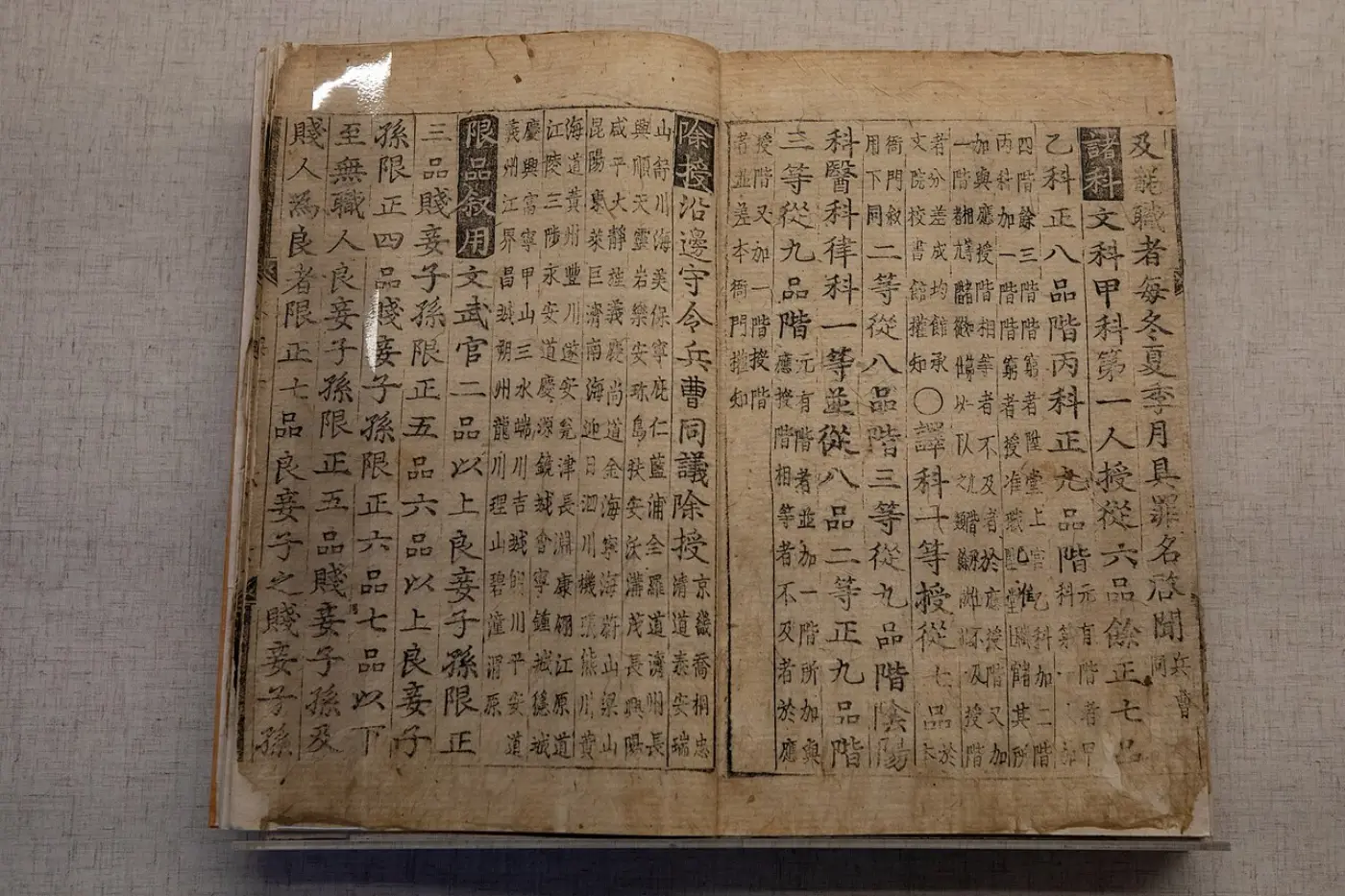
The circle of officials who wore badges widened again in late Joseon. The National Folk Museum describes the process: "Under Sukjong the use of hyungbae was extended to the sixth rank, and in 1745 (the 21st year of Yeongjo) it was extended to the ninth rank, which was specified the following year, 1746, in the Sokdaejeon 續大典."
Note that the extension and its codification happened in different years. The extension to the ninth rank took place in 1745, and it was written into the Sokdaejeon (續大典) in 1746. It is a reminder to distinguish the year a system changed from the year it appeared in a text.
The Encyclopedia of Korean Culture likewise says that under Yeongjo badges came to be worn by lower-grade (danghagwan) officials down to the ninth rank. Both sources name Yeongjo's reign as the point when badges reached the ninth rank. Compared with the third-rank-and-above rule of 1454, the group of officials wearing badges had widened considerably. The first-to-ninth-rank scope that had appeared in 1505 had, in effect, returned.
This change is why dating matters when looking at a badge. Officials of the same rank may or may not have worn one, depending on the period. A portrait or artifact with a badge does not, therefore, automatically indicate high rank.
Twin and Single Cranes and Tigers in Jeongjo-Era Records
The badge patterns themselves also changed in late Joseon. Civil badges divided into twin-crane (ssanghak) and single-crane (danhak) badges, and military badges into twin-tiger (ssangho) and single-tiger (danho) badges. This arrangement differs from the Gyeongguk daejeon's peacock, cloud and wild goose, and silver pheasant, and from its tiger and leopard and bear. Sources word the timing of the new system slightly differently.
The National Folk Museum states: "The distinction between twin-crane and single-crane badges was first confirmed in records from Jeongjo's reign (1795)." The Encyclopedia of Korean Culture says the two systems became established in the last years of Jeongjo's reign. Another National Folk Museum entry says the two systems began in the late 18th century, at the end of Yeongjo's reign.
The three accounts are better read as referring to different things than as contradicting one another. "Began" refers to the start of the system, and "first confirmed" to its first appearance in the records. "Established" refers to when it took hold. 1795 can be read as the year the distinction first shows up in the record. Rather than memorizing a single date, it is more accurate to ask what each date measures.
The Encyclopedia of Korean Culture gives more detail on the military side. Twin-tiger badges for military officials began to appear under Jeongjo. From Sunjo's reign on, they settled into the twin-tiger and single-tiger system, which remained in force until 1910. Even within the same encyclopedia, then, the military system is described as becoming established from Sunjo's reign on.
Military Badges: Gyeongguk daejeon Rules Versus Practice
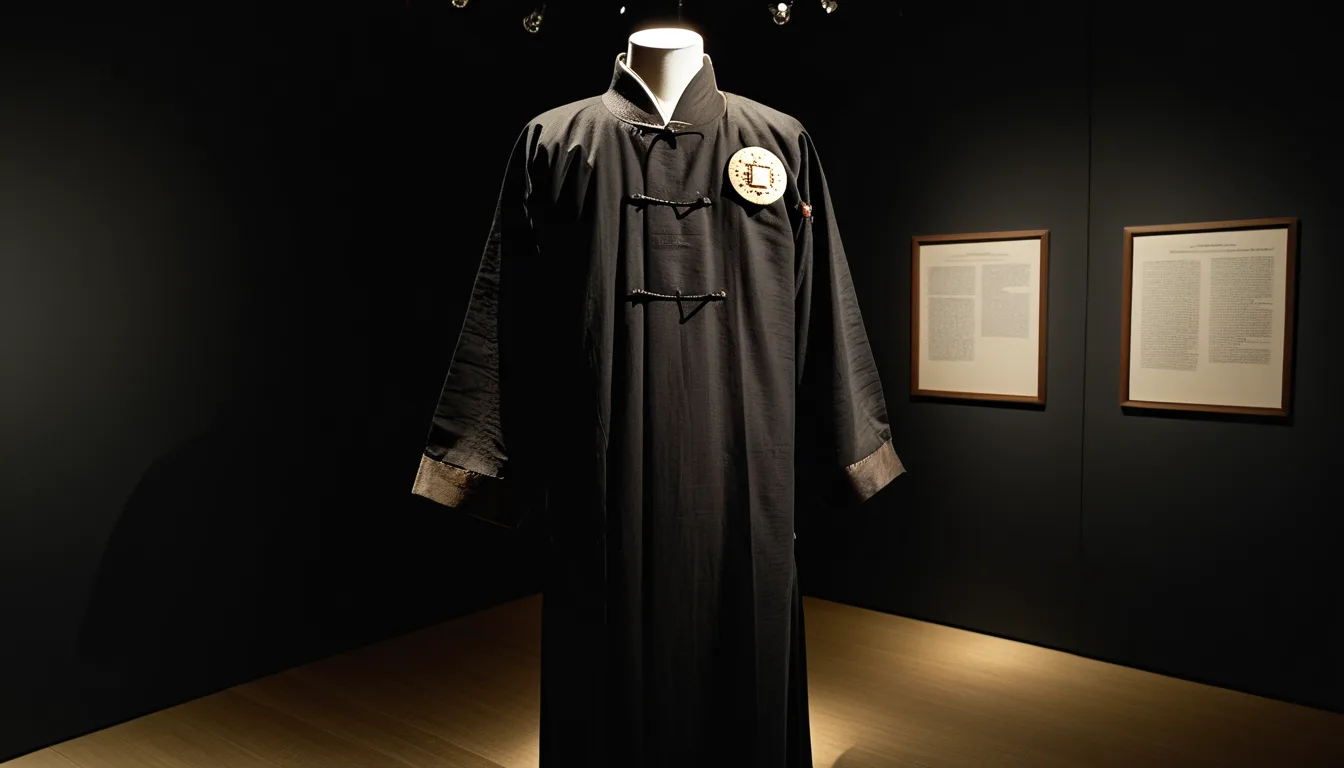
For military badges, the records show a gap between rule and practice. One National Folk Museum entry states: "The rules for military officials' badges did not differ from the Gyeongguk daejeon, but in practice military officials in the central government used lion badges, while those on the frontier used tiger badges."
Under the same rules, then, officials wore different badges depending on where they served. Military officials in the central government wore lion badges, and those on the frontier wore tiger badges. In the Gyeongguk daejeon, the lion was the pattern of the Commander-in-Chief. The pattern table in the texts cannot, on its own, explain the robes officials actually wore.
The surviving objects point the same way. According to the National Folk Museum, four kinds of beast appear on badges: the tiger, the leopard, the haechi and the lion. The same source notes that no bear badge, the pattern the Gyeongguk daejeon prescribed for third-rank military officials, has yet been identified. It is a case where the patterns in the rules and those on surviving objects do not match.
The tiger pattern deserves a closer look too. Of the late-18th-century twin- and single-tiger badges, the same source says: "The tiger of this period is not a striped tiger but a leopard-spotted badge corresponding to the badge of third-rank military officials in Qing China." The badge was called a tiger badge, but the animal had leopard spots. Guessing the pattern from a badge's name alone can lead you astray.
Sejong's Five-Clawed Dragon Badge and the Grand Prince's Qilin Badge
Records also survive on the king's insignia. The National Folk Museum describes the change under King Sejong: "Sejong used the four-clawed dragon badge at the beginning of his reign. He later began to use the five-clawed dragon badge, and when the emperor happened to send a five-clawed dragon badge in 1444, the king's five-clawed dragon badge became established."
The word "happened" stands out. Sejong's use of the five-clawed badge is described as beginning before 1444. The five-clawed badge the Ming emperor sent in 1444 is presented as what cemented that use. It suggests that the king's insignia, too, took shape within Joseon's relationship with Ming China.
Royal insignia had grades of their own. The Gukjo sok oryeui boseorye (國朝續五禮儀補序例) of 1751 prescribed a square three-clawed dragon badge for the royal grandson and heir. In late Joseon the queen wore the same five-clawed dragon badge as the king. The crown princess wore the same four-clawed dragon badge as the crown prince. Moving from king to crown prince to royal grandson, the badge's name changed from five claws to four to three.
The grand prince's badge was the qilin of the Gyeongguk daejeon, as seen earlier. The Korea Heritage Service explains Heungseon Daewongun's qilin badge this way: "The 'Rites' (Yejeon) section of the Gyeongguk daejeon records that grand princes wore badges embroidered with the qilin; on this basis, the qilin badge said to have been worn by Heungseon Daewongun appears to reflect the honors due to a grand prince." The passage reads the meaning of an object against a textual rule. As the word "appears" signals, the Heritage Service presents this interpretation as an inference.
How Ming and Qing Buzi (补子) Differed from Joseon Hyungbae
China, too, had square insignia that showed an official's rank. The English Wikipedia article "Mandarin square" says Ming officials were first officially permitted to wear the squares under sumptuary laws of 1391. The National Folk Museum describes the link between Joseon badges and the Ming system: "Applying the principle of lowering by two grades 二等遞降原則 to the Ming system of civil and military badges, Joseon's first rank used the badge of Ming's third rank."
This shows that Joseon badges were tied to the Ming system. The principle of lowering by two grades meant applying the Ming system two grades down. A Joseon first-rank badge was thus a Ming third-rank badge. The same pattern, it seems, could signify different grades in the two countries.
Set side by side, the two countries' sources line up like this. First, the principle behind the patterns was the same. The Chinese Wikipedia article 补子 states: "文官的补子的图案用飞禽,武将的的补子用猛兽。" That is, civil officials' squares used birds and military officers' squares used fierce beasts. Second, the rules on the number of figures differed. English Wikipedia explains that Ming regulations never specified how many birds or animals a square should bear.
Third, size and form varied by period. Chinese Wikipedia states: "明朝的补子前后图案一致,而清朝的补子分前后两半。明朝的补子一般在40厘米见方左右,清代则一般在30厘米左右。" That is, Ming squares had identical front and back designs and measured about 40 cm, while Qing squares had a front panel split in two and measured about 30 cm. English Wikipedia also notes that Qing squares were smaller and had decorative borders. Joseon badges, too, measured 30–40 cm until the 17th century and shrank to less than 20 cm by the early 20th century. Taken together with the late-Joseon twin- and single-crane distinction, this suggests that Joseon built its own details on a shared principle.
Heungseon Daewongun's Qilin Badge and Surviving Artifacts
The way badges were made also changed. According to the Encyclopedia of Korean Culture, early Joseon used jikseong pillyo (織成匹料), cloth with the badge pattern woven directly into it. Gradually this gave way to badges woven separately and attached as pieces. From the 17th century on, most badges were embroidered. The badge thus went from being part of the fabric to a separately made ornament.
The National Folklore Cultural Heritage "Qilin Badge of Heungseon Daewongun" was attached to the official robe of Heungseon Daewongun, Yi Ha-eung (1820–1898). The Korea Heritage Service describes its design: "This qilin badge shows a single qilin galloping through clouds with its hooves drawn together, embroidered in gold and silver thread on slightly blackish blue satin." The passage shows what the grand prince's qilin rule, discussed earlier, looked like on an actual object. Because it records even the ground color and the thread materials, it offers a standard to check against in front of the artifact.
The qilin badge also appears in other sources. The Encyclopedia of Korean Culture cites a portrait of Yi Ha-eung in black dallyeong. It also lists a gold-thread qilin badge in the Onyang Folk Museum and a qilin badge in the Los Angeles County Museum of Art. The same encyclopedia introduces Heungseon Daewongun's gold-thread turtle badge as well, South Chungcheong Province Folklore Material No. 30, held by the Onyang Folk Museum. It states: "This artifact is virtually the only turtle-decorated badge in Korea and China combined."
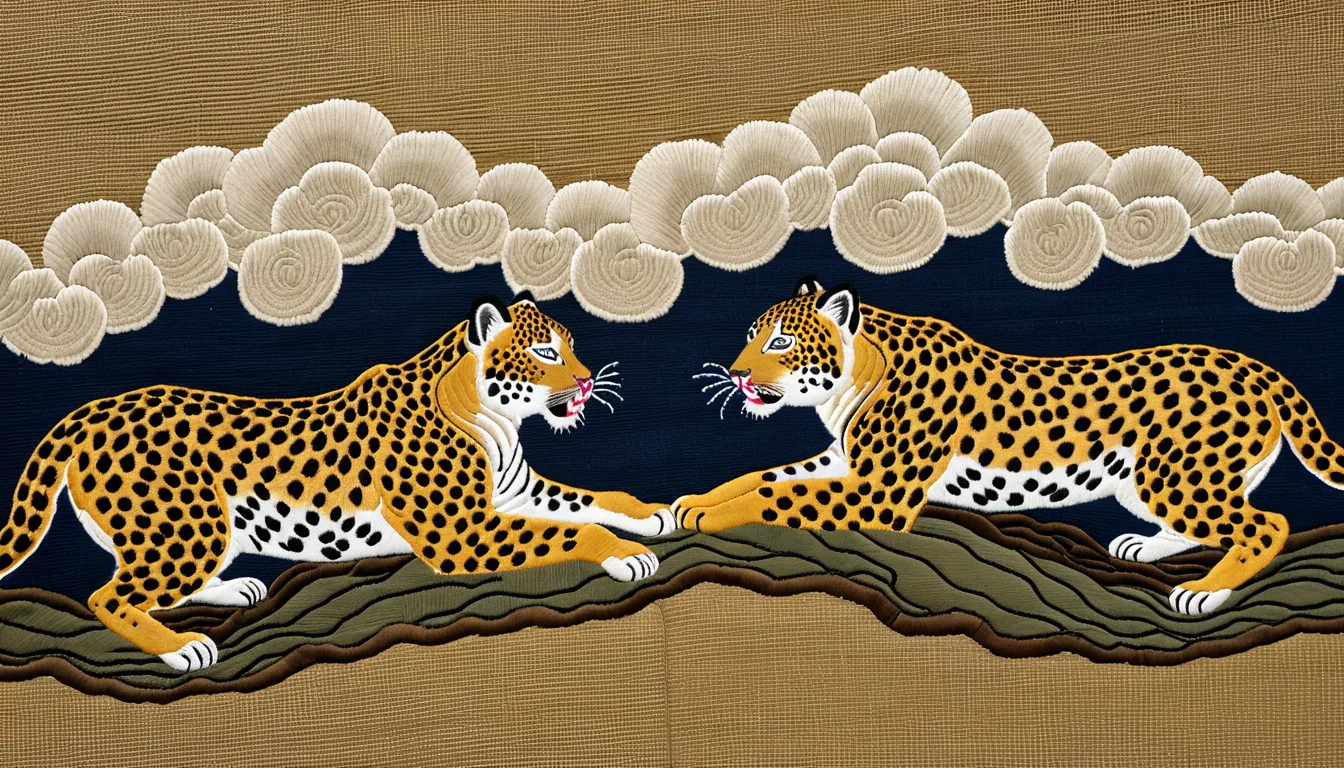
Artifacts from other periods survive too. According to the National Folk Museum, one haechi badge was found in the tomb of Jo Gyeong, who died in 1609. It is the earliest surviving haechi badge. English Wikipedia describes a Korean badge from about 1850–1900 in the Victoria and Albert Museum (museum number FE.272-1995). It is embroidered with a pair of black and white leopards and was probably worn by a military official of the first to third rank. Readers can consult the records on hyungbae directly in the Encyclopedia of Korean Culture, the Encyclopedia of Korean Folklore and Traditional Culture, and the heritage information on the Korea Heritage Service website.
| Text | Passage used in this article | How it differs from the other texts |
|---|---|---|
| Gyeongguk daejeon | Civil officials: peacock (1st rank), cloud and wild goose (2nd), silver pheasant (3rd); military officials: tiger and leopard (1st–2nd), bear (3rd); grand princes: qilin | Sets patterns by rank and status; military officials sometimes wore different badges in practice |
| Sokdaejeon (1746) | Codifies the 1745 extension of badge use to the ninth rank | Deals with who wore badges, not with patterns |
| Gukjo sok oryeui boseorye (1751) | Prescribes a square three-clawed dragon badge for the royal grandson and heir | Deals with the royal grandson's insignia, not officials' |
| Ming sumptuary laws (1391) | First officially permitted officials to wear squares | Ming regulations did not specify the number of birds or beasts |
Related reading: Moon Jars: Why Korea's White Porcelain Jars Aren't Perfectly Symmetrical · Gache: How Banning Korea's Traditional Hairpiece Changed Joseon Women's Hair
Summing Up
The hyungbae that emerges here is a system that changed as it moved between textual rule and actual object. The Gyeongguk daejeon's pattern table, the Sokdaejeon's wider scope and the new distinction in the 1795 record form separate layers. Military officials' lion badges and leopard-spotted tiger badges reveal a practice the rules alone do not show. With any single badge, it pays to ask about the period, the wearer and the place of service.
Some questions remain. Why has the bear badge written into the Gyeongguk daejeon not turned up as an actual object? What did the 1505 pig, deer, goose and wild goose patterns look like on real robes? Whether the twin- and single-crane distinction was in use before the 1795 record is another question to test against surviving artifacts.