State Control and Social Hierarchy Worn at the Waist by Men Aged 16 and Older
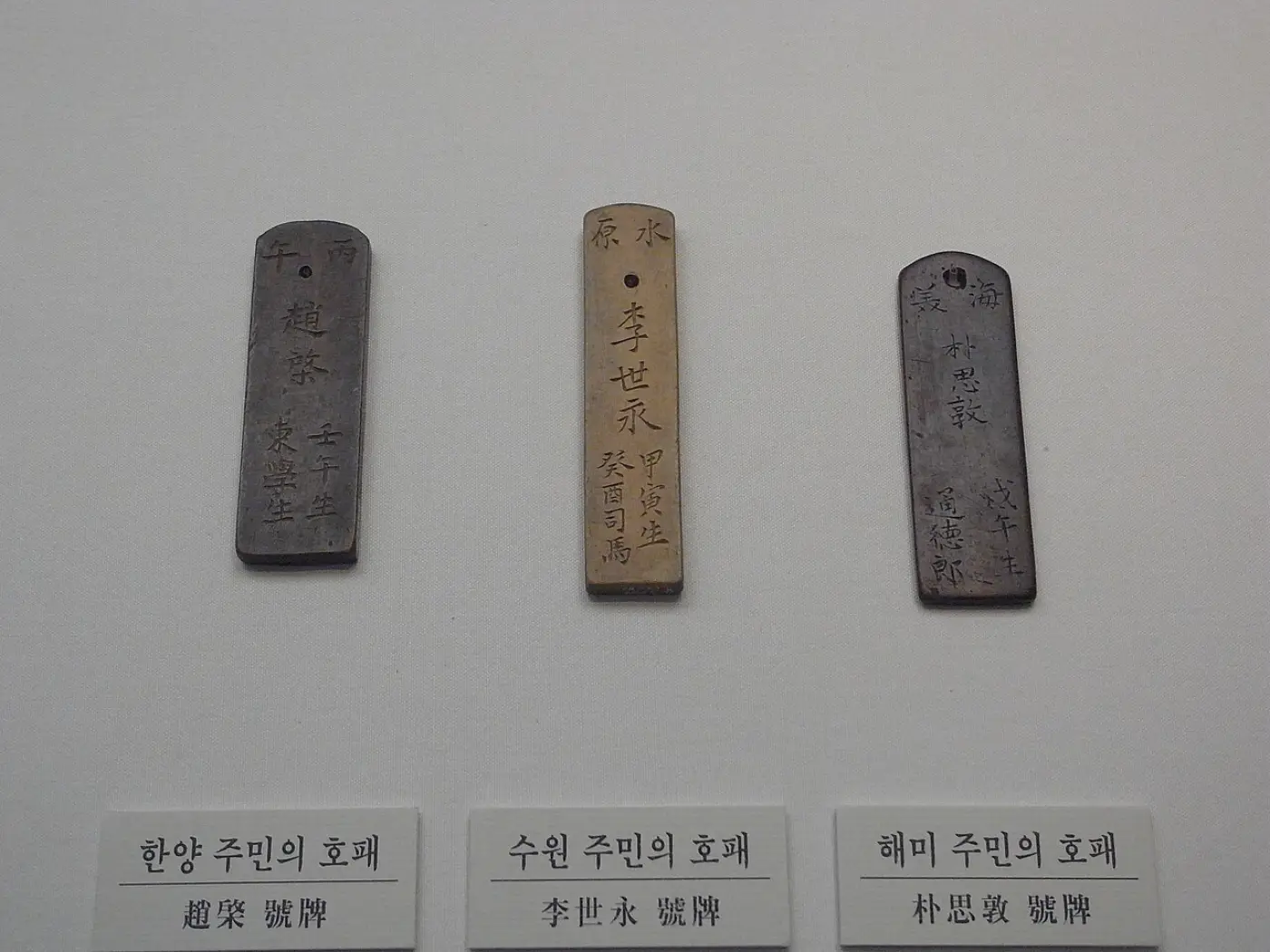
In Joseon Korea, the hopae (號牌, 戶牌) was a small identity tag that men aged 16 and older were legally required to carry. Under the regulations, males across every social stratum—from royal relatives and officials (gwanin, 官人) to freeborn commoners (yangin, 良人) and slaves (nobi)—were required to wear these tags (pae, 牌). Yet the state did not create hopae to treat everyone equally. Instead, the system strictly differentiated each tag's material and inscription by the wearer's social status. High-ranking officials listed only minimal information, whereas commoners and slaves had to record detailed physical traits.
According to the Encyclopedia of Korean Culture published by the Academy of Korean Studies, the royal court implemented hopae to strengthen centralized rule. The state sought to count households and population while preventing people from abandoning their homes to become wandering migrants. At the same time, it used the tags to mobilize compulsory labor such as military service and to maintain the status hierarchy and local stability. As English Wikipedia notes, a hopae listed the bearer's name, date of birth, birthplace, social status, and residence, helping the government collect taxes and track down runaway slaves.
Once issued, a hopae had to be carried at all times and returned to the state when the holder died. Primary texts and artifact records on the system can be read directly in the Encyclopedia of Korean Culture, the Korea Heritage Service portal, and Wikipedia. Its late Goryeo origins, King Taejong's specifications, King Sejo's crackdowns, and the punishments codified in the Sokdaejeon reveal how the institution worked. Putting those rules alongside military official Ryu Hyeong's (柳珩) ivory hopae, Ming and Qing waist plaques (yaopai, 腰牌), and statistics from the Veritable Records brings the true nature of the hopae into focus.
King Taejong's Hopae Regulations and Status-Based Differences in Material and Inscription
The Encyclopedia of Korean Culture explains who wore hopae and how the rules differed by rank: "All men aged 16 and older, from royal relatives and officials (gwanin, 官人) to commoners (yangin) and slaves (nobi), wore hopae. However, the material, recorded details, position of the carved seal (gagin, 刻印), supervising office, order of issuance, and punishment rules for violators of the hopae law varied somewhat by social status and period of enforcement." English Wikipedia summarizes these material distinctions broadly, noting that high-ranking officials used ivory (sanga, 象牙) and lower-ranking officials used deer horn (nokgak), while commoners wore small wooden tags and slaves wore large wooden tags.
Dimensions and inscriptions also varied by status. Korean Wikipedia summarizes the early Joseon rules as follows: "According to the regulations under King Taejong, the tag measured 3 chi (寸) 7 pun (分) in length, 1 chi 3 pun in width, and 2 pun in thickness; officials of the 2nd rank and above recorded their office and name; court officials of the 3rd rank and below, Seongjunggwan (成衆官), and protected descendants (yueum jaje, 有蔭子弟) recorded their office, name, and residence; commoners (seoin) added their complexion and presence or absence of a beard; military officers (gungwan, 軍官) of the 5th rank and below added their unit and height; miscellaneous duty personnel (japsaegin, 雜色人) recorded their duty (jigyeok, 職役) and affiliation; and slaves added their master, age, residence, complexion, height, and presence or absence of a beard." Here, chi and pun are traditional units of length, protected descendants are offspring privileged through ancestral merit, and jigyeok refers to one's assigned post and compulsory labor.
According to the Encyclopedia of Korean Culture, the issuance process likewise divided responsibilities between government offices and private individuals. Hanseongbu (漢城府) oversaw the capital, while provincial governors (gwanchalsa, 觀察使) and local magistrates (suryeong, 守令) supervised the provinces. Practical administration fell to local functionaries such as village heads (ijeong, 里正), ward chiefs (tongsu, 統首), troop leaders (gwallyeong, 管領), and inspectors (gamgo, 監考). After each man submitted his personal details on a slip called a danja (單子), government offices manufactured tags only for officials of the 2nd rank and above and members of the Three Offices (Samsa, 三司). Everyone else had to carve his own tag, have it verified against the submitted danja, and receive a hot-iron brand (nagin, 烙印) before wearing it.
These rules show how hopae visibly hardened status distinctions. While high officials carried government-made ivory tags inscribed only with their title and name, commoners and slaves carved their own wooden tags and listed physical traits. The primary group the state sought to track and bind to the land was the base population bearing state labor and corvée duties.
Repeated Enforcement and Repeal: From King Gongmin in 1354 to Hwang Sa-hu's 1413 Proposal
The hopae system originally began in the Yuan dynasty. Korean Wikipedia carries an account that in 1354 (the 3rd year of King Gongmin of Goryeo), Goryeo imitated the Yuan practice by issuing tags only to naval and land soldiers (suryuk gunjeong, 水陸軍丁), though the measure was poorly enforced. By contrast, the Encyclopedia of Korean Culture dates the late Goryeo origin to 1391 and describes it as follows: "The practice originated in late Goryeo in 1391 (the 3rd year of King Gongyang), when soldiers (gunjeong, 軍丁) were required to wear the tags following a petition from the Privy Council (Dopyeonguisasa, 都評議使司), drawing on the Yuan dynasty system." The Dopyeonguisasa was the supreme state council of late Goryeo, and gunjeong were able-bodied men subject to military duty.
A system limited to soldiers during Goryeo expanded in Joseon into a nationwide auxiliary tool for the Household Registration Law (hojeokbeop, 戶籍法). The Encyclopedia of Korean Culture recounts its introduction under King Taejong: "Then, in the 9th month of 1413 (the 13th year of King Taejong), acting on a proposal from Hwang Sa-hu (黃士厚), former Magistrate of the Innyeongbu (Innyeongbu-yun, 仁寧府尹), the court drafted the Hopae Regulations (Hopae Samok, 號牌事目) and put the system into effect." The Hopae Samok was the rulebook setting out detailed operational guidelines. According to English Wikipedia, the royal edict enacting the hopae law cited control of population movement as its primary aim, but once the new household registers were completed and commoners continued to resist, the law was repealed in 1416 after just three years.
Thereafter, the hopae system was repeatedly revived and abolished whenever the state needed tighter control. English Wikipedia states that after the earlier suppression of Yi Jing-ok's rebellion in Hamgil Province—which had drawn support from wandering migrants—King Sejo revived the system in 1458 to curb population movement. Although the same source states that this revival lasted 12 years, it also lists reinstatements in 1459, 1469, 1536, 1610, 1626, and 1675, alongside repeals in 1416, 1461, 1469, 1550, 1612, and 1627. The Encyclopedia of Korean Culture explains that enforcement was frequently halted because population flight (yumang, 流亡) did not subside and freeborn commoners evaded receiving hopae out of fear of heavy state labor (gugyeok, 國役) burdens.
Combining both accounts clarifies why the hopae system struggled to take root. Expanding the requirement from Goryeo soldiers to all adult males across Joseon multiplied the burden felt by ordinary people. The harder the state forced men to wear tags to prevent migration, the more fiercely people pushed back to escape compulsory labor, driving an ongoing cycle of suspension and revival.
Anti-Forgery Measures from King Sejo's Monk Hopae and Hopaecheong to King Sukjong's Paper Tags
Commoners shunned hopae because receiving a tag served as the basis for entry into military registers and state labor drafts. According to Korean Wikipedia, receiving a hopae meant being entered into the household and military registers, exposing the holder to being drafted as a soldier or assigned state labor. To escape that burden, growing numbers of ordinary commoners voluntarily entered yangban households as slaves, while illegal practices such as forging hopae or swapping tags with others spread and caused nationwide confusion.
Disguising oneself as a Buddhist monk to evade compulsory labor also became widespread. The Encyclopedia of Korean Culture describes King Sejo's countermeasure: "Meanwhile, from 1461 (the 7th year of King Sejo), the monk hopae system (seungin hopaeje, 僧人號牌制) was enforced. As part of Sejo's policy of protecting Buddhism (hobulchaek, 護佛策), the monk hopae system aimed to prevent labor-liable men (yuyeogin, 有役人) and public or private slaves (gongsacheon, 公私賤) disguised in monk's garb (seunghyeong, 僧形) from evading service (piyeok, 避役), and to issue ordination certificates (docheop, 度牒) and hopae to uncertified monks after they completed a set amount of state labor." Here, seunghyeong means the appearance of a monk, yuyeogin refers to men obligated to perform state labor, gongsacheon denotes government and private slaves, piyeok means labor evasion, and docheop is a state-issued monk's license.
To curb forgery, the court adjusted punishments, administrative bodies, and even the material of the tags. Korean Wikipedia notes that the government enacted laws punishing hopae counterfeiters with death and severely penalizing those who failed to wear their tags; it also established a dedicated agency, the Hopaecheong, under King Sejo to handle hopae affairs, and under King Sukjong introduced paper tags (jipae, 紙牌) that were easier to carry and keep. As commoners hid among slaves or monks to escape state labor, the state responded with the monk hopae system, the Hopaecheong, and paper tags to close the loopholes in its surveillance net.
Severity of Punishments Shown by Violation of Royal Edicts and Penal Servitude in the Sokdaejeon
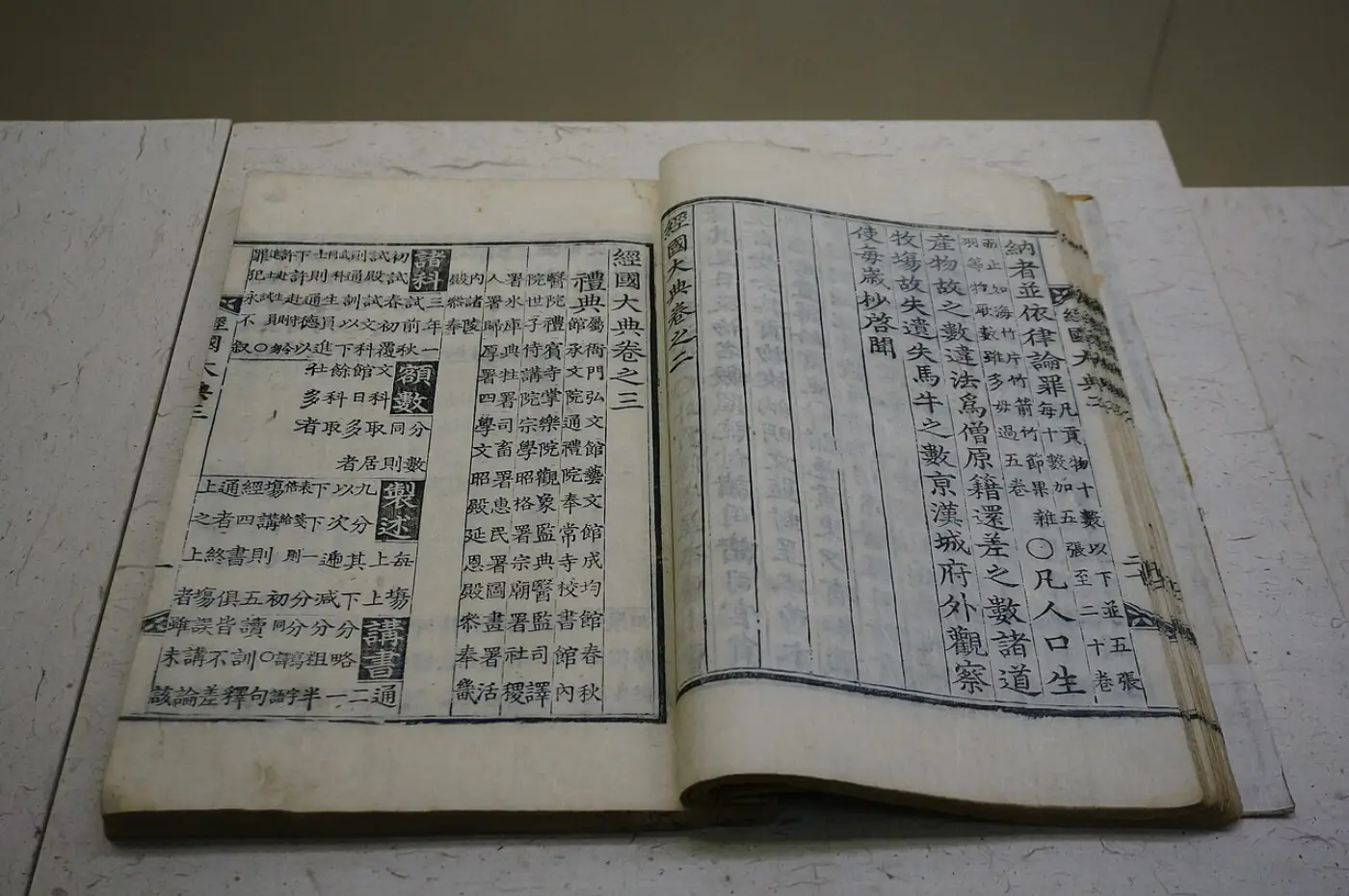
The Sokdaejeon, a late Joseon legal code, sets out specific penal standards for hopae violations. Korean Wikipedia quotes the provision as follows: "According to the regulations of the Sokdaejeon, anyone who fails to wear a hopae is subject to the law on violating royal edicts (jeseo yuwiryul, 制書有違律), anyone who lends one is punished with 100 blows of the heavy rod (jang, 杖) and three years of penal servitude (dohyeong, 徒刑), and when the holder dies, the hopae is returned to the government office." This statute bound mandatory wearing, a ban on lending, and posthumous return into a single legal framework.
Unpacking the legal terms in the statute reveals how harsh the penalties were. Applied to anyone caught without a tag, the statute on violating royal edicts (jeseo yuwiryul) framed the offense not as a minor administrative lapse, but as direct defiance of a royal command. Moreover, lending a tag to another person carried 100 blows of the heavy rod (jang, 杖) followed by three years of forced labor as penal servitude (dohyeong, 徒刑).
Requiring families to return a deceased holder's hopae to the government office likewise aimed to prevent others from borrowing or altering a dead man's tag for fraudulent use. By tightly regulating non-wearing, lending, forgery, and posthumous return under criminal law, the Sokdaejeon shows that a hopae was not personal property, but a piece of the state labor register imposed on the populace.
The Ivory Hopae and Three Royal Documents of 1594 Military Exam Graduate Ryu Hyeong
Surviving artifacts from mid-Joseon also show how high officials used ivory hopae with concise inscriptions, though the specific items recorded differed by period from King Taejong's initial rules. One example documented on the Korea Heritage Service portal is the hopae of Joseon military official Ryu Hyeong (柳珩, 1566–1615) of the Jinju Ryu clan, whose courtesy name was Saon (士溫), pen name was Seokdam (石潭), and posthumous title was Chunggyeong (忠景). During the Imjin War, he distinguished himself on Ganghwa Island alongside righteous army commander Kim Cheon-il and passed the military examination in 1594 (the 27th year of King Seonjo). During the second Japanese invasion (Jeongyujaeran), he assisted Admiral Yi Sun-sin and took command of the fleet at the Battle of Noryang after Yi Sun-sin fell in action, earning appointment in 1602 (the 35th year of King Seonjo) as Commander-in-Chief of the Three Provinces' Naval Forces (Samdo Sugun Tongjesa).
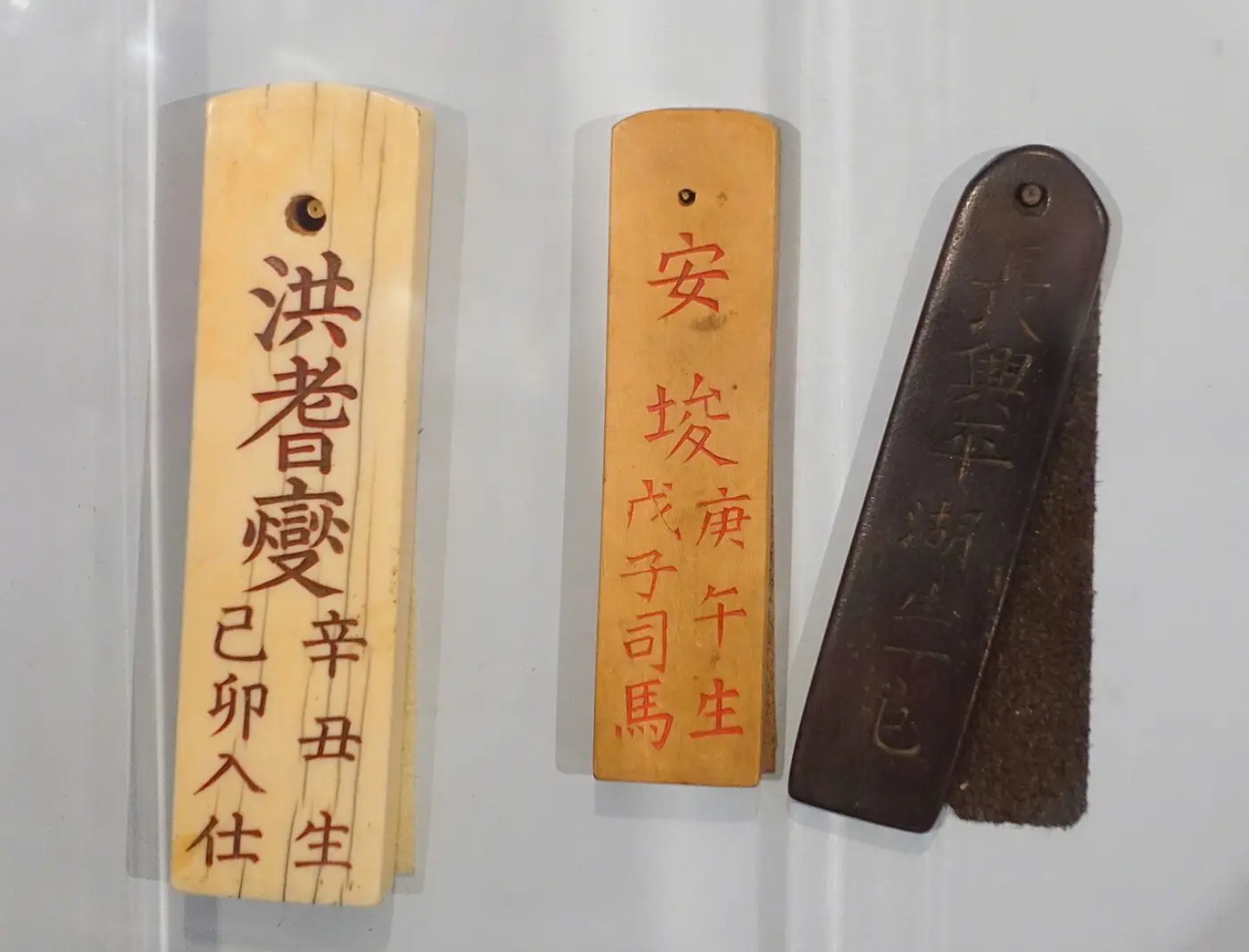
After serving as Provincial Military Commander (Byeongma Jeoldosa) across several provinces, Ryu Hyeong died in office while holding that post in Hwanghae Province in 1615 (the 7th year of Gwanghaegun). Nearly two centuries later, he was granted the posthumous title Chunggyeong in 1796 (the 20th year of King Jeongjo) and posthumously promoted to Chief State Councilor (Yeonguijeong) in 1802 (the 2nd year of King Sunjo). The Korea Heritage Service portal describes his tag as follows: "General Ryu Hyeong's hopae is made of ivory (sanga, 象牙) with the nine characters 'Ryu Hyeong, Byeongin-saeng, Gabo Mugwa (柳珩丙寅生甲午武科)' incised into the surface: his name 'Ryu Hyeong' sits at the upper center, his birth year 'Byeongin-saeng' on the upper right, and 'Gabo Mugwa' on the left, recording that he passed the military examination in 1594." Here, eumgak (incised inscription) means carving recessed characters into the surface.
This ivory hopae has been passed down together with three royal documents (gyojiryu). Its surface bears only nine characters stating his name, birth year, and military examination pass. Unlike the wooden tags of commoners and slaves discussed earlier—whose surfaces were crowded with details of complexion, beard status, and height—Ryu Hyeong's ivory hopae records no physical traits at all. The artifact suggests that for high yangban officials, a hopae functioned less as a record of physical traits than as a marker attesting to examination success and elite status.
Comparing Ming Shangbaosi Court Ivory Plaques and Qing Neiwufu Waist Plaques
Wearing a waist tag to prove identity was also widespread across Chinese dynasties. According to the Chinese Wikipedia article on waist plaques (yaopai), ancient East Asian officials wore waist plaques inscribed with their name and duties as entry passes checked at palace gates or military camps. Waist plaques were made of wood, copper, or ivory, with ivory plaques (yapai, 牙牌) forming one specific category. The plaques most commonly used by Ming officials were rectangular ivory tags registered and issued by the Seal Office (Shangbaosi, 尚寶司); topped with a rounded arch carved with ruyi cloud motifs, these court attendance ivory plaques (chaochan yapai, 朝參牙牌) were carried only by central capital officials, not provincial officials.
A court attendance ivory plaque worn by an officer of the Ming Embroidered Uniform Guard (Jinyiwei, 錦衣衛) bore no personal name or date. The front carried the three characters Jinyiwei along with an official title such as Commander of a Hundred Households of the Right Thousand-Household Battalion (You Qianhusuo Baihu, 右千戶所百戶), while the left edge bore a Wu-series serial number—such as Wu No. 2,991 (武字貳仟玖佰玖拾壹號)—and the back listed usage rules. Chinese Wikipedia gives the original inscription on the reverse as "朝參官懸帶此牌,無牌者依律論罪,借者及借與者罪同,出京不用"—meaning that court officials must wear this plaque, those without it are punished according to law, borrowers and lenders receive the same punishment, and it is not used outside the capital. Because no personal name was engraved, the plaque was returned upon transfer, retirement, or death and reissued to a newly appointed capital official.
Qing palace waist plaques first appear in records from the reign of Emperor Taizong Hong Taiji (Huang Taiji, 清太宗皇太極). According to Chinese Wikipedia, these plaques served as identification for palace personnel and listed the bearer's affiliated office (yamen), serial number, age, facial features, and year of issue. Valid only inside the palace grounds, they were administered by the Imperial Household Department (Neiwufu, 內務府), which issued roughly 7,000 to 8,000 plaques each year to the Neiwufu and various court offices.
Comparing Joseon hopae with Ming and Qing plaques item by item reveals three main differences. First, whereas Ming court ivory plaques were worn only by central capital officials and Qing palace waist plaques only by palace staff, Joseon hopae were mandatory for all men aged 16 and older. Second, Ming ivory plaques bore only official titles without personal names so they could be returned and reused, whereas Joseon hopae were engraved with personal names, birth years, and—depending on status—physical features, tying each tag to a single individual. Third, while Ming and Qing plaques functioned as entry passes for the capital and palace precincts, the Joseon hopae served as a nationwide state register for counting households and mobilizing compulsory labor.
Only 18 Years in Force Out of 260: The 10–20% Limit in the Veritable Records of Sejong and Seongjong
The plan to manage state labor by tagging every adult male across the country ran into severe practical limits on the ground. Drawing on the Veritable Records, the Encyclopedia of Korean Culture summarizes the actual results: "Across the roughly 260 years from 1413 (the 13th year of King Taejong), when the hopae system was first implemented, to 1675 (the 1st year of King Sukjong), when it began to be enforced continuously, it was in effect for only 18 years. Even then, the Veritable Records of Sejong states that those who received hopae accounted for only 1 or 2 hal of the total population, and the Veritable Records of Seongjong states that among those who received hopae, freeborn commoners (yangin) who actually performed state labor amounted to no more than 1 or 2 hal."
English Wikipedia likewise notes that the system operated for just 18 years out of those 260 years. In traditional Korean units, the 1 to 2 hal recorded in the Veritable Records means 10 to 20 percent of the total. Across those two and a half centuries, from King Taejong's introduction of the law to the early reign of King Sukjong, the hopae mandate remained active for a cumulative total of just 18 years.
These figures from the Veritable Records of Sejong and the Veritable Records of Seongjong expose the wide gap between statutory law and administrative reality. The rule that all men aged 16 and older wore hopae was a legal target rather than everyday reality. Although the 1 to 2 hal (10 to 20 percent) figure in the Veritable Records of Sejong measured recipients aged 16 and older against the entire population—reflecting demographic structure as well as evasion—and the 1 to 2 hal (10 to 20 percent) figure in the Veritable Records of Seongjong measured actual labor-bearers among hopae recipients in a different reign, they nonetheless suggest that population flight, labor evasion, and forgery undermined the state's system of control.
| Category | Wearers and Material | Key Inscriptions | Supervising Office and Operation |
|---|---|---|---|
| Joseon High Officials' Hopae | High yangban officials of the 2nd rank and above (ivory) | Official title and full name (Ryu Hyeong's hopae records name, birth year, and military exam pass) | Under Hanseongbu, provincial governors, and local magistrates, government offices produced and issued tags for officials of the 2nd rank and above and the Three Offices; returned upon death |
| Joseon Commoners' and Slaves' Hopae | Ordinary commoners (small wood) and slaves (large wood) aged 16 and older | Commoners added complexion and beard status; slaves recorded master, age, residence, complexion, height, and beard status | Carved by the bearer, checked against a submitted record form (danja, 單子), branded with a hot iron seal (nagin, 烙印) by the government office, and returned upon death |
| Ming Court Ivory Plaques (Chaochan Yapai, 朝參牙牌) | Held only by central capital officials, not provincial officials (ivory) | Agency, official title, serial character and number, and usage rules (no personal name or dates) | Registered and issued by the Seal Office (Shangbaosi, 尚寶司); returned upon transfer, retirement, or death and reused |
| Qing Palace Waist Plaques (Yaopai, 腰牌) | Palace staff and personnel on official duty (restricted to palace use) | Affiliated office (yamen), serial number, age, facial features, and year of issue | Supervised by the Imperial Household Department (Neiwufu, 內務府), which issued roughly 7,000 to 8,000 plaques annually |
Norms of a Status Society and Traces of Everyday Life Layered onto a Small Tag
A single hopae measuring three chi and seven pun in length captures how Joseon society classified human beings. The brevity of the nine characters incised on military official Ryu Hyeong's ivory tag and the dense listing of complexion, beard, and height on a slave's wooden tag reveal how differently life weighed on each class. Unlike Ming court ivory plaques inscribed only with an official title and passed from one holder to the next, Joseon's practice of carving personal names and status-specific bodily traits shows that the hopae went beyond a palace pass to bind subjects to household and military registers.
At the same time, the distance between harsh penal statutes and the 1 to 2 hal (10 to 20 percent) issuance rate in the Veritable Records highlights the gulf between legal codes and lived reality. How did everyday life shift again from 1675 under King Sukjong, when a system active for only 18 of the previous 260-odd years entered continuous enforcement and paper jipae appeared? Examining the material and character layout of a small tag in a museum offers a starting point for encountering the lives of people who navigated the Joseon state's web of control.